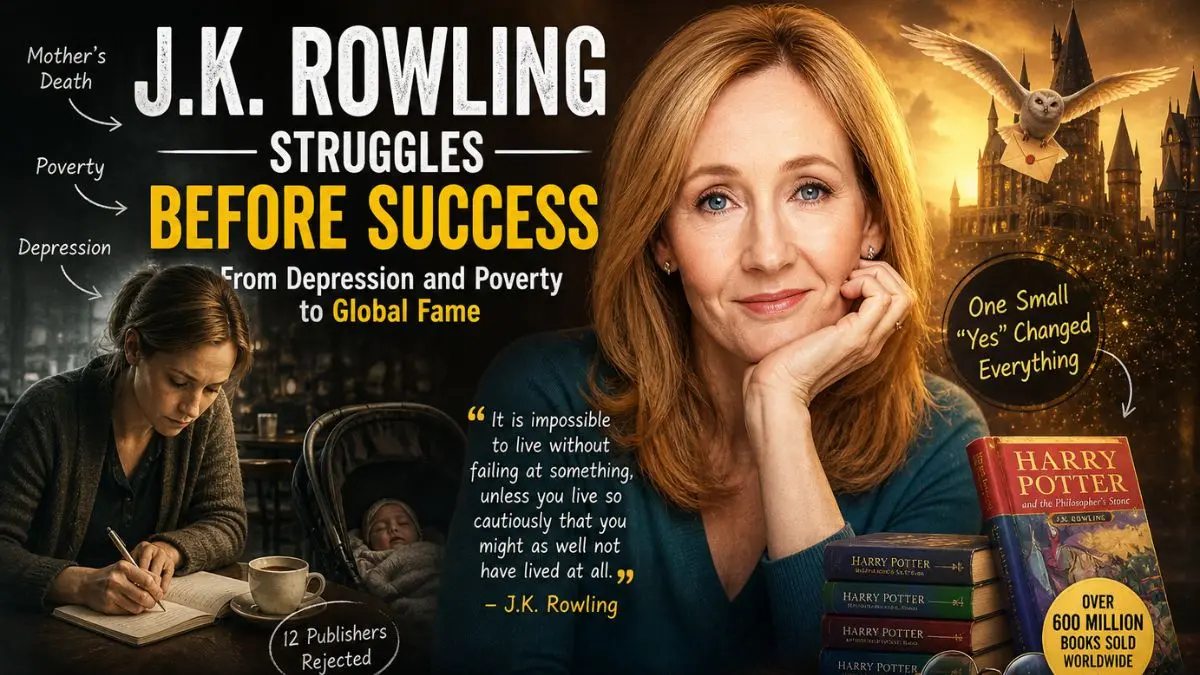
J.K. Rowling Struggles Before Success: From Depression and Poverty to Global Fame
When people hear the name J. K. Rowling, they instantly think of massive success, global fame, and the magical world of Harry Potter. Today, she is known as one of the most successful authors in history, with millions of books sold worldwide.
But what most people don’t see is the painful journey behind that success.
Before the fame, before the wealth, and before the world recognized her talent, Rowling faced some of the darkest moments a person can experience—grief, failure, rejection, poverty, and even depression.
This is not just a success story.
This is a story of survival.
The Beginning of a Dream
In 1990, Rowling was just an ordinary woman with an extraordinary idea.
While traveling on a delayed train, the idea of a young wizard named Harry Potter came into her mind. She didn’t have a pen or paper at that moment, but the story began to grow in her imagination.
That moment would later change her life—and the world.
But at that time, it was just the beginning of a dream.
What she didn’t know was that the next few years would test her strength in unimaginable ways.
The Most Painful Moment: Losing Her Mother
Just six months after she began writing Harry Potter, tragedy struck.
Rowling’s mother passed away.
She was only 25 years old.
This wasn’t just a loss—it was a life-changing emotional shock. Rowling has described this as the most traumatizing moment of her life.
What made it even more painful was the fact that her mother never knew she was writing Harry Potter.
Imagine carrying a dream…
and losing the one person you wish could see it come true.
This grief deeply influenced her writing. Themes of loss, love, and death became central to the Harry Potter series.
Her pain didn’t stop her—but it changed her forever.
Must Read: If You’re Losing Motivation, This Story of Abraham Lincoln Will Inspire You Deeply
Searching for a Fresh Start in Portugal
After her mother’s death, Rowling needed a change.
In 1991, she moved to Portugal to teach English as a foreign language. She hoped a new environment would help her heal and rebuild her life.
For a while, things seemed to improve.
She met a man, fell in love, got married, and soon gave birth to her daughter, Jessica.
It looked like life was finally moving in the right direction.
But sometimes, life tests you again just when you think things are getting better.
Marriage, Divorce, and Starting Over
Rowling’s marriage did not last long.
Within just 13 months, her relationship ended in divorce.
Now, she was not just dealing with grief—but also a broken marriage.
She returned to the United Kingdom, settling in Edinburgh with her infant daughter.
At this point, her life had completely changed.
She was:
- A single mother
- Unemployed
- Struggling financially
- Emotionally drained
She later described herself as:
“As poor as it is possible to be in modern Britain without being homeless.”
This was not the life she had imagined.
But this was her reality.
Living in Poverty: The Lowest Point
Life in Edinburgh was extremely difficult.
Rowling had no stable income and depended on state benefits to survive. She lived in a small apartment and struggled to take care of her daughter.
She couldn’t even afford basic things many people take for granted.
For example:
- She had no computer
- She couldn’t afford photocopying
- She had very limited resources
Yet, despite all of this, she continued writing.
Every day, she would take her daughter to a café. While her baby slept in a pram beside her, Rowling would write her story.
Those cafés became her workplace.
Those quiet moments became the foundation of a global phenomenon.
Writing in Cafés: Where Magic Was Created
One of the most inspiring parts of Rowling’s journey is how she continued to write despite her circumstances.
She didn’t wait for the “perfect time.”
She didn’t wait for financial stability.
She didn’t wait for support.
She wrote anyway.
Sitting in small cafés, often with very little money, she poured her heart into her manuscript.
While the world saw an ordinary woman…
she was building an extraordinary story.
This is where Harry Potter truly began to take shape.
Battling Depression and Dark Thoughts
But the struggle wasn’t just financial.
Rowling fell into deep depression.
The weight of her life situation—poverty, loneliness, single parenthood, and past trauma—became overwhelming.
She later admitted that she even considered suicide.
This is one of the most powerful and honest parts of her story.
Because it shows that even the strongest people can feel broken.
Even those who go on to inspire millions…
once struggled just to keep going.
But instead of giving up, she sought help and slowly started to heal.
Her story reminds us that mental health struggles are real—and recovery is possible.
Rejection After Rejection
After completing her manuscript, Rowling faced another major challenge: rejection.
She sent her book to 12 different publishers.
Every single one rejected it.
Imagine working for years on something you deeply believe in…
only to have it dismissed again and again.
Rejection can destroy confidence.
And for Rowling, it almost did.
She began to doubt herself.
She began to question whether her story was good enough.
But she didn’t stop.
And that decision made all the difference.
The Turning Point: One Small “Yes”
After multiple rejections, something unexpected happened.
A small publishing company, Bloomsbury, decided to give her manuscript a chance.
Interestingly, the decision wasn’t purely based on business logic.
The CEO’s young daughter read the first chapter—and loved it.
That simple reaction changed everything.
In 1997, Harry Potter and the Philosopher’s Stone was finally published.
What started as a struggling writer’s dream…
began to turn into reality.
Success Didn’t Come Overnight
Even after publication, success didn’t happen instantly.
Rowling continued to work hard.
She kept writing, improving, and believing in her story.
Over time, the Harry Potter series grew in popularity.
Eventually, it became a global phenomenon.
The books sold hundreds of millions of copies and were translated into dozens of languages.
Today, the series has sold over 600 million copies worldwide and is considered the best-selling book series in history.
But behind this success lies years of struggle that most people never see.
Lessons from J.K. Rowling’s Struggles
Rowling’s journey is not just inspiring—it’s full of practical lessons that anyone can apply.
1. Failure is Not the End
Rowling once considered herself a failure.
But failure was not the end of her story—it was part of it.
Your lowest point can become your turning point.
2. Keep Going Despite Rejection
12 publishers rejected her.
But she kept going.
Rejection doesn’t define your worth—it tests your persistence.
3. You Don’t Need Perfect Conditions
Rowling didn’t have money, resources, or support.
Yet she created something extraordinary.
Start where you are, with what you have.
4. Mental Health Matters
Her struggle with depression shows that success doesn’t mean you are immune to pain.
Seeking help is strength—not weakness.
5. One Opportunity Can Change Everything
It only took one “yes” from Bloomsbury to change her life.
Never give up—because your opportunity might be closer than you think.
From Struggles to Global Success
Today, J.K. Rowling is more than just a successful author.
She is a symbol of resilience.
She went from:
- A struggling single mother
- Living on benefits
- Battling depression
- Facing rejection
To becoming one of the most influential writers in the world.
Her journey proves that success is not about where you start.
It’s about how you keep going.
Final Thoughts: Your Story Isn’t Over Yet
If you’re going through a difficult time right now, remember this:
J.K. Rowling’s story could have ended in failure.
She had every reason to give up.
But she didn’t.
And because of that, the world gained one of the greatest stories ever told.
Your life may feel uncertain right now.
You may be facing rejection, failure, or hardship.
But that doesn’t mean your story is over.
In fact…
this might just be the chapter where everything begins to change.