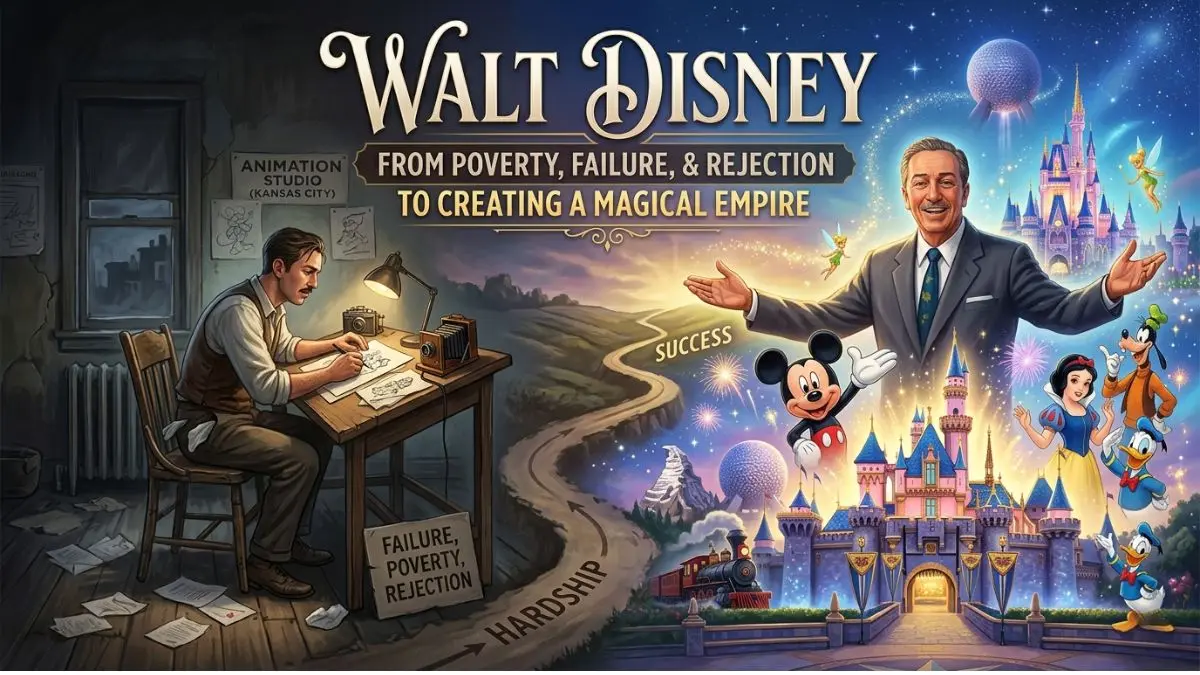
Walt Disney: From Poverty, Failure, and Rejection to Creating a Magical Empire
When people hear the name Walt Disney, they instantly think of magic, happiness, cartoons, and world-famous theme parks. His name is now associated with dreams coming true.
But the reality of his life tells a very different story.
Behind the success was a man who faced extreme poverty, repeated failures, betrayal, mental breakdowns, financial crises, and constant rejection. His journey wasn’t easy—it was brutal.
This is the full story of Walt Disney’s struggles and how he turned them into one of the greatest success stories in history.
A Childhood of Hard Work and Responsibility
Walt Disney was born on December 5, 1901, in Chicago, USA, but much of his childhood was spent in Missouri. While many imagine a creative and happy early life, the truth is that his childhood involved intense discipline and labor.
His father, Elias Disney, was strict and believed in hard work. At a very young age, Walt and his brother were assigned a demanding task: delivering newspapers.
- They woke up at 4:30 in the morning
- Delivered newspapers before school
- Worked again after school in the evening
- Continued this routine for over six years
This exhausting schedule often left Walt tired, and he would sometimes fall asleep in class. His grades suffered, but he had little choice.
Yet even in this difficult environment, something special began to grow inside him—his love for drawing.
Discovering His Passion
Despite the hardship, Walt found joy in art.
- He copied cartoons from newspapers
- Practiced drawing whenever he could
- Took art classes to improve his skills
- Earned small money drawing pictures for neighbors
One early moment stands out: a neighbor paid him to draw a cartoon of his horse. It was a small event, but it showed Walt that his passion had value.
While school didn’t excite him, drawing did.
At the age of 16, Walt made a bold decision—he dropped out of school and joined the Red Cross during World War I, becoming an ambulance driver in France.
Even during war, he couldn’t let go of his creativity.
👉 He decorated his ambulance with cartoons.
People recognized him not just as a driver, but as an artist.
Early Career Failures and Harsh Reality
After returning to America, Walt tried to build a career in art. But reality was tough.
- He worked at a commercial art studio but got laid off
- Started a business with a friend—it failed
- Tried again with another venture—it also failed
Finally, he launched Laugh-O-Gram Studio, an animation company.
At first, it looked promising. But soon:
- The company struggled financially
- Clients delayed payments
- Expenses kept rising
Eventually, the company went bankrupt.
Extreme Poverty: Living in His Office
This phase of Walt Disney’s life is one of the most shocking.
After his company failed:
- He had no money
- He couldn’t pay rent
- He had no stable food
👉 He started living inside his office.
Even worse:
👉 He survived on cold beans because he couldn’t afford proper meals.
Imagine building a dream while being hungry, alone, and uncertain about the future.
Most people would have given up.
Walt Disney didn’t.
Moving to Hollywood: Starting From Zero Again
With nothing left in Kansas City, Walt moved to Hollywood. At that time, Hollywood was becoming the center of film and entertainment.
He partnered with his brother Roy and started a new studio.
But success didn’t come immediately.
Betrayal and Loss: Oswald the Lucky Rabbit
Walt’s first big success came with a character named Oswald the Lucky Rabbit. It seemed like things were finally improving.
But then came one of the biggest setbacks of his life.
- His distributor took control of Oswald
- Walt lost the rights to his own character
- Most of his team left him
He lost everything again—his creation, his income, and his staff.
This was more than failure. It was betrayal.
The Birth of a Legend: Mickey Mouse
Instead of giving up, Walt decided to start fresh.
He created a new character:
Mickey Mouse
But even this wasn’t an instant success.
- His early cartoons were rejected
- Studios didn’t believe in the idea
Walt took a bold step—he introduced synchronized sound in animation, something new at the time.
In 1928, Steamboat Willie was released.
It became a huge success and changed animation forever.
Innovation Comes With Pressure
Walt Disney wasn’t just creative—he was constantly pushing boundaries.
He introduced:
- Synchronized sound
- Full-color animation
- Advanced camera techniques
- Emotional storytelling in cartoons
But innovation came at a cost.
He faced:
- Financial risks
- High expectations
- Stress from managing a growing company
“Disney’s Folly”: Risking Everything Again
In 1934, Walt made another bold decision:
👉 To create the first full-length animated film
Snow White and the Seven Dwarfs
People thought he had lost his mind.
- The project was expensive
- No one believed audiences would watch a long cartoon
- The budget went three times higher than expected
At one point, Walt ran out of money.
👉 He had to act out scenes in front of bankers to convince them to fund the project.
Despite all odds, the film was released in 1937.
It became a massive success and revolutionized the film industry.
Mental Breakdown and Stress
The pressure of constant work, financial risk, and responsibility took a toll on Walt.
👉 In 1931, he suffered a nervous breakdown.
He had to step away from work and take a long break to recover.
This shows that even the strongest people can reach their limits.
Financial Crisis and Employee Strike
Success didn’t eliminate problems.
During the early 1940s:
- Films like Pinocchio and Fantasia struggled financially
- The company faced heavy debt
- Salaries were cut
Then came another major crisis:
👉 A strike by his employees in 1941
- Workers protested against management
- Walt faced criticism and emotional stress
- Many employees left
This period deeply affected him personally and professionally.
World War II Challenges
World War II made things worse.
- European markets were lost
- Revenue dropped significantly
- The studio shifted to making military training films
At one point:
👉 The company had millions in debt.
It was fighting for survival.
Reinvention and Comeback
After the war, Walt slowly rebuilt his company.
He worked on new films and ideas, including:
- Cinderella (1950), which became a major success
- Live-action films
- Nature documentaries
He adapted to changing times and kept moving forward.
Disneyland: A Dream Everyone Doubted
Walt had another vision—to create a theme park where families could experience magic together.
This became:
Disneyland
But once again, people doubted him:
- Investors refused to fund it
- Critics didn’t understand the idea
- It was considered too risky
Walt used his own money and took huge risks.
When Disneyland opened in 1955, it faced initial problems.
But soon, it became a massive success.
Personal Struggles Behind the Success
Walt Disney’s personal life wasn’t as perfect as his creations.
- He was naturally shy and insecure
- He set extremely high standards for himself and others
- He faced criticism and controversies
- He lived under constant pressure to succeed
Despite his public image, he struggled internally.
Final Dreams and Unfinished Vision
Walt continued dreaming bigger.
He planned:
- Walt Disney World
- A futuristic city concept called EPCOT
But he never got to see these dreams completed.
👉 He passed away in 1966 due to lung cancer.
Even in his final days, he was working and thinking about the future.
A Legacy Built on Struggle
Today, The Walt Disney Company is one of the largest companies in the world.
Walt Disney achieved:
- 22 Academy Awards (a record)
- 59 nominations
- Global recognition as a cultural icon
But behind this success was a lifetime of struggle.
Lessons From Walt Disney’s Life
His journey teaches us powerful lessons:
1. Follow Your Passion
Even in war and poverty, Walt never left drawing.
2. Don’t Fear Failure
He failed multiple times—but kept going.
3. Take Risks
Great success requires bold decisions.
4. Stay Persistent
He never gave up, even when everything was lost.
5. Keep Innovating
He constantly pushed boundaries and tried new ideas.
Final Thoughts
Walt Disney was not born successful.
He was:
- Broke
- Hungry
- Rejected
- Betrayed
- Stressed
- Criticized
Yet he built magic for the world.
👉 A man who once lived in his office and survived on cold beans…
👉 Created one of the greatest entertainment empires in history.
If you feel like giving up, remember this: your struggles today might be building your success tomorrow—just like they did for Walt Disney.