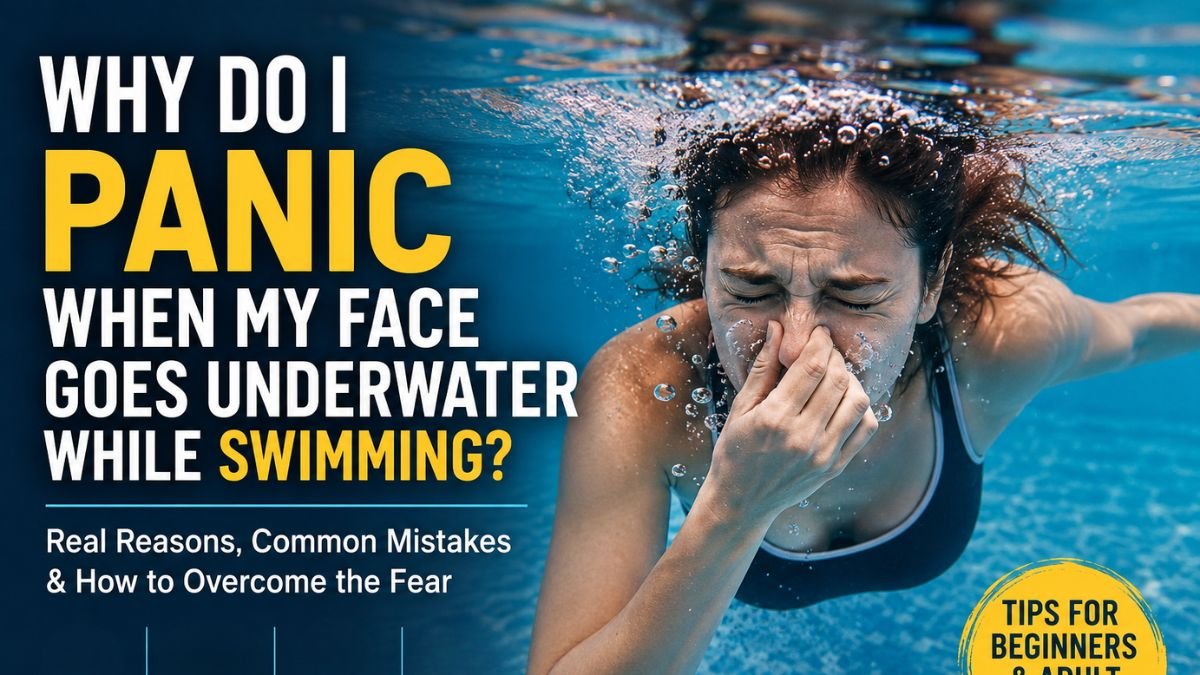
Why Do I Panic When My Face Goes Underwater While Swimming?
Many beginner swimmers experience sudden panic the moment their face goes underwater. Even people who have taken lessons or can already swim may still feel fear, discomfort, or the urge to immediately lift their head.
This reaction is extremely common—and it is not a sign that you cannot swim. In fact, it is a natural psychological and survival response that even experienced swimmers never fully lose.
Understanding the Real Cause of Panic in Water
When your face goes underwater, your brain quickly evaluates the situation. Because breathing is temporarily blocked, your survival system reacts instantly.
This activates the fight-or-flight response, controlled by a deep part of the brain called the amygdala. At this moment, logic is not the main driver—instinct is.
That is why even simple underwater moments can feel overwhelming.
Key Reasons Why You Panic When Your Face Goes Underwater
1. Humans Are Not Instinctive Swimmers
Unlike some animals, humans are not born with natural swimming ability.
A very common mistake—especially among parents—is to assume that a child will “learn by being thrown into water.” While this might seem like a shortcut, it often backfires.
Instead of learning, the child may develop:
- Fear of deep water
- Fear of being underwater
- Long-term water anxiety
Swimming is a learned skill, not an instinct.
2. Fear of Drowning Never Fully Disappears
Many people believe that once you learn swimming, fear goes away. In reality, even experienced swimmers still carry a small awareness of drowning risk.
The goal is not to eliminate fear completely—but to learn how to function calmly despite it.
This is an important psychological shift that changes how you experience water.
3. Panic Comes from the Subconscious Mind
One of the biggest misunderstandings is the idea that you can simply “calm down” during panic.
In reality:
- Panic is controlled by the subconscious brain
- The amygdala reacts before logical thinking
- You cannot fully control it in the moment
That is why advice like “just stay calm” often doesn’t work when someone is already scared in water.
4. Overconfidence in Swimming Ability
Many accidents and panic moments happen not during learning—but during situations where people think they are “good enough.”
For example:
- Swimming short distances confidently
- Then suddenly getting tired in open water
- Underestimating conditions like coral, waves, or depth
In such moments, fatigue + surprise + distance from safety can quickly trigger panic.
5. Misunderstanding Floating vs Swimming
Many beginners assume floating is easier than swimming. However, this is not always true.
- Vertical floating can actually be difficult under stress
- It requires relaxation and balance
- Panic makes floating harder, not easier
In real situations, switching to a relaxed back float or survival position is often safer than trying to stay upright.
6. Fear Becomes Stronger in Real-Life Scenarios
Even strong swimmers can panic when conditions change unexpectedly:
- Feeling tired suddenly
- Being far from the pool edge or boat
- Minor injuries or discomfort
- Seeing deeper or unfamiliar water
These situations trigger survival thinking rather than skill-based thinking.
Why “Throwing Into Water” Backfires
One of the most damaging approaches is forcing someone into water too early.
This can:
- Create long-term fear responses
- Make underwater experiences stressful
- Increase anxiety instead of confidence
Instead of building comfort, it creates a fear memory that stays for years.
The Important Truth: Fear Is Not Abnormal
Many people think fear of underwater situations is irrational. But it is actually extremely common.
In fact, research suggests a large percentage of people experience discomfort or fear around deep or underwater environments.
This makes sense because:
- Humans are land-based beings
- Water removes control and stability
- Breathing becomes limited
So fear is not weakness—it is a natural protection system.
A Real Insight: Fear Can Stay Even After Learning
Even people who learned swimming at a young age may still:
- Feel cautious in deep water
- Avoid underwater movement
- Experience fear in unfamiliar environments
This shows that swimming skill and emotional comfort are two different things.
How Panic Usually Develops (Simple Breakdown)
- Face goes underwater
- Breathing feels restricted
- Brain detects possible danger
- Body activates survival response
- Panic increases if you struggle or stay underwater too long
Understanding this process helps reduce confusion and fear.
Mistakes That Make Swimming Terrifying for Beginners
- Throwing a child or beginner directly into deep water, which can create panic and long-term fear of water
- Forcing someone to submerge their head before they are ready
- Skipping basic water comfort exercises like floating, splashing, and breath control
- Not teaching how to relax in water before teaching swimming techniques
- Using fear or pressure instead of calm guidance during learning
- Letting beginners struggle alone without proper supervision or support
- Ignoring individual fear levels and pushing everyone at the same speed
- Bad first experience in water, which can lead to lasting aquaphobia (fear of water)
Final Thoughts
Panic when your face goes underwater is not unusual—it is a built-in survival response that affects beginners and experienced swimmers alike.
The key is not to fight fear aggressively, but to gradually train your body and brain to feel safe in water. Over time, controlled exposure and proper breathing habits help reduce panic and build confidence.
Swimming is not just a physical skill—it is also a mental adaptation process.