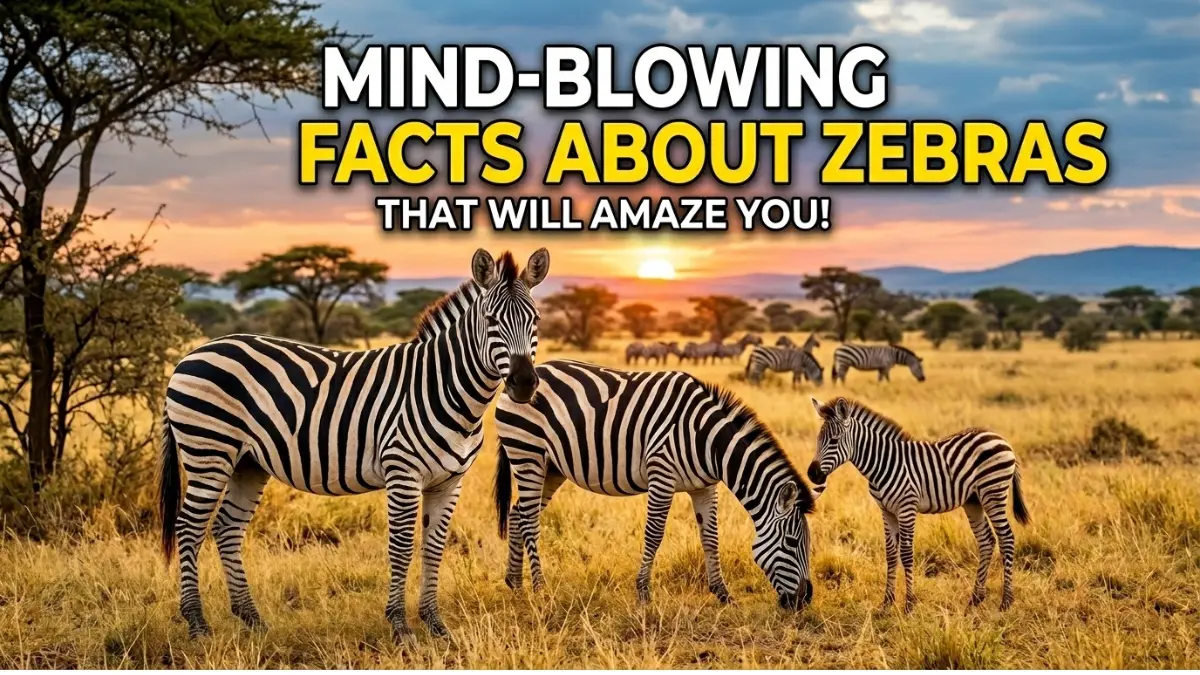
Mind-Blowing Facts About Zebras That Will Amaze You!
When most people think about zebras, they imagine their famous black-and-white stripes. These bold patterns make zebras easy to recognize anywhere in the world. However, zebras are much more interesting than just their appearance. They are smart, social, and highly adaptable animals. Over time, they developed special survival skills that help them live in the tough grasslands of Africa.
For more than 150 years, scientists argued about why zebras have stripes. Recent studies now show that these stripes serve several important purposes. They can help protect zebras from insects and also confuse predators.
Besides their stripes, zebras have many surprising abilities that make them some of the most fascinating animals in nature. Scientists have discovered facts about zebras that may completely change the way you think about them.
Fun Facts About Zebras
1. ZEBRAS ARE ACTUALLY BLACK — THE WHITE STRIPES COME SECOND
Here’s a question that has confused people for many years: are zebras white with black stripes, or black with white stripes? Science gives a clear answer that surprises many people. Zebras are actually black animals with white stripes.
Before birth, zebra embryos are completely black inside the womb. Later, during development, white stripes appear when pigment production stops in certain parts of the skin. In simple words, the black color is the natural base, while the white stripes form afterward.
2. Every Zebra Has a Unique Stripe Pattern—Just Like Human Fingerprints
No two zebras have exactly the same stripe pattern. Each zebra has its own special combination of stripe shapes, widths, and arrangements. Scientists can even identify individual zebras in the wild by studying their stripes, just like humans use fingerprints for identification.
These unique patterns are also very important for zebra families. Baby zebras, called foals, learn to recognize their mother’s stripe pattern soon after birth. This helps them stay close to her, even when they are surrounded by a large herd filled with hundreds of striped zebras. A foal that can quickly find its mother has a much better chance of staying safe from danger.
Interestingly, zebra foals are not born with deep black-and-white stripes. At birth, their stripes usually appear reddish-brown or cream-colored. As the foal grows older, the stripes slowly become darker. Most zebras develop their full black-and-white pattern between nine and eighteen months of age.
Zebra Stripes Work as Natural Pest Protection
For more than 150 years, scientists argued about why zebras have stripes. Some believed the stripes helped zebras hide from predators. Others thought the patterns helped control body temperature or allowed zebras to recognize each other. Today, new research suggests that the main purpose of zebra stripes is to protect them from biting flies.
In an important 2019 study, researchers compared zebras with horses, which are their closest relatives. Both animals stayed in the same environment during the experiment. Scientists noticed something very interesting: biting flies attacked horses far more often than zebras. Although flies flew near both animals equally, very few actually landed on zebras.
Researchers believe the black-and-white stripes confuse the vision of insects. From far away, flies may see the zebra as a plain gray animal. But when they fly closer, the strong stripe patterns disturb their eyesight and make it difficult for them to land properly. The insects become confused, fly around for a while, and often leave without biting.
This gives zebras a major survival advantage in Africa, where insect-borne diseases are common. Biting flies can spread dangerous illnesses, so avoiding these insects may help save zebra lives.
The Body Cooling Theory
Another popular idea suggested that zebra stripes help cool the animal’s body. Scientists discovered that black stripes become hotter in sunlight than white stripes. Some researchers believed this temperature difference could create small air currents that cool the zebra naturally.
However, studies produced mixed results. Some research found that zebras living in hotter regions often have darker and stronger stripe patterns, which may suggest some cooling benefit. Other studies found no clear difference in body temperature between zebras and animals without stripes living in the same conditions.
Today, most scientists believe that protection from biting flies is the main reason zebras evolved stripes. Still, the stripes may also provide extra benefits, such as helping with temperature control in very hot areas.
In the end, zebra stripes likely serve several purposes at the same time, helping these animals survive and thrive in the wild.
3. There Are Three Different Species of Zebra
Not all zebras are the same. Africa is home to three living zebra species, and each one has its own special features, habitat, and way of life.
Plains Zebra
The Plains Zebra is the most common zebra species. These zebras live in grasslands and woodland areas across eastern and southern Africa. Adult plains zebras usually stand around 1.1 to 1.5 meters tall at the shoulder and can weigh between 220 and 450 kilograms.
They live in organized family groups called harems. A typical group includes one dominant male, several females, and their young. Their stripe patterns can look different depending on where they live. Some have strong black stripes, while others have lighter brownish stripes. Scientists believe climate and temperature may influence these differences.
Mountain Zebra
The Mountain Zebra is the smallest zebra species. These zebras live mainly in the mountain regions of South Africa, Namibia, and Angola. They are specially adapted for rough and rocky landscapes at high elevations.
Unlike other zebras, mountain zebras do not have stripes on their bellies. Their body stripes are also thinner in certain areas. They are excellent climbers and have hard, pointed hooves that help them move safely across steep mountain paths while searching for food and water.
Grévy’s Zebra
Grévy’s Zebra is the largest zebra species. It was named after Jules Grévy, a French president who received one of these zebras as a gift in the 1800s.
These zebras can weigh between 450 and 1,000 kilograms. They have very narrow stripes that cover almost their entire body, including their ears and mane. Grévy’s zebras live mainly in Ethiopia and Kenya, where they prefer dry grassland and semi-desert areas.
Their social behavior is also different from other zebras. Instead of staying in fixed family groups, their herds often change from day to day.
All three zebra species belong to the genus Equus, the same animal group that includes horses and donkeys. Even though they share a common ancestry, zebras developed unique features that help them survive in different parts of Africa.
4. Zebras Are Surprisingly Fast and Strong Runners
Even though zebras look heavy and strong-bodied, they are excellent runners. They usually weigh between 200 and 450 kilograms, but they can still reach speeds of about 40 to 55 miles per hour (around 65 km/h). This speed helps them escape from predators like lions, leopards, hyenas, and cheetahs.
Zebras are not only fast but also very strong in endurance. They can travel long distances while searching for food and water. In some cases, zebra herds may move more than 1,000 miles in a year. Scientists have even used satellite tracking to study zebra migration in places like Botswana, where some of the longest zebra migrations take place. These studies are important because climate change is affecting rainfall patterns and the availability of grasslands that zebras depend on.
When zebras are in danger, they do not just run in a straight line. Instead, they often move in fast zig-zag patterns. When a whole herd runs together, their black-and-white stripes blur into a moving pattern. This effect is called “motion dazzle.”
Motion dazzle makes it very difficult for predators to focus on a single zebra. The stripes that help confuse flies at rest also become a powerful defense when zebras are running at full speed.
5. Zebras Can Sleep While Standing Up
Zebras have a special ability that helps them survive in the wild—they can sleep while standing. They do this by locking the joints in their legs, especially the knees and hind legs. This lets them stay upright and still rest at the same time.
This skill is very important on the African savanna, where predators are always nearby. If danger appears, a standing zebra can quickly wake up and run away within seconds.
However, sleeping while standing has a limitation. It does not give zebras deep, full rest. For deeper sleep, zebras must lie down on the ground. But this position makes them more vulnerable to predators, so they only do it when they feel safe and the herd is protected.
To stay safe while still getting enough rest, zebras use a smart group strategy. They take turns staying alert while others sleep. Some zebras act as guards and watch for danger, while others rest. This system ensures that the herd is always protected, and every zebra gets a chance to recover and stay healthy.
6. Zebras Are Intelligent Animals With Strong Social Bonds
Zebras are not just animals with striking stripes. They are intelligent and emotionally complex creatures with rich social lives. They feel emotions such as fear, joy, stress, anxiety, and comfort. These emotions directly affect how they behave and how they survive in the wild.
New Research: How Zebras Handle Drought
A 2025 study from Princeton University found something very interesting about zebra behavior during extreme drought. Researchers tracked 109 wild plains zebras in Kenya’s Laikipia–Samburu ecosystem during a severe two-season drought.
They discovered that zebras reduced their social interactions when food became scarce because they needed to focus more on feeding. However, their most important social relationships stayed strong and unchanged.
Male zebras (stallions) increased greeting behaviors during the drought. This helped reduce conflict with bachelor males and allowed females more time to graze peacefully. Young zebras also became more socially active, even when their mothers spent less time with them. In many cases, other adult females stepped in and helped care for the young, sharing social responsibility within the group.
Researchers also noticed changes in communication. Zebras used fewer signals during the drought, but they kept the most important parts of their communication system. This shows that zebras simplify communication when resources are low, but they do not break their social structure.
Strong Family and Herd Bonds
Plains zebras live in family groups called harems. Each group usually has one dominant male, several females, and their young. The females often form very strong bonds with each other and may stay together even if the dominant male changes or dies.
Zebras also show signs of emotional attachment. When a herd member dies or gets separated, other zebras show clear signs of stress and distress. This behavior suggests that zebras have deeper emotional lives than many people assume, and they rely heavily on their social connections for survival.
7. Newborn Zebra Foals Grow at an Extremely Fast Rate
Zebra foals are some of the most impressive newborn animals in the wild. They develop very quickly because they must survive in a dangerous environment full of predators.
A newborn foal can stand on its own legs within 15 to 20 minutes after birth. Within 20 to 40 minutes, it can start walking. In less than one hour, it can even run with the herd. This fast development helps the foal stay close to its mother and avoid danger on the African savanna.
Foals are not born with fully developed black-and-white stripes. Instead, they usually have reddish-brown or cream-colored stripes at birth. These softer colors help them blend into the environment and stay hidden from predators. As the foal grows, the stripes slowly darken and eventually become the strong black-and-white pattern seen in adult zebras.
Young zebras stay with their mothers for about a year. During this time, they learn important survival skills and social behavior from the herd. After this period, they gradually become more independent.
Male foals usually leave their birth group when they are between one and three years old. They join bachelor groups where they live with other young males. Later, when they become strong enough, they try to compete for control of their own family groups.
8. Zebras Are Powerful and Fierce Defenders
Even though zebras may look calm and graceful, they are actually strong and aggressive animals when needed. They can defend themselves very well against both rivals and predators.
Male zebras, called stallions, often fight with each other to gain control of a group of females. These fights are intense and involve strong kicks, biting, and pushing. A serious fight can cause heavy injuries, and in some cases, one of the zebras may even die.
When zebras face predators, they use smart group defense strategies. One of the most effective is when the herd stays close together, forming a tight moving group. This creates a confusing wall of stripes that makes it harder for predators to pick a single target.
If a predator gets too close, zebras can defend themselves with powerful kicks. A zebra’s kick is strong enough to seriously injure or even kill an attacker. If one zebra is injured or in danger, other members of the herd often gather around it and try to protect it by driving the predator away together.
This combination of strength and teamwork makes zebras much more dangerous than they appear. A single zebra can be vulnerable, but a full herd working together becomes a powerful defensive group that can challenge predators like lions, leopards, and hyenas.
Additional Fascinating Facts About Zebras
Zebras are not only beautiful animals, but they also have many surprising traits that help them survive in the wild.
Lifespan in the Wild
Zebras usually live around 25 years in the wild. This longer lifespan allows them to learn important survival skills over time, such as finding water, remembering migration routes, and understanding predator behavior. They also pass this knowledge on to younger members of the herd.
Unique Sounds
Zebras make several distinct sounds. One of their most recognizable calls is a chirping sound. They also produce a loud “kua-kua” barking sound that often ends in a horse-like whinny. This call is used as a warning when predators are nearby.
Advanced Communication
Plains zebras use multiple vocal signals to communicate with each other. Scientists have found that they also use body language, touch, smell, and sound in complex ways. Recent research shows that when zebras are under stress, such as during droughts, they simplify their communication but still keep the most important signals needed for survival.
Nearly 360-Degree Vision
Zebras have eyes placed on the sides of their heads, which gives them almost full panoramic vision. They can see around themselves without turning their heads. They also have strong night vision, which helps them detect predators in low light.
“Horse-Tigers” of Ancient Rome
When zebras were first brought to ancient Rome for shows and games, people were confused by their appearance. The Romans called them Hippotigris, which means “horse-tiger.” This name came from their horse-like body and their tiger-like stripes.
Daily Need for Water
Zebras must drink water every single day. Unlike animals such as camels, they cannot go long without water. Because of this, herds stay close to rivers and waterholes. Their migrations and survival depend heavily on access to water sources.
Longer Life in Captivity
In the wild, zebras usually live 20 to 25 years due to predators and harsh conditions. In zoos or protected environments, where they receive regular food and medical care, they can live up to around 40 years.
Role in the Ecosystem
Zebras play an important role in nature. They are often the first animals to graze in an area. They eat tall, tough grasses that other animals avoid. This clears the land and makes it easier for animals like wildebeest and gazelles to feed.
Not Domesticated Animals
Humans have tried many times to domesticate zebras, but they were not successful. Zebras are naturally more aggressive and unpredictable than horses or donkeys because they evolved under constant threat from predators.
They also have a strong bite-and-hold defense reflex, which makes them difficult to handle safely. Although they can be crossed with horses or donkeys to create hybrids like zorses or zonkeys, zebras themselves remain wild animals and cannot be fully domesticated.
The Cutting Edge of Zebra Conservation: New Science and Tools
Modern science is now using advanced technology to protect zebras and help them survive in the future.
Stem Cells and Endangered Zebras
Scientists at Kyoto University have created special stem cells from the endangered Grévy’s zebra. They took skin cells from a zebra that died naturally in a zoo and reprogrammed them into stem cells. These cells can turn into different types of body cells, including possible egg and sperm cells.
This is a major breakthrough for conservation. It means scientists may one day use these cells to help reproduce endangered zebras and protect their genetic diversity, even if wild populations continue to decline.
Tracking Zebra Migration from Space
NASA satellites are now used to study and predict zebra migrations in Botswana, where zebras travel long distances every year.
Scientists analyze rainfall and grass growth from space to understand when and where zebras will move. This helps wildlife managers and local communities plan better and avoid conflicts with migrating herds.
As climate change changes rainfall patterns, this technology becomes even more important. If zebras miss the right timing or routes, it could seriously affect their survival.
The Medical Lesson: “Horses, Not Zebras”
In medicine, doctors often say: “When you hear hoofbeats, think of horses, not zebras.” It means they should first look for common diseases instead of rare ones.
But in nature, zebras really do exist—and they are far from ordinary. Their bodies and behavior show millions of years of evolution. They have developed smart solutions for survival, including protection from predators, insect control, fast growth, and complex communication.
A Zebra in Pop Culture
Zebras have also appeared in popular culture. One famous example is Yipes, the zebra mascot of Fruit Stripe Gum. Over time, Yipes became a well-known character and even appeared as a collectible toy in 1988. Even as the brand changed ownership, the zebra mascot remained a recognizable symbol.
Conservation Challenges
All zebra species face threats today. The main problems include habitat loss, hunting for their skins, and competition with livestock for grazing land. Drought, disease, and loss of genetic diversity also make survival harder.
Grévy’s zebra is the most at risk. Its population dropped from about 5,800 in the 1980s to around 2,000 today. Mountain zebras are also declining, with fewer than 35,000 left. Plains zebras are more numerous, but their population is also decreasing.
Scientists are now studying how zebras share land with livestock. In some areas, grazing by livestock actually improves grass quality for zebras, which suggests that humans and zebras may be able to coexist with careful management.
Protecting the Future of Zebras
Conservation efforts are very important. Protecting national parks, stopping illegal hunting, managing land wisely, and using new technologies like satellite tracking and stem cell research can all help save zebras.
Final Thought
Zebras are not just striped animals. They are intelligent, social, and highly adapted creatures shaped by millions of years of evolution. Their stripes, speed, behavior, and survival skills all work together to help them live in one of the toughest environments on Earth.
When you see a zebra, you are looking at a living example of nature’s creativity and survival power.