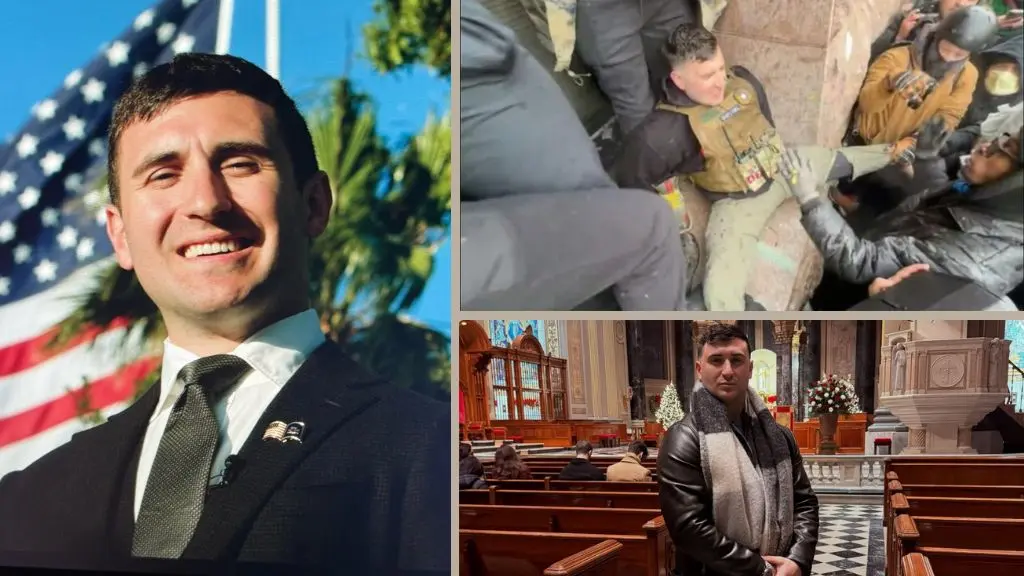
Who Is Jake Lang? Jan. 6 Capitol Riot Figure’s Minneapolis Rally Draws Massive Backlash and Less Than 12 Supporters
A controversial rally in Minneapolis has drawn national attention, putting renewed focus on Jake Lang—a pardoned January 6 Capitol riot defendant who has repositioned himself as a far-right political activist and Florida Senate candidate. The event, which took place on Saturday, January 17, 2026, sparked community concerns, massive counterprotests, and significant security measures in Minnesota’s largest city.
Who Is Jake Lang?
Jake Lang is a right-wing political activist best known for his involvement in the January 6, 2021, attack on the US Capitol. Federal authorities charged Lang with 11 criminal offenses linked to the riot, including civil disorder, obstruction of an official proceeding, and assaulting law enforcement officers. Prosecutors alleged he attacked police officers using a baseball bat and a riot shield during the breach of the Capitol.
Lang, a pardoned Jan. 6 rioter, has nearly 77,000 followers on Facebook, making him a significant conservative influencer with substantial reach on social media platforms. The 30-year-old New York native and e-commerce entrepreneur became one of the most recognized faces from that fateful day.
Despite the severity of the charges, Lang never faced trial and spent nearly four years in pretrial detention, during which he repeatedly delayed court proceedings. During his incarceration, Lang claimed to have spent approximately 900 days in solitary confinement, often being moved between different facilities after he continued political campaigning from behind bars.
The Presidential Pardon That Changed Everything
Lang’s legal troubles ended abruptly in January 2025 when President Donald Trump issued a sweeping pardon covering nearly 1,600 January 6 defendants, including Lang. The mass clemency came on Trump’s first day of his second term, fulfilling a campaign promise that resonated deeply with those convicted or awaiting trial for offenses related to the Capitol attack.
Since his release, Lang has re-emerged as a prominent far-right voice, often referring to himself as a “January 6 political prisoner” and positioning his detention as political persecution. He maintained his innocence throughout, refusing plea deals and framing his prosecution as an example of government targeting of political dissidents.
Witnesses Say Something Went Wrong: Emmy Raeann Forgette Missing and Needs Our Voices Now
Life After Prison: From Defendant to Political Candidate
Since receiving his presidential pardon, Lang has dramatically reinvented himself as a political figure and activist. His transformation includes several key initiatives:
Running for U.S. Senate in Florida: Lang is currently running for the US Senate in Florida, framing his campaign around claims of government overreach, immigration crackdowns, and opposition to what he calls “elite corruption”. He has filed paperwork to challenge Secretary of State Ashley Moody in Florida’s Republican primary for the Senate seat vacated by Marco Rubio, scheduled for August 2026.
Media Platform: Lang previously hosted a podcast focused on the January 6 attack, using it as a platform to challenge official narratives and amplify far-right viewpoints. Through this medium, he built a following among those who view the Capitol riot defendants as political prisoners rather than criminals.
Controversial Rhetoric: His rhetoric frequently targets immigrants and Muslim communities, making his involvement in Minneapolis particularly sensitive. On Jan. 4, Lang, who is running for the U.S. Senate in Florida, stood in front of the headquarters of the pro-Israel lobby AIPAC in Washington, D.C. and made several threats against AIPAC-funded politicians and said several antisemitic tropes.
The Minneapolis Rally: “March Against Minnesota Fraud”
Lang organized the “March Against Minnesota Fraud” to start at roughly 1 p.m., Jan. 17, outside Minneapolis City Hall. According to the permit application, Lang received official authorization for the rally, which he describes as a peaceful protest aimed at uniting Christian and conservative voices.
The Fraud Allegations That Sparked the Rally
The rally wasn’t just about immigration—it focused heavily on allegations of massive fraud in Minnesota’s social services programs. The protest comes after former First Assistant U.S. Attorney Joe Thompson said that since 2018 at least half of the $9 billion paid through Minnesota’s Medicaid waiver programs could be fraudulent.
Included in the fraud scandal are the leaders of the Minnesota nonprofit Feeding our Future, who were convicted for their roles in a scheme that stole $250 million from a pandemic relief program meant to feed children, with more than 70 people charged in the case.
Allegations of widespread fraud brought Minnesota into the national spotlight by President Donald Trump and U.S. House Majority Whip Tom Emmer, R-Minn. The issue gained even more traction when conservative influencer Nick Shirley released a video in late December that shows him visiting multiple Twin Cities daycare centers, which he alleges are abandoned despite receiving public funds.
The video went viral with more than 140.5 million views on X, bringing more attention to Minnesota’s fraud scandal. The video became particularly notable because one of the daycares had a spelling error in its signage, calling itself the “Quality Learing Center”.
This became a symbol for Lang’s supporters. Three of Lang’s supporters held a replica “Quality Learing Center” sign, including Mike Anderson of Greater Minnesota, who said he wants people to immigrate to the country legally.
Why Minneapolis? Why Now?
Lang’s decision to hold the rally in Minneapolis wasn’t random. The event occurred amid heightened tensions in the Twin Cities following several controversial incidents:
ICE Enforcement Surge: On Jan. 4, days before an ICE agent shot Renee Good in south Minneapolis, more than 2,000 ICE agents were deployed to the state, and the Department of Homeland Security has since said it plans to send hundreds more.
Fatal Shooting: The killing of Renee Nicole Good by an ICE officer on January 7, 2026, had sparked daily protests in the area and prompted a Department of Justice investigation.
Additional Violence: On Wednesday night, a second ICE-involved shooting took place in Minneapolis, where a man was shot in the leg after three men reportedly hit him with broom sticks and shovels.
Community Clashes: Clashes between ICE agents and Minnesotans have taken place across the state, including in St. Cloud where on Jan. 12 ICE agents deployed pepper spray after the “community responded” to an attempt to allegedly detain one person.
Lang positioned his rally as supporting ICE operations and opposing what he characterized as fraud in Minnesota’s social services programs, particularly targeting immigrant communities.
Once Everywhere, Now Almost Gone: Why is Francesca’s Closing After 26 Years?
Community Alarm and Pre-Rally Warnings
However, the rally’s planned location near Cedar-Riverside—a diverse neighborhood with a large Muslim population—alarmed residents and leaders. The choice of location appeared particularly provocative given Lang’s history of anti-Muslim rhetoric and his announced intention to burn a Quran on the steps of City Hall and march through Cedar-Riverside.
In a statement, a coalition of community leaders warned, “A group of racist and anti-Muslim agitators may be coming to Cedar Riverside on Saturday, January 17th. Their goal is to create chaos and cause violence in our community”.
The stark warning mobilized both law enforcement and community organizations. The Minnesota National Guard was placed on high alert, though not deployed to the streets.
Community Response and Security Measures
Local organizations mobilized to prevent tensions from escalating, with community patrollers and religious leaders present alongside law enforcement to monitor the situation and ensure public safety.
According to organizers, “There will also be community patrollers in yellow vests, religious leaders in orange vests, the sheriff, and MPD monitoring and responding to potential threats”. This multi-layered security approach aimed to maintain peace while allowing constitutionally protected speech.
The counter-protest, organized by People’s Action Coalition Against Trump, rallied about 150 people across the street at the federal courthouse in downtown Minneapolis, which is different from the federal immigration courthouse at Fort Snelling where protests have consistently taken place this month. Additionally, a group of roughly 15 counter-protesters were on the same side of the street as Lang.
What Actually Happened During the Rally
The demonstration played out dramatically different from what Lang had planned. Conservative influencer Jake Lang was met by counter-protesters in Minneapolis on Saturday, some of whom sprayed him with silly string and water. The event garnered far fewer supporters than expected—less than a dozen attendees showed up for Lang’s rally, while he was vastly outnumbered by counterprotesters.
The Confrontation Unfolds:
Lang stood in front of Minneapolis City Hall around 1 p.m., where he made a fist bump in the air. A counter-protester was next to him and attempted to block Lang with a trash can cover with a fist painted on it. At one point, Lang grabbed the trash can lid and bent it. The counter-protester bent it back into shape.
Mike Anderson, one of Lang’s supporters, characterized the interactions differently. Anderson called counter-protesters aggressive, saying “They’re being so aggressive and violent toward other protesters. They’re getting in our faces and stuff”.
The Abbreviated Event: Lang and his supporters left the protest shortly before 1:30 p.m., as counter-protesters followed through downtown Minneapolis. The rally was cut short—lasting less than 30 minutes—as the crowd chased Lang and his supporters away before they could carry out their planned march to Cedar-Riverside.
Counter-protesters eventually regrouped outside the Hennepin County Government Center, roughly a block south of the original protest site.
Lang claimed on social media that he had been stabbed during the confrontation. However, the Minneapolis Police Department stated they were aware of social media accounts alleging assault but that no police report had been filed, and no injuries were officially reported by anyone from the downtown protests.
Despite the physical altercations captured on video and social media, police confirmed there were no arrests made during the downtown demonstrations. Minneapolis police deployed armored vehicles twice during the day’s events, though they largely maintained distance from the confrontations.
Perspectives from Both Sides
Lang’s Supporters’ View:
Anderson, a supporter of Lang, said he agrees with the deployment of ICE agents, and said he believes agents are doing their jobs to enforce immigration laws. Anderson said he is engaged to a Canadian immigrant, who, he said, went through the process to legally immigrate, so he thinks it’s not fair for undocumented immigrants to not go through that same process.
“These people are skipping the line,” Anderson said.
Counter-Protesters’ View:
Counter-protesters voiced frustrations about U.S. Immigration and Customs agents being employed in mass to the North Star State. Minnesota resident Gage McClean-Coyer explained why he opposed the ICE surge: Those who oppose ICE, including McClean-Coyer, allege the agency uses aggressive tactics.
McClean-Coyer said instances of violence scare minority communities, which is why he decided to attend the counter-protest. He stated: “If they (ICE detainees) are of illegal status, (and) if they are a criminal and they (ICE) have evidence of that, I think there’s a way to detain them in a more strategic way that doesn’t involve terrorizing communities”.
Ex-Nickelodeon Child Star Kianna Underwood Killed In NYC Hit-And-Run on Friday morning
Lang’s Controversial Background and Political Journey
Lang’s involvement in Minneapolis was particularly contentious given his documented history of targeting multiple communities through his rhetoric and activism. His rhetoric frequently targets immigrants and Muslim communities, and his recent actions have raised additional concerns. On Jan. 4, Lang stood in front of the headquarters of the pro-Israel lobby AIPAC in Washington, D.C. and made several threats against AIPAC-funded politicians and said several antisemitic tropes, demonstrating a pattern of provocative and extremist rhetoric.
His claims about January 6 also remain contentious. While Lang maintains he was trying to save lives during the Capitol breach and acted in self-defense, federal prosecutors painted a very different picture in his indictment, which included detailed descriptions of how he allegedly “repeatedly, and strategically, attacked the officers guarding the Capitol.”
During his nearly four years in pretrial detention, Lang became something of a celebrity among far-right circles, using social media and interviews to maintain his public profile and continue advocating for himself and other January 6 defendants. He refused multiple plea deals, insisting on his innocence and positioning himself as a victim of political prosecution.
Why Jake Lang Remains a Polarizing Figure
Lang’s story reflects a broader shift in American politics, where figures once sidelined by criminal charges now leverage controversy to gain visibility and influence. His transformation from Capitol riot defendant to Senate candidate exemplifies how the political landscape has evolved in the aftermath of January 6, 2021.
Supporters view him as a symbol of resistance against the federal government, while critics see him as a provocateur who thrives on division. This split reflects the deep partisan divide over how to interpret the events of January 6 and the appropriate response to those involved.
His Senate campaign in Florida, while considered unlikely to succeed by political analysts, represents this shift. Lake County Commissioner and former GOP state Rep. Anthony Sabatini, who represented Lang legally for four months, told reporters he is not involved with Lang’s campaign. Jake Hoffman, executive director of the Tampa Bay Young Republicans, dismissed Lang’s candidacy as having “less than 0% chance of winning.”
Yet Lang’s ability to draw media attention, secure rally permits, and mobilize both supporters and opponents demonstrates his continued relevance in far-right political circles. His social media following and podcast audience provide him with a platform that extends far beyond what traditional metrics of political viability might suggest.
Political Implications and the Bigger Picture
The Minneapolis rally serves as a microcosm of larger debates playing out across America about the limits of free speech, the appropriate response to extremism, and how communities should handle provocative demonstrations designed to inflame tensions.
Lang’s choice to target Minneapolis—a city with significant immigrant and refugee populations, particularly from Somalia—while framing his message around immigration enforcement and alleged social services fraud, appeared calculated to generate maximum controversy. The timing of the rally, coming amid an unprecedented ICE deployment and multiple violent incidents involving federal immigration agents, added additional fuel to an already tense situation.
The community’s response—organizing 150 counterprotesters across the street and another 15 on the same side as Lang, coordinating between law enforcement and community groups, and successfully preventing Lang from carrying out his full agenda—demonstrated an alternative model for responding to such provocations without resorting to government censorship or restricting constitutionally protected speech.
The fact that Lang’s rally drew fewer than a dozen supporters while facing more than 150 counterprotesters suggests that his message, while generating significant media attention and online engagement, has limited appeal when it comes to actual ground-level organizing in diverse urban communities.
Conclusion
After the protest in Minneapolis, Jake Lang’s appearance reminded people that the divisions caused by the January 6 Capitol riot are still very real in America. The issues of political extremism, responsibility for past actions, and what counts as acceptable protest are still being argued.
Even though Lang’s rally was small, short, and disrupted by local residents, it symbolized a bigger conflict. On one side are people who support strict immigration enforcement and aggressive political action; on the other are those who believe this language is used to target and harm minority communities.
Lang’s journey—from a Capitol riot defendant to a political candidate—shows how complicated and troubling modern U.S. politics has become. While he has a pardon and a large online following, the strong backlash in Minneapolis suggests many people reject his message when he appears in public.
The event also showed the strength of community action. Local residents, faith leaders, and police worked together to oppose what they saw as hate without silencing free speech.
Overall, Lang remains a controversial figure who attracts attention and conflict. His story raises lasting questions about accountability, democracy, extremism, and how America deals with figures who push political and social limits.
Dwayne “The Rock” Johnson: Movies, Series, Age, Height, Weight, Wife, & Weight Loss Journey