The 2026 Tumbler Ridge Shooting: A Complete Account — What Happened, Who Was Lost, and What It Means for Canada
February 10, 2026 — Tumbler Ridge, British Columbia, Canada
Tumbler Ridge Shooting: On Tuesday, February 10, 2026, a mass shooting took place in the small Canadian mining town of Tumbler Ridge, British Columbia. An 18-year-old resident killed two family members at a private residence before traveling to Tumbler Ridge Secondary School, where she killed five students and one education assistant, injured 27 others, and then died from a self-inflicted gunshot wound.
Eight people were killed. Nine died in total, including the perpetrator. Two survivors remain hospitalized with critical injuries in Vancouver as of the date of this writing. The dead include six children, the youngest of whom was 11 years old.
The incident is the highest casualty mass shooting event in Canadian history, with 36 total casualties (including the perpetrator). It is the deadliest school shooting in Canada since the École Polytechnique massacre in Montreal in 1989 — a tragedy that occurred 37 years ago and that still shapes how Canadians think about gun violence and women’s safety.
Canada is in mourning. A small community of 2,400 people, tucked against the Rocky Mountain foothills in northeastern British Columbia, is trying to understand something that may never be fully comprehensible.
This is the complete account of what happened.
Tumbler Ridge: The Town
To understand why this shooting landed with the particular force it did across Canada, it helps to understand where it happened.
Tumbler Ridge is a remote municipality with a population of about 2,400. It is located in the foothills of the Rocky Mountains in northern British Columbia, approximately 1,155 km (717 miles) northeast of Vancouver. Tumbler Ridge Secondary School is a Grade 7–12 school with 160 students, according to its website.
The town was purpose-built in 1981 to house workers for two new open-pit coal mines: the Quintette and the Bullmoose. It has the planned, orderly feel of a community designed from scratch rather than grown organically — streets laid out with intention, houses built to similar specifications, a town center that is modest and functional. There is a community center. There is a swimming pool. There are hockey rinks. There is one secondary school.
Tumbler Ridge Mayor Darryl Krakowka said: “I will know every victim. I’ve been here 19 years, and we’re a small community. I don’t call them residents. I call them family.”
That is not a politician’s flourish. In a town of 2,400 with one secondary school of 160 students, the mayor almost certainly did know every one of the victims. In a community this small, the shooter’s family was also known — to police, to neighbors, to the parents of the children who were killed.
After the shooting, Tumbler Ridge councillor Chris Norbury described Tumbler Ridge as “an incredibly safe community,” stating that “we don’t have to worry about crime here.” That sentence — spoken in genuine shock, not defensiveness — captures the specific kind of devastation that mass violence inflicts on communities that have no prior framework for it.
Tumbler Ridge Shooting: February 10, 2026 (A Minute-by-Minute Account of What Happened)
The Residence — Early Afternoon
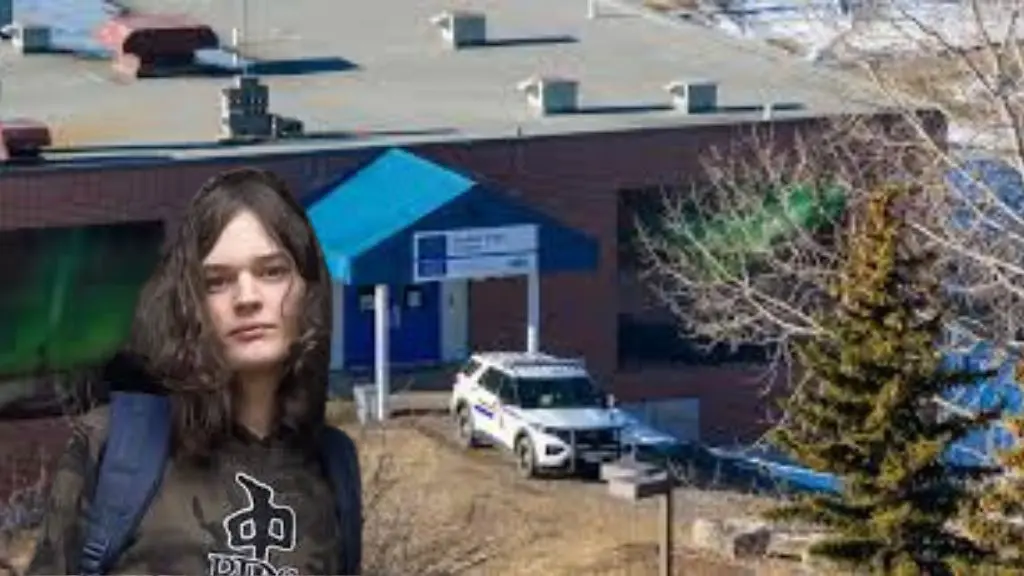
At some point in the early afternoon of February 10, 2026, Jesse Van Rootselaar — an 18-year-old resident of Tumbler Ridge — used a shotgun to kill two members of her family at the family home in the town.
Police confirmed that the two victims found at the residence were the perpetrator’s mother, 39-year-old Jennifer Strang, and the perpetrator’s 11-year-old half-brother, Emmett Jacobs.
Both were shot at the residence before the perpetrator left for the school.
The Walk to School
The RCMP said the two crime scenes — the school and the home — were approximately 1.5 kilometres apart. Van Rootselaar traveled on foot between the two locations, armed with a modified handgun and a long gun.
2:20 PM: Active Shooter at Tumbler Ridge Secondary
At approximately 2:20 p.m. MST, RCMP received a report of an active shooter at the school. An alarm in the school instructed students to close the doors for a lockdown. Students then barricaded the doors with tables.
Around 2:20 p.m. on Tuesday, a student returning to Jarbas Noronha’s class said he’d heard what sounded like gunfire. Two minutes later, another student approached Mr. Noronha. The principal had just come to the door, the student said, as the alarm sounded. The school was in lockdown. Mr. Noronha sprang into fight-or-flight mode and took a quick head count: 15 students, all in Grades 11 or 12.
Darian Quist, a grade 12 student at the school, told CBC Radio West that he and other students “got tables and barricaded the doors” for more than two hours during the mass shooting.
The Attack Inside the School
Van Rootselaar went to Tumbler Ridge Secondary School with a modified handgun and a long gun and opened fire, first killing a victim in a stairwell. She then killed five others in the school’s library, before committing suicide shortly before officers arrived on the scene.
Alex Pretti, 37-year-old ICU nurse, killed by Border Patrol in Minneapolis Jan 24, 2026
RCMP Response: Two Minutes
British Columbia Premier David Eby described the mass shooting as an “unimaginable tragedy.” Nina Krieger, the provincial public safety minister, commended the RCMP for their rapid response: “This is a small, tight-knit community with a small RCMP detachment who responded within two minutes.”
The RCMP shared the names of the first four officers who responded: Sgt. Bill Hughes, Const. Jonathan Kohut, Const. Tyler Noon and Const. Nick Gachter. Combined, they have 45 years of policing experience. RCMP Staff Sgt. Kris Clark said the officers “acted with immeasurable bravery in the face of extreme violence while surrounded by unfathomable trauma.”
3:15 PM: Province-Wide Alert
An Alert Ready emergency alert was released in the region by the RCMP at around 3:15 p.m. MST, asking residents to shelter in place due to the active shooter situation. Other schools in the area were also placed on lockdown. The police emergency alert was cancelled at 6:45 p.m. MST.
Evacuation and Triage
Two victims were “airlifted to hospital with serious or life-threatening injuries,” and some 25 others were “being assessed and triaged at the local medical centre for non-life-threatening injuries.” The RCMP later clarified that while 25 people initially attended the local clinic, the two who were airlifted were the only ones with confirmed physical injuries.
The Eight Victims: Their Names and Their Lives
The RCMP released the names of all eight victims on Thursday, February 12, 2026. They deserve to be known as people — not as a number, not as a statistic.
At the Residence
Jennifer Strang (also identified as Jennifer Jacobs), 39 — the mother of the shooter. She had earned her Possession and Acquisition Licence in 2020 alongside her oldest child and had introduced her family to hunting as a way of life in rural British Columbia. She raised her children in Tumbler Ridge and was, by the accounts of those who knew her, a working mother doing her best in a difficult situation. She was 39 years old.
Emmett Jacobs, 11 — Jennifer’s youngest son and Van Rootselaar’s half-brother. He was found dead at the family home alongside his mother. He was 11 years old. He did not know what was coming.
At the School
Shannda Aviugana-Durand, 39 — an education assistant at Tumbler Ridge Secondary School who had devoted her professional life to supporting students with learning needs. She was 39 years old. One victim had reportedly tried to lock the library door to save her classmates in the final moments before the shooting in the library.
Kylie May Smith, 12 — described by her aunt Shanon Dycke as “a beautiful, kind, innocent soul.” Her aunt’s social media announcement of Kylie’s death — “our families world has crumbled with the loss of my beautiful niece” — was widely shared across Canada in the hours after the shooting. She was 12 years old.
Ticaria Lampert, 12 — described by her mother Sarah as “loud and proud,” always trying to make people laugh, and as “the glue that bridged the age gaps” between her siblings. Her mother called her “my tiki torch, powered by love and happiness.” Sarah Lampert said: “She was a dork of all dorks. She had a Santa sack of every bad dad joke you could think of. She felt accomplished when everybody’s tummy hurt.” She was 12 years old.
Zoey Benoit, 12 — identified by the RCMP among the three 12-year-old female students killed at the school. She was 12 years old.
Abel Mwansa Jr., 12 — one of two male students killed at the school. He was 12 years old.
Ezekiel Schofield, 13 — the oldest of the student victims, shot and killed inside the school. He was 13 years old.
Former Olympic Snowboarder Ryan Wedding Arrested: From Olympian to FBI Most Wanted Drug Fugitive
The Two Surviving Critical Patients: Maya and Paige
The two surviving victims, Maya and Paige, remain in hospital.
Maya Gebala, 12, was airlifted to BC Children’s Hospital in Vancouver with gunshot wounds to the head and neck. Her mother, Cia Edmonds, posted updates from the hospital in the days following the shooting. On Wednesday, Ms. Edmonds posted an update saying she’d been warned “that the damage to her brain was too much for her to endure, and she wouldn’t make the night.” She posted a photo of Maya in her hospital bed and wrote: “I can feel her in my heart. I can feel her saying it’s going to be OK. Our baby needs a miracle.” As of February 13, Maya remains in critical but stable condition.
A 19-year-old woman — identified by police as “Paige” — was also airlifted with serious injuries and remains hospitalized in Vancouver.
Who Was Jesse Van Rootselaar? What the Investigation Has Revealed
The RCMP have been deliberate and careful in releasing information about the perpetrator, stating repeatedly that no motive has been determined and that the investigation is ongoing. What follows is a factual account of what has been publicly confirmed by law enforcement and verified news organizations.
Basic Facts
Jesse Van Rootselaar (August 4, 2007 – February 10, 2026) was identified as the shooter by RCMP deputy commissioner Dwayne McDonald. McDonald stated that Van Rootselaar was a trans woman. Van Rootselaar had dropped out of school about four years prior; McDonald disclosed that there was no information that suggested she was bullied at school. She was 18 years old at the time of the shooting.
McDonald said Van Rootselaar identified as female but was assigned male at birth. McDonald said she began to transition about six years ago.
Family Background and Custody History
Van Rootselaar and her siblings had been the subject of custody disputes between their parents, and had moved between Newfoundland and Labrador and Western Canada multiple times between 2010 and 2015.
Her mother, Jennifer Strang, had raised her children in Tumbler Ridge and had a valid Possession and Acquisition Licence for firearms at the time of her death.
Mental Health History
RCMP Deputy Commissioner Dwayne McDonald confirmed: “Police had attended that residence on multiple occasions over the past several years, dealing with concerns of mental health with respect to our suspect. On different occasions the suspect was apprehended for assessment and follow-up” under B.C.’s Mental Health Act, and had been taken to hospital “in some circumstances.”
The police had last visited the home in spring 2025 regarding mental health issues.
In the fall of 2023, her social media had veered into distressing territory. Posts expressed anguish about delays in accessing hormone replacement therapy and explicitly spoke about being suicidal. During that time, she set fire to her room while high on psychoactive mushrooms and, according to the RCMP, was detained for a psychiatric assessment by police.
Van Rootselaar described trying to “burn her house down after using psychedelic mushrooms, and regularly took DMT — another powerful hallucinogenic drug.” After using psychedelic mushrooms in October 2023, she wrote: “I had a complete break from reality and did a lot of irrational things, I felt like I was dreaming.”
According to The London Times, she claimed in 2023 to be treating ADHD and OCD with antidepressants and antipsychotic drugs.
Renee Nicole Good Killed by Federal Agent Amid Immigration Crackdown – Full Details and Controversy
Online Activity
Her TikTok account featured multiple reposted videos of a transgender mass shooter who killed six people at a Christian school in Nashville in 2023. In a social media post from around 2022, Van Rootselaar’s mother “promoted the teenager’s YouTube channel, noting that her child ‘posts about hunting, self-reliance, guns.'”
On Aug. 24, 2025, a new user opened an account on a website that bills itself as a place to post gore videos of people dying violently. The user posted photos of guns and a cat that matched photos on social-media accounts confirmed to have belonged to the shooter and her mother. The user wrote “I appreciate this post” in response to a long compilation of mass shooting videos.
The Firearms Licence
Van Rootselaar had previously held a valid minor’s firearms licence, which allows for borrowing a non-restricted firearm; it had expired in 2024.
The Firearms: What Is Known and What Isn’t
The firearms question is at the center of the ongoing investigation and the broader policy debate that has followed this shooting.
The BC RCMP has prioritized the analysis of two firearms seized from the school and two firearms, including a shotgun, seized from the residence. The shotgun is believed to be involved in the homicides at the home and has never been previously seized by police. The main firearm believed to be used in the mass shooting at the school has never been seized by the RCMP and its origin is unknown.
Officials confirmed that firearms were seized from the family home “a couple of years ago,” but were returned “at a later point in time” after a successful court petition to get them back.
Section 117.04 of the Criminal Code allows for the seizure of firearms by a peace officer, even without a warrant, if there are “reasonable grounds” to believe a person poses a safety risk to themselves or others by possessing those firearms. If any firearms, weapons or firearms licences are seized, a judge will have to review the evidence behind the seizure at a hearing within 30 days. The judge will then determine whether the items should be forfeited or destroyed, or issue a prohibition order that forbids the person in question from possession for up to five years.
The fact that firearms were seized from this family’s home due to safety concerns, and then legally returned after a court petition, despite the shooter’s documented and worsening mental health crisis, has become the central policy question of this tragedy.
RCMP Deputy Commissioner McDonald said he can’t share specific details other than to say a review of all previous incidents related to the shooter and their family found “police followed proper protocol and the law.”
That answer — accurate, legally careful, and deeply unsatisfying — has not quieted the questions.
The Response: Grief, Community, and Political Leadership
The Vigil
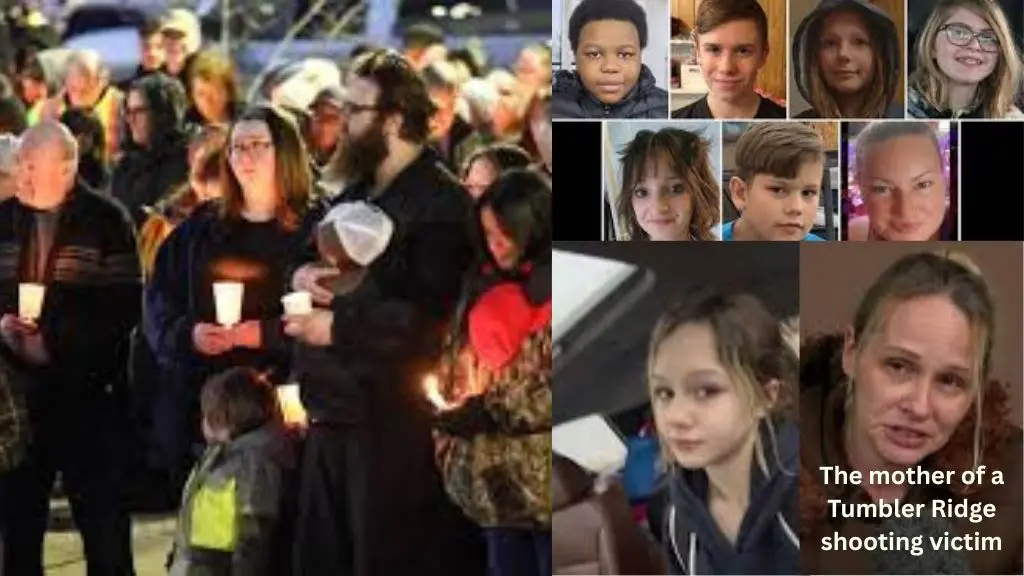
Hundreds assembled in the town’s centre for a vigil on Wednesday evening to remember those killed. Flowers, candles, teddy bears and framed photos were carefully placed at the base of a tree just outside the local community centre, on a hill overlooking the school where five students and an educator were killed. At night, locals in the town placed candles from vigils out on their doorsteps.
Prime Minister Mark Carney
Carney cancelled his imminent trip to the 62nd Munich Security Conference in Europe, and announced that flags would be flown at half-mast on federal buildings and Parliament Hill for seven days.
On February 12, two days after the shootings, the Prime Minister’s Office stated that Carney intended to visit Tumbler Ridge in the coming days. Carney extended invitations to Opposition leaders to travel with him to the community on February 13. Conservative Party leader Pierre Poilievre, Bloc Québécois leader Yves-François Blanchet, and interim NDP leader Don Davies confirmed that they would travel with the prime minister.
Premier David Eby
BC Premier David Eby described the attack as an “unimaginable tragedy.” BC Minister of Public Safety and Solicitor General Nina Krieger declared that her office would “deploy every resource” to support the investigation.
The Father’s Statement
The father of Jesse Van Rootselaar issued a public statement in the days following the shooting, saying: “I carry a sorrow.” He did not elaborate further publicly. His statement drew a complex response — grief for what his child had done, some small measure of compassion for a parent navigating an incomprehensible circumstance alongside the families of the children his daughter killed.
The Investigation: Where Things Stand (February 14, 2026)
As of Friday, February 13, 2026, officers and Forensic Identification Services are continuing to process two scenes, with one located at Tumbler Ridge Secondary School and the second at a nearby home. A vehicle connected to the suspect, which is located outside the school, is also being processed. It is expected that forensic work underway at Tumbler Ridge Secondary will continue through the weekend and the home could be finished by tomorrow. Autopsies on the eight victims and the suspect are expected to be complete by the end of the weekend. So far, officers have interviewed more than 80 students, educators, and first responders. Additional witness interviews are still underway.
The BC RCMP has launched an online portal to streamline the collection of additional evidence that may have not yet been shared with police, such as footage captured on phones inside the school.
No note has been found. No motive has been determined. The investigation continues.
The Policy Questions: Firearms, Mental Health, and the “Red Flag” Gap
The Tumbler Ridge shooting has immediately ignited debate across Canada about several overlapping policy failures — none of which, individually or collectively, provides a simple answer to the question of how this happened.
The Firearm Seizure and Return
The central policy puzzle is straightforward to state and difficult to resolve: a family with documented mental health concerns had firearms seized by police — and then successfully petitioned a court to have them returned. The shooter subsequently used guns from that household to kill eight people.
The previous Liberal government in 2023 passed Bill C-21, which updated Canada’s “red flag” laws to allow anyone — including civilians, such as a family member — to apply to a court for an emergency prohibition order if there is a safety concern. Whether that law was used in this case, and why the firearms were returned despite the documented history, are questions that remain unanswered.
Canada’s Gun Laws in Context
Experts have attributed the rarity of school shootings in Canada to the country’s strict gun laws, which make it difficult to own assault-style weapons like those which have been used in many U.S. school shootings.
Canada has prohibited approximately 2,500 types of firearms since May 2020, including the AR-15 and Ruger Mini-14. The Tumbler Ridge shooting was carried out with a modified handgun and a long gun — not assault-style weapons in the prohibited category. The relevant question is not whether Canada’s laws are stricter than the United States’ (they are), but whether the specific mechanisms for removing weapons from people with documented mental health crises functioned as they should have.
Mental Health System Failures
Multiple agencies were aware of Van Rootselaar’s deteriorating mental health over a period of years. She had been apprehended under the Mental Health Act and taken to hospital on more than one occasion. She had set fires. She had posted publicly about suicidal ideation. She had reposted mass shooting content. And yet no mechanism in the system — not mental health services, not police, not the courts — produced an outcome that prevented access to firearms.
This is not unique to Canada. The gap between documented mental health crisis and effective intervention is a documented failure across multiple high-income countries. Tumbler Ridge has given that abstract policy failure a set of faces: Kylie, Ticaria, Zoey, Abel, Ezekiel, Shannda, Jennifer, Emmett.
Historical Context: Canada’s Worst Mass Shootings
The Tumbler Ridge shooting is now the deadliest school shooting in Canada since 1989. To understand its place in Canadian history:
École Polytechnique, Montreal — December 6, 1989: A gunman killed 14 women at an engineering school, shouting that he was “fighting feminism.” It remains Canada’s deadliest school shooting and the event that fundamentally reshaped Canada’s approach to gun control. The massacre directly led to the passage of the 1995 Firearms Act, which introduced a long-gun registry (later abolished by the Harper government in 2012) and mandatory licensing.
Portapique, Nova Scotia — April 18–19, 2020: A gunman masquerading as an RCMP officer killed 22 people in a 12-hour rampage across multiple properties. It remains the deadliest mass shooting in Canadian history in terms of victims killed. The Nova Scotia massacre directly led to the 2020 assault-style weapons ban and the 2023 Bill C-21 red flag law expansion.
Tumbler Ridge, British Columbia — February 10, 2026: The incident is the highest casualty mass shooting event in Canadian history, with 36 total casualties (including the perpetrator). The distinction from Nova Scotia is in the number of people affected — injured plus killed — rather than the raw death toll alone.
The Community: How Tumbler Ridge Is Healing
The work of grieving a mass casualty event in a community of 2,400 people is not abstract. Every person in Tumbler Ridge either knew one of the victims or knows someone who did. The school that closed on Tuesday will reopen eventually, and the children who barricaded doors with tables will return to it.
Rev. Gerald Krauss and his wife, Tracey Krauss, spoke to the aftermath of the mass shooting at Tumbler Ridge Secondary School and its impact on the community. Clergy, counselors, and mental health workers have been deployed to the community. School District 59 announced both schools in Tumbler Ridge would remain closed for the rest of the week. Counseling is being made available.
The GoFundMe pages for Kylie Smith’s family and Ticaria Lampert’s family received donations from across Canada within hours of being launched.
To the local health care centre staff who had to deal with a catastrophic situation: in a community this small, they would know some, if not all, of the victims. And yet they were able to put personal worries aside to do their jobs. Triage, treatment, care. For kids.
Mayor Krakowka said he would know every victim. He was right. That is not a comfort. It is a particular kind of wound.
What Comes Next
The immediate future holds several parallel processes:
The forensic investigation will continue through the weekend and into the following week. Autopsies will be completed. The origin of the primary firearm used at the school — still unknown — will hopefully be determined.
The public inquiry dimension is already forming. Questions about the firearm seizure and return, the adequacy of the red flag provisions, and the mental health system’s failure to intervene more effectively will be examined by legislators, policymakers, and the press.
The political response will include the multi-party visit to Tumbler Ridge on February 13 and, almost certainly, proposed legislative changes. What those changes will be, and whether they will address the specific gaps this shooting revealed, remains to be seen.
The community’s recovery will take years. Some students and families will never fully recover. The four first-responding RCMP officers — with 45 combined years of experience — have been given time to decompress and heal. Volunteers from across the province have stepped in to staff the local detachment while they do.
The victims’ families are beginning the unimaginable work of planning funerals for children. Kylie Smith’s family is making arrangements. Ticaria Lampert’s mother Sarah — a single mother of eight children, who lost the one who made everyone’s “tummy hurt” with her bad jokes — is making arrangements. Emmett Jacobs’s father confirmed that Emmett was Jesse’s half-brother, not stepbrother, in a correction that was small in its detail and enormous in its human specificity. These are real families, trying to bury their children.
Remembering the Eight
Eight lives were taken on February 10, 2026, in Tumbler Ridge, British Columbia. They were not symbols. They were not statistics. They were people.
Jennifer Strang, 39. A mother of five who taught her children to hunt, who earned her firearms licence on the same day as her oldest child, who deserved to grow old.
Emmett Jacobs, 11. The little brother. He was 11.
Shannda Aviugana-Durand, 39. An education assistant who showed up for students every day, who may have died trying to protect the children in her care.
Kylie May Smith, 12. Beautiful, kind, innocent. Her aunt’s words. Her family’s world.
Ticaria Lampert, 12. The tiki torch. The one with the bad dad jokes. The glue of her large family.
Zoey Benoit, 12. Twelve years old.
Abel Mwansa Jr., 12. Twelve years old.
Ezekiel Schofield, 13. Thirteen years old, the oldest of the students. He had barely started.
The RCMP’s online portal for witness evidence from the Tumbler Ridge shooting is available through the BC RCMP website at rcmp.ca. The investigation is ongoing.
Crisis support is available to Canadians affected by this event through Crisis Services Canada at 1-833-456-4566 (24/7) or by texting 45645.
GoFundMe pages supporting the families of Kylie Smith and Ticaria Lampert can be found by searching their names at gofundme.com.