
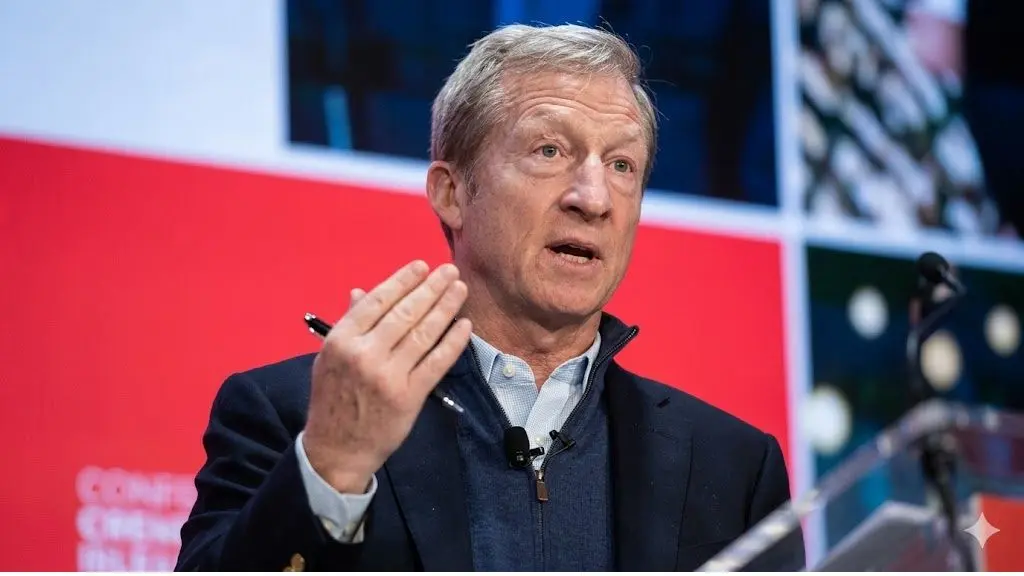
Tom Steyer: The Billionaire Who Chose Principle Over Profit
From Wall Street Success to Climate Crusader – The Complex Journey of a Hedge Fund Legend Turned Political Activist
When Thomas Fahr Steyer sat in his San Francisco office in October 2012, taking a phone call from environmental writer Bill McKibben about the Keystone Pipeline and carbon emissions, he faced a decision that would cost him billions of dollars in potential future earnings. For most hedge fund managers managing $20 billion in assets at the peak of their powers, this would have been background noise. For Steyer, it would become the defining moment of his life.
Steyer, born June 27, 1957, is an American billionaire, entrepreneur, and environmentalist who founded Farallon Capital and later became a major Democratic political donor and climate activist. His story is one of extraordinary financial success, moral reckoning, political ambition, and the complex contradictions that define modern American wealth and activism. This is the remarkable journey of the man who walked away from Wall Street to fight climate change—and is now seeking to become California’s next governor.
Tom Steyer Privileged Beginnings: Manhattan’s Upper East Side
Tom Steyer was born in Manhattan, New York City. His father, Roy Henry Steyer, was a partner in the prestigious New York law firm Sullivan & Cromwell and served as a prosecutor at the Nuremberg Trials. His mother, Marnie, was a teacher of remedial reading at the Brooklyn House of Detention. His father was Jewish and his mother was Episcopalian.
Steyer grew up on the Upper East Side of Manhattan in a household where intellectual achievement and public service were valued. His father’s work prosecuting Nazi war criminals at Nuremberg taught young Tom that privilege came with moral obligations—that those with power and resources had a duty to fight injustice.
Steyer attended the exclusive Buckley School and Phillips Exeter Academy, where he excelled academically and was named valedictorian of his class. These elite prep schools provided not just education, but access to networks that would prove invaluable throughout his career.
Academic Excellence: Yale and Stanford
At Yale University, Tom Steyer studied economics and political science, graduating summa cum laude and earning election to Phi Beta Kappa. But he wasn’t just an academic star—he also served as captain of the Yale soccer team, demonstrating the competitive drive that would later fuel his business success.
After graduation in 1979, Steyer began his finance career at Morgan Stanley before recognizing he needed more formal business training. He earned his MBA from Stanford Business School in 1983, joining an elite network of Stanford alumni who would come to dominate Silicon Valley and global finance.
During his Stanford years, Steyer also worked for Walter Mondale’s 1984 presidential campaign—his first taste of Democratic politics that would later consume his attention and resources.
David Montgomery: From Poverty to the Pros – The Inspiring Journey of an NFL Star and Eagle Scout
Wall Street Apprenticeship: Goldman Sachs
After graduate school, Tom Steyer joined Goldman Sachs, where he worked in the firm’s legendary merger arbitrage group led by future Treasury Secretary Robert Rubin. This was Steyer’s financial education in the most exclusive classroom imaginable.
At Goldman Sachs, Steyer worked in risk arbitrage, a type of hedge fund investment strategy based on investing in corporate mergers. He became known for his aggressive investments—a reputation that would follow him throughout his career.
Under Rubin’s mentorship, Steyer learned how to identify mispricings in the market, how to manage risk, and most importantly, how to think probabilistically about complex situations. These skills would prove invaluable when he struck out on his own.
Founding Farallon: Building an Empire
In 1986, at age 29, Steyer made the leap every ambitious financier dreams of: he left Goldman Sachs to start his own hedge fund. Steyer became a partner at the San Francisco-based private equity firm Hellman & Friedman, then founded Farallon Capital in January 1986.
The hedge fund was named for the Farallon Islands, a group of islands 30 miles west of the Golden Gate Bridge known for their shark-infested waters—a fitting metaphor for the aggressive, opportunistic investment style Steyer would employ.
Beginning with $15 million in seed capital, Steyer’s firm earned a reputation in merger arbitrage, real estate investment, and credit investment. His strategy was simple but brutally effective: identify distressed assets in volatile markets, buy them cheaply, and hold until they recovered.
Tom Steyer made his fortune running Farallon, which was managing $20 billion by the time he left the company. Despite reportedly losing 36% in 2008, Farallon managed to average a 13.4% annual rate of return from 1986 to 2012—when Steyer stepped down from day-to-day management—versus a 9.5% annual return for the S&P 500 over the same interval.
Farallon became known for managing university endowments, including a major investment program with Steyer’s alma mater Yale. The firm’s assets under management grew to over $30 billion, making it one of the world’s largest and most successful hedge funds.
Tom Steyer operated Farallon Capital Management for nearly twenty-seven years, building his personal wealth to over $1.6 billion.
The Contradictions: Fossil Fuels and Climate Activism
Here’s where Steyer’s story becomes complex and controversial. Even as he began positioning himself as an environmental advocate in the late 2000s, Farallon continued investing heavily in fossil fuel companies.
A 2014 New York Times article revealed that coal-mining companies Farallon invested in or lent money to under Steyer had increased their coal production by 70 million tons annually since receiving money from Farallon, and that Steyer remained invested in the Maules Creek coal mine.
While Tom Steyer became increasingly interested in environmental activism in the 2010s, Farallon had significant investments in the coal and petroleum industries, including investments in British Petroleum (BP) and coal-mining operations in Australia. One of the company’s largest single partnerships was a $220 million investment in the oil and gas company Nexen in September 2012.
The contradictions extended beyond energy. According to SEC filings, Steyer was at the helm as the hedge fund purchased nearly $90 million of Corrections Corporation of America stock (5.5% of the company’s outstanding shares)—investing in private prisons even as he positioned himself as a progressive activist.
In 2004, Steyer became the target of left-wing attacks by student activists at both Yale and Stanford when they learned the universities had millions invested in Farallon. Student activists started a website called unfarallon.info and organized public protests and political theater events.
Tom Steyer decided to dispose of his carbon-polluting investments in 2012, although critics noted he did not dispose of them quickly enough and that the lifespan of the facilities he funded would extend through 2030.
The Great Pivot: Leaving Farallon
In 2012, after that fateful phone call with Bill McKibben and mounting pressure over his environmental contradictions, Steyer made a momentous decision. He would retire from Farallon at age 55, walk away from managing $20 billion, and dedicate his life to fighting climate change and progressive causes.
When Steyer sold his ownership stake in Farallon Capital Management in late 2012, the hedge fund was the fourth largest in the world, having turned $8 million into $30 billion over 20 years.
The decision cost him dearly in financial terms. By some estimates, staying at Farallon could have made Steyer significantly wealthier. But he had decided that making more money wasn’t the point—using his existing fortune to drive change was.
Political Awakening: Becoming a Democratic Megadonor
Tom Steyer served as a delegate to the Democratic National Conventions in 2004 and 2008 and became one of Barack Obama’s most prolific fundraisers. But his political spending really accelerated after leaving Farallon.
Steyer’s $74 million in contributions and expenditures on the 2014 midterm elections made him the top political donor during that cycle. Reporters called Steyer a liberal alternative to the conservative billionaires Charles G. Koch and David H. Koch, owners of Koch Industries.
In 2010, Steyer joined former Secretary of State George Shultz to co-chair the No on Prop. 23 campaign. Proposition 23, backed by the Koch brothers, aimed to overturn California’s Global Warming Solutions Act of 2006. Steyer donated $5 million to defeat the proposition. He also solicited $700,000 from Bill Gates and $500,000 from billionaire hedge fund manager Julian Robertson in the successful effort.
Steyer helped lead the 2016 campaign that yielded a $2 per-pack tax hike on tobacco products, with money steered to state health care programs. Steyer was also a top opponent of a 2010 ballot initiative that would have rolled back California’s clean air and climate law.
NextGen America: Building a Political Machine
In 2013, Tom Steyer founded NextGen Climate, now known as NextGen America, a political nonprofit that supports progressive positions on climate change, immigration, health care and education and encourages youth civic engagement.
NextGen became Steyer’s primary vehicle for political influence. The organization focused on electing candidates with strong environmental records, defeating anti-climate ballot measures, and mobilizing young voters.
In October 2017, NextGen America donated grants totaling $2.3 million to eight national immigration law service organizations, expanding the organization’s focus beyond just climate issues to a broader progressive agenda.
In 2014, Steyer funded political campaigns to advocate for the election of at least nine candidates. Reportedly, Steyer spent $1.8 million attacking Stephen Lynch in a Massachusetts Senate special election, including money for a plane to fly over a Boston Red Sox game with a banner reading “Steve Lynch for Oil Evil Empire.” The aggressive tactics showed Steyer was willing to play hardball politics.
The Impeachment Crusade: Confronting Trump
When Donald Trump was elected president in 2016, Tom Steyer found a new mission. Steyer spent millions of his own money touring the country and pushing for Trump’s impeachment during the Republican president’s first term.
In March 2018, Steyer launched a 30-city town hall tour called “Need to Impeach,” and by fall the campaign had amassed close to 6 million petition signatures. As of 2019, he had reportedly spent over $70 million on the effort.
The Need to Impeach campaign made Steyer a household name among Democrats and fueled speculation about his political ambitions.
Presidential Ambitions: The 2020 Campaign
After initially indicating he would not seek the presidency, Steyer launched a campaign for the Democratic presidential nomination on July 9, 2019, in an online campaign video posted to Twitter. Steyer stepped down from his role as president of Need to Impeach in July 2019 when he announced his presidential campaign.
Tom Steyer was largely able to fund his own campaign, funneling $200 million into the effort from his own pocket. Steyer spent over $253 million, with all but a little over $3.5 million coming from his personal funds.
After distant finishes in Iowa caucuses and New Hampshire primary, Steyer doubled down with an expensive push in South Carolina, finishing third behind eventual nominee Joe Biden and Vermont Sen. Bernie Sanders.
This amount worked out to be $3,373 for every vote he received in the three primaries where he was on the ballot before dropping out of the race. The campaign demonstrated that unlimited personal wealth alone cannot buy electoral success—voters need authentic connection and compelling messaging.
After leaving the race, Steyer co-chaired then Vice President Biden’s Climate Engagement Advisory Council to help mobilize climate voters. He had failed to become president, but he could still influence policy.
Philanthropy: The Giving Pledge and Beyond
In August 2010, Tom Steyer and his wife Kat Taylor, along with thirty-seven other American billionaires, signed Bill Gates and Warren Buffett’s “Giving Pledge” agreement to donate at least half of their fortune to charitable causes.
In 2007, Steyer and his wife opened OneCalifornia Bank, later called One PacificCoast Bank and then Beneficial State Bank. The bank specializes in providing commercial loans and banking assistance to low- and medium-income businesses in the Bay Area and invests in nonprofit institutions and supports environmental initiatives.
Steyer and Taylor have donated millions to their alma maters, Yale and Stanford, to fund advanced energy solutions. The TomKat Center for Sustainable Energy at Stanford, funded by a $41 million donation, trains the next generation of clean energy innovators.
The couple also owns an environmentally minded cattle grazing operation near San Francisco to experiment on curbing greenhouse emissions in the farming industry.
Personal Life: Partnership with Kat Taylor
Steyer’s wife, Kat Taylor, is far more than just a spouse—she’s a full partner in his business and philanthropic ventures. Taylor comes from her own banking family and shares Steyer’s progressive values. Together, they control the TomKat Charitable Trust, which funds their policy advocacy work.
The couple has four children and maintains homes in the San Francisco area. Despite their immense wealth, they’re known for relatively modest lifestyles compared to other billionaires—though “modest” is relative when you’re worth over a billion dollars.
The 2026 California Governor’s Race: A New Chapter
In November 2025, Steyer announced his candidacy in the 2026 California gubernatorial election, joining a crowded field seeking to succeed termed-out Democratic Governor Gavin Newsom.
“Californians deserve a life they can afford, but the Californians who make this state run are being run over by the cost of living,” Steyer said in his campaign launch video. His core promises are to preserve California’s status as a hub for business and innovation while lowering the state’s cost of living by making corporations pay “their fair share.”
By early February 2026, Steyer’s campaign had shelled out at least $27.4 million, primarily on television and digital ads—nearly twice as much as the rest of the field combined. Steyer personally pumped $28.8 million into his campaign through the end of 2025.
However, money alone hasn’t guaranteed success. A recent poll from UC Berkeley showed that 44% of voters were undecided, with Steyer garnering just 1% support in late October polling.
Steyer is pitching himself as an outsider who can take on corporations, saying “Sacramento politicians are afraid to change up this system—I’m not.” Yet critics question whether a billionaire hedge fund manager can credibly position himself as a populist outsider.
“He still has the albatross of being a zillionaire who has offshore money,” noted David McCuan, a political science professor at Sonoma State University. “He still has a plausibility and believability problem.”
In a social media post, Steyer tried to address this contradiction directly: “I’m the billionaire who will fight billionaires.”
The race includes prominent Democrats like former Rep. Katie Porter, former HHS Secretary Xavier Becerra, and former Los Angeles Mayor Antonio Villaraigosa, along with Republican candidates including Riverside County Sheriff Chad Bianco and former Fox News host Steve Hilton. No clear frontrunner has emerged.
Legacy and Impact: A Complex Reckoning
How should we evaluate Tom Steyer’s life and career? The answer is far from simple.
On one hand, Steyer represents the worst contradictions of modern American capitalism—building a fortune partly on fossil fuels and private prisons, then using that fortune to position himself as a progressive champion. His critics see hypocrisy and opportunism.
On the other hand, Steyer walked away from billions in potential earnings to dedicate his life to causes he believes in. He has spent over $250 million of his personal fortune on Democratic politics and climate advocacy. He helped make California the largest jurisdiction in the world with a 100% clean energy law and successfully fought Big Oil’s attempts to roll back climate protections.
As of 2023, Forbes reported Steyer’s net worth at $1.5 billion—still enormous, but significantly less than it might have been had he stayed at Farallon.
Perhaps Steyer’s greatest contribution is demonstrating that extreme wealth comes with moral obligations. By walking away from his hedge fund at the peak of his earning power, he established a new model for how successful investors might use their resources and influence for public good—even if that model remains imperfect and controversial.
Conclusion: An Unfinished Story
As Tom Steyer campaigns for California governor in 2026, his story remains unfinished. Will voters embrace a billionaire promising to fight other billionaires? Can someone who made his fortune on Wall Street credibly champion working-class Californians?
These questions reflect broader tensions in American politics about wealth, power, and progressive values. Steyer embodies all the contradictions of modern liberalism—enormous wealth derived from capitalism, deployed in service of causes that challenge capitalist excess.
Whether he becomes California’s next governor or suffers another expensive electoral defeat, Steyer has already left his mark on American politics and environmental advocacy. His journey from hedge fund billionaire to climate crusader to political candidate demonstrates both the possibilities and limitations of using personal wealth to drive social change.
The phone call from Bill McKibben in 2012 cost Steyer billions. But it also gave his life meaning beyond accumulation. In an era when many billionaires simply seek to amass more wealth and power, Steyer chose a different path—one that’s messy, contradictory, and incomplete, but undeniably consequential.
His story reminds us that redemption is possible, that people can change, and that wealth—for all its corrosive effects—can sometimes be deployed in service of something larger than personal gain. Whether that’s enough to earn him the California governorship remains to be seen.