
‘The Rip’ Review: Genre Pro Joe Carnahan Keeps Matt Damon and Ben Affleck’s Gritty Netflix Cop Thriller in Confident Hands
Director: Joe Carnahan | Screenplay: Joe Carnahan | Story by: Joe Carnahan, Michael McGrale | Cast: Matt Damon, Ben Affleck, Steven Yeun, Teyana Taylor, Catalina Sandino Moreno, Kyle Chandler, Sasha Calle, Scott Adkins, Néstor Carbonell, Jose Pablo Cantillo, Lina Esco, Cliff Chamberlain, Alex Hernandez, Daisuke Tsuji | Runtime: 1 hour 52 minutes | Rating: R | Streaming: Netflix | Producers: Ben Affleck, Matt Damon, Dani Bernfeld, Luciana Damon | Executive Producers: Kevin Halloran, Michael Joe
A Return to Old-School Crime Thrillers
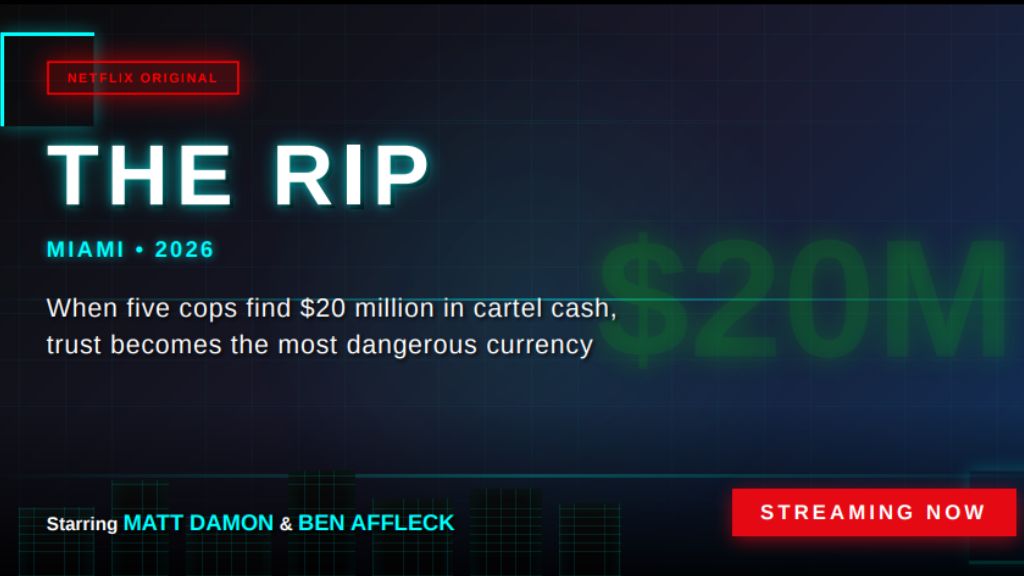
Netflix kicks off 2026 with a gritty bang in the form of “The Rip,” a taut cop thriller that feels like a throwback to the character-driven crime dramas of the 1970s and the stylistic mastery of Michael Mann. Directed and written by genre veteran Joe Carnahan, this film reunites Hollywood’s most enduring bromance—Matt Damon and Ben Affleck—in a pressure-cooker scenario that tests loyalty, morality, and survival instincts when a team of Miami narcotics officers discovers $20 million in cartel cash.
Released globally on January 16, 2026, “The Rip” arrives with minimal fanfare but maximum impact, delivering the kind of mid-budget, character-focused thriller that once dominated multiplexes but now finds its home on streaming platforms. While it doesn’t reinvent the wheel, Carnahan’s confident direction and an ace ensemble cast make this one of the most compelling original action films Netflix has produced in recent memory.
The Director: Joe Carnahan’s Return to Form
Joe Carnahan is no stranger to the gritty world of cops, criminals, and moral ambiguity. The 56-year-old filmmaker has built a career on visceral, testosterone-fueled action films that never sacrifice character for spectacle. His breakthrough came with 2002’s “Narc,” a neo-noir crime thriller starring Ray Liotta and Jason Patric that earned critical acclaim and Independent Spirit Award nominations for Best Director and Best Screenplay.
Since then, Carnahan has carved out his niche with films like “Smokin’ Aces” (2006), “The A-Team” (2010), and “The Grey” (2012)—the latter being a survival thriller with Liam Neeson that showcased his ability to extract powerful performances while maintaining edge-of-your-seat tension. More recently, he directed “Copshop” (2021) and “Boss Level” (2021), proving his mastery of genre filmmaking remains sharp.
With “The Rip,” Carnahan returns to the crime thriller territory that made his name, channeling his love for classics like “Serpico,” “Prince of the City,” and particularly Michael Mann’s “Heat.” The film’s foreboding Miami nightscapes, pulsing synth score by Clinton Shorter, and focus on interpersonal relationships all pay homage to Mann’s aesthetic while maintaining Carnahan’s own distinct voice.
The True Story Behind ‘The Rip’
“The Rip” is inspired by real events, specifically the experiences of Christopher Casiano, a veteran Miami-Dade Police Department captain and longtime friend of Carnahan’s. The two met while Carnahan was working on “Bad Boys for Life” (2020), and Casiano shared a story that would become the foundation for this film.
In real life, Casiano led a tactical narcotics team that executed a raid on a suspected cartel stash house. What they found was staggering: 24 orange Home Depot buckets hidden behind a false wall, each packed with bundles of $100 bills—$24 million in total, the largest cash seizure in Miami-Dade Police Department history.
The officers used sledgehammers to break through the walls and extract the money, then faced the legally mandated requirement to count every dollar on-site—twice. The entire process took Casiano and his team 42 hours in real life. During this marathon counting session, Casiano couldn’t shake the feeling they were being watched, that someone might come for the money at any moment.
“My first instinct was that we were being watched and someone was coming to get the money,” Casiano explained. The tension, paranoia, and temptation of that night stayed with him, and he shared with Carnahan a stark observation: “That amount of money just does dark things to the soul.”
A Personal Tragedy Reshapes the Story
The film took on deeper emotional resonance after a heartbreaking personal tragedy. In 2021, Casiano’s 11-year-old son, Jake Casiano, died after a battle with cancer. This loss profoundly affected both Casiano and Carnahan, who reworked the script to incorporate themes of grief, loss, and the fragility of life.
In “The Rip,” Matt Damon’s character, Lieutenant Dane Dumars, is a man haunted by the death of his own son—a trauma that has left him heavily in debt, divorced, and emotionally unstable. The film is dedicated “In loving memory of Jake William Casiano,” and in 2022, a street in Miami Springs was named after the young boy.
Casiano served as a consultant on the film, ensuring authenticity in the procedural details and the emotional truth of what it means to be a cop in Miami’s high-stakes narcotics world.
Plot Synopsis: Trust Frays in the Stash House
“The Rip” opens with a visceral prologue: Miami-Dade narcotics division Captain Jackie Velez (Lina Esco) speeds through a rainy night, desperately trying to keep a woman on the phone calm, promising to protect her and get her out of a dangerous situation. Before she can reach the distressed woman, Jackie is ambushed and killed by two men in ski masks. She manages to send one quick text before disposing of her burner phone. The brutal opening sets the tone for a film steeped in violence, paranoia, and betrayal.
The action shifts to police headquarters, where a series of interrogations is underway. Who killed Captain Velez? Was it a cartel hit, or was she murdered by someone in her own department? The film cuts between angry accusations and furious defensiveness, establishing that nobody in the Miami-Dade Police Department knows who’s clean and who’s dirty.
Lieutenant Dane Dumars (Matt Damon), who has been promoted to fill Velez’s spot, urges his chief, Major Thom Vallejo (Néstor Carbonell), to let his team take charge of the case. But Vallejo, struggling with budget cuts and allegations of corruption in the force, defers to the Feds. Dumars is immediately suspicious—a cop killing has yielded a strangely low-key internal investigation with no task force, especially as the Violent Criminal Apprehension Team has been shut down and further job cuts loom.
Hailee Steinfeld Is Pregnant | Husband | Net Worth | Family | Movies | Songs
The Tip and the Discovery
Later, while the team is unwinding at the end of a shift, Dumars shares news of a crime-stopper tip about a cartel stash house in neighboring Hialeah. Despite disgruntlement about a freeze on overtime pay, he musters his colleagues to go investigate.
The sniffer dog handled by Lolo starts barking intensely even before they knock on the door, then bolts up the stairs as soon as they enter, heading straight for the attic. Unlike the rest of the cluttered house, the attic is pristine and empty.
When they arrive at the house in the neighboring community of Hialeah, they meet Desiree “Desi” Lopez Molina (Sasha Calle), who claims the house belonged to her recently deceased grandmother and insists she has never even been in the attic. But once the TNT officers smash through a false wall and find $20 million in cash, her innocence seems a stretch.
In Miami cop parlance, a “rip” means taking the bad guys’ stuff—and this is the biggest rip any of them have ever seen.
Counting the Money, Losing Trust
Miami-Dade police procedure requires a full count of cash seized from stash houses before the officers leave the scene. This mandate creates the perfect pressure-cooker scenario, as Dumars confiscates everyone’s phones and radios, insisting they sit on the discovery before calling it in—an unusual move that immediately raises red flags.
As they begin the painstaking process of counting, tensions escalate. The amount mentioned on the alleged crime-stopper tip keeps changing, and Dumars remains reluctant to phone in their findings to Major Vallejo. Byrne, despite being Dumars’ oldest friend, begins to suspect his partner might be planning to steal the money. After all, Dumars is drowning in debt after losing his son, and his behavior is increasingly erratic.
Mysterious phone calls start coming in, threatening the team: take $150,000 and leave, or everyone dies. But the calls aren’t coming from the cartel—they’re coming from someone much closer to home.
Paranoia, Gunfire, and Betrayal
Threatening anonymous calls give them a half-hour to take a cut of the millions and get out of there before people start dying. Desi, handcuffed to a chair, is the most nervous as she slowly reveals what she knows about the other people who make intermittent use of the house.
Two shady-looking cops in a Hialeah patrol car asking questions raises the temperature further. As night falls, what appears to be a widening rift between Dane and J.D. intensifies tensions among the team, even before a hailstorm of bullets rains down on them. Officer Salazar is wounded in the attack. A cartel member is spotted signaling from a nearby house, and former cop turned DEA officer Matty Nix (Kyle Chandler) turns up in an armored truck and starts meddling.
The Twists Unravel
Carnahan demonstrates considerable skill at bouncing suspicion from one character to another as the destination of the $20 million remains up for debate and the time until the forewarned siege continues shrinking. The plotting gets a bit muddy at times, but the movie keeps sneaky surprises up its sleeve—including the connection of the case to Jackie’s murder—while also illuminating unexpected complicity between law enforcement and drug traffickers that blurs the lines as to what qualifies as corruption.
Without spoiling the intricate plotting, the film reveals that J.D.’s involvement is complicated by the badly kept secret of his relationship with Jackie and by heightened friction with one especially aggressive FBI agent, Del (Scott Adkins), who turns out to be his brother. The true traitors are revealed, alliances shift, and the film’s central question—”Are we the good guys?”—is questioned, perhaps a little too pointedly, in the acronyms tattooed across Dane’s knuckles.
In a clever resolution, the team manages to swap the real money with periodicals hoarded by Desi’s grandmother, turning in the cash while ensuring Desi receives a 20% informant fee. On a beach at sunrise, Dumars and Byrne remove the memorial bands from their shields in honor of Jackie Velez, having delivered justice at last.
Carnahan and editor Kevin Hale keep the audience on its toes piecing together fragments of background information as they intercut among various interrogations throughout the film.
The Cast: Chemistry and Charisma
Matt Damon as Lieutenant Dane Dumars
Damon delivers one of his grittiest performances in years as Dane Dumars, a character inspired by Captain Chris Casiano himself. Leaning into his age in ways he rarely has before, Damon portrays a man broken by the end of his marriage and the loss of his 10-year-old son to cancer. He appears calm and methodical on the surface, but his emotional volatility constantly threatens to break through.
The role requires Damon to balance vulnerability with volatility, and he nails it. Whether he’s quietly counting stacks of cash or erupting in frustration at his team, Damon makes Dumars feel like a real person on the edge of a breakdown. There’s a particularly striking moment when he walks into frame from out of focus, accompanied by an ambient music cue that screams he’s lost his grip on reality.
Ben Affleck as Detective Sergeant J.D. Byrne
Affleck plays the hothead to Damon’s calm and methodical approach—the kind of guy whose volatile energy constantly threatens to explode. As J.D. Byrne, Affleck brings his natural swagger and physicality to a role that requires him to be both loyal friend and suspicious investigator.
The real magic is in the chemistry between Damon and Affleck. These two have been friends since childhood, growing up as neighbors in Cambridge, Massachusetts, and that decades-long friendship translates to the screen in every scene. The long friendship and creative collaboration between the two adds genuine history to their onscreen rapport, giving weight to their banter and making the underlying tension of their fractured trust feel authentic.
As one reviewer noted, their pairing “turns every banter-filled scene into something more than just plot mechanics.” Even when the plot gets convoluted, you believe in their bond.
The Exceptional Supporting Cast
Steven Yeun as Detective Mike Ro brings an air of gentleness and honesty to the rookie that is put to good, perhaps misdirecting use. Yeun, best known for “The Walking Dead” and his Oscar-nominated turn in “Minari,” continues to prove his versatility.
Teyana Taylor as Officer Numa Baptiste and Catalina Sandino Moreno as Officer Lolo Salazar have an understated edge to their interplay that makes their characters intriguing. While the women disappear from the testosterone-heavy film for a significant stretch, creating a noticeable absence, both make the most of their screen time. Taylor, fresh off her acclaimed performance in “A Thousand and One,” deserved more material in this ensemble, while Moreno delivers a particularly standout moment when her character contemplates taking some of the money to provide for her family.
Kyle Chandler as DEA Agent Matty Nix brings his trademark relaxed manner and mildly folksy affability to a role that keeps audiences guessing until the final act.
Sasha Calle, who made an impression as Supergirl in Andy Muschietti’s unfairly mistreated “The Flash” and appeared in the poetic coming-of-age drama “In the Summers” (which won Sundance’s Grand Jury Prize in 2024), walks a shrewd line with her character. Desi has the sullen guardedness of someone who knows not to trust cops and the vulnerability of a woman steadily realizing she’s in over her head.
Scott Adkins, known for his action prowess, appears as Del Byrne, J.D.’s FBI agent brother, adding another layer to the jurisdictional complications and family drama.
Facts About Claire Danes | Biography, Movies, Family, Husband, Net Worth and More
Carnahan’s Direction: Confident and Atmospheric
Joe Carnahan directs with the assurance of a filmmaker who knows exactly what kind of movie he’s making. He creates a cinematic pressure cooker where morals are tested and loyalty bends under sustained heat.
Visual Style: A Love Letter to Michael Mann
“The Rip” bows at the altar of Michael Mann, from its foreboding Miami nightscapes bathed in neon and sodium light to Clinton Shorter’s pulsing synth score that echoes the tense atmosphere of Mann’s classics like “Thief” and “Heat.” The film captures Miami as a city of shadows and danger, where corruption lurks in every corner.
Cinematographer Juan Miguel Azpiroz shoots the city with a mix of beauty and menace, finding poetry in rainy streets and abandoned neighborhoods. The production design by Judy Becker transforms the stash house into a character unto itself—a crumbling structure where walls literally hide secrets.
Performance Direction
Carnahan is an underrated director of actors. He previously extracted one of Ray Liotta’s best performances in “Narc” and one of Liam Neeson’s finest in “The Grey.” Here, he gets the entire ensemble to work at a high level, with not a false note among them.
During filming, Carnahan sometimes kept cameras rolling beyond formal takes, encouraging actors to remain in character between setups. Real Miami-Dade police officers, often occupying background roles, interacted in character during those stretches as well, creating an authentic camaraderie and shared language that feels genuine rather than manufactured.
Pacing and Structure
At 112 minutes (1 hour 52 minutes), “The Rip” is a relatively lean thriller that maintains remarkable momentum for most of its runtime. The constant flow of questions—Who killed Jackie? Is Dumars planning to steal the money? Who’s calling the house? Can anyone be trusted?—keeps audiences engaged and guessing.
The film does stumble slightly in its final scenes, where the resolution feels a bit drawn out. Several supporting characters get sidelined as the twists are revealed, and the “tying things up” portion could have been trimmed by about half. However, the very last scene is a beautiful grace note that honors the film’s emotional core.
Themes: Money, Morality, and Memory
At its heart, “The Rip” explores what happens to good people when faced with extraordinary temptation. The $20 million isn’t just money—it’s a symbol of every character’s secret desires and fears.
The Corrupting Power of Cash
Dumars’ observation that “that amount of money just does dark things to the soul” permeates every frame. The film asks: How much is your integrity worth? What would you do to save your family from financial ruin? Where’s the line between justice and theft when the money belongs to murderous drug cartels anyway?
Multiple characters contemplate what the money could provide: a better life for children, freedom from debt, retirement security. Moreno’s character has a particularly poignant moment imagining all the good that money could do for her family.
Sabrina Carpenter 2025: Age, Net Worth, Hit Songs, Movies and Shocking Personal Life Secrets!
Loyalty Under Pressure
The relationship between Dumars and Byrne forms the emotional backbone of the film. They’re peers turned unequal partners when Dumars gets promoted, creating natural resentment. Their friendship is tested when they can no longer be sure they can trust each other.
As Affleck’s character notes, “There are questions raised as to whether that’s created some resentments.” When money enters the equation, even the strongest bonds can fray.
Grief and Loss
Thanks to the personal tragedy that reshaped the script, “The Rip” carries unexpected emotional weight. Dumars’ grief over his son’s death isn’t just backstory—it’s the wound that makes him vulnerable to corruption and explains his desperate financial situation.
Carnahan hopes audiences finish the film on a reflective note: “Think about the people you love. The people you’ve lost. How fragile this whole experience can be, and how wonderful it can be.”
The dedication to Jake Casiano adds real-world poignancy, transforming what could have been just another cop thriller into something more meaningful—a tribute to a friend who endured what no parent should have to face.
Critical Reception: Mostly Positive
“The Rip” has received largely favorable reviews since its release, currently holding an 82% critics’ score on Rotten Tomatoes based on 39 reviews.
The consensus: while the film doesn’t reshape the mold of the cop thriller, its ace cast, twisty plotting, and Carnahan’s confident direction make it compulsively watchable.
Rotten Tomatoes Critics Consensus: “Leveraging Ben Affleck and Matt Damon’s classic chemistry to texturize a friendship tested by greed, The Rip tears into its potboiler setup with compulsively watchable confidence.”
Positive Takes:
Critics praised the film’s atmosphere, performances, and entertainment value. Many noted it as a welcome throwback to mid-budget thrillers that used to dominate theaters. The Damon-Affleck chemistry is universally celebrated, with their natural, lived-in dynamic turning banter-filled scenes into character moments rather than mere plot mechanics.
Several reviewers highlighted how the film succeeds as old-school entertainment in an era dominated by IP franchises and algorithmic content. As one critic wrote, “In a proper world The Rip would get a theatrical release… because it’s got the right star power to make you go, ‘Sure, why not?’ and deliver the appropriate excitement and intrigue to justify the price.”
The Hollywood Reporter praised it as “both more convincing and more watchable than the average original streaming movie,” noting that while it “doesn’t reinvent the cops-in-a-pressure-cooker genre, its mix of closed-quarters tension, car chases and gunfire gets the job done.”
Mixed and Negative Elements:
However, not all reviews were glowing. The New York Times offered a more critical assessment, describing the film as having “all the concepts but not much else.” The review characterized it as a “Netflixified version of ‘Training Day,’ with a dash of ‘Bad Boys,'” criticizing the film for being overly formulaic: “We’ve got a murdered captain and a stash of drug money; a dead son and a fractured marriage; a cartel in the shadows and a police squad looking at one another sideways.”
The Times review was particularly pointed about the film’s execution: “Tension is all about gesticulation and the drama is all in the explication,” suggesting the film lays out its narrative in “rote, practically flow chart, form” rather than earning its suspense organically.
Some critics noted that the story, while well-executed, doesn’t offer much that’s original. The formula of cops discovering cartel money and facing temptation has been told many times before. A few reviews mentioned that little in the plot feels particularly plausible, despite being inspired by true events.
The film’s length and final act drew occasional criticism, with some feeling the resolution could have been tighter.
Negative Perspectives:
While most reviews were positive, some critics felt “The Rip” was a minor genre exercise that doesn’t meaningfully grapple with its central themes about corruption and morality. The New York Times’ review was particularly dismissive, suggesting the film reduces complex moral questions to simple gestures and explanations, complete with “thumping synths” as shorthand for tension. A few gave it middling scores, calling it entertaining but ultimately forgettable—competently made but derivative.
Audience Response:
On IMDb, the film currently holds a 6.9/10 rating. User reviews are generally enthusiastic, with many praising it as exactly the kind of quality, character-driven thriller that’s missing from modern cinema. Audiences particularly responded to the tension, performances, and the film’s willingness to be dark and morally complex.
The Netflix Release Strategy: A Double-Edged Sword
“The Rip” premiered on Netflix on January 16, 2026, and its release strategy reveals both the benefits and limitations of streaming’s dominance.
The Streaming Advantage
Netflix gave “The Rip” a global release, making it instantly available to 260+ million subscribers worldwide. For a mid-budget thriller without franchise recognition, this kind of reach would be impossible in theaters. The film can be discovered by audiences scrolling their home screens, recommended by the algorithm, or found through word-of-mouth on social media.
Graham Greene: Life, Career, Movies, and Legacy of the Beloved Actor
The Theatrical Loss
However, many critics and filmmakers have expressed frustration that “The Rip” didn’t receive a theatrical release. This is exactly the kind of movie that used to be a staple of the theatrical experience—not an event film like Marvel movies, but a solid, entertaining option for a spontaneous moviegoing decision.
As one reviewer lamented: “In a proper world The Rip would get a theatrical release—and in a proper month, like March or May or August—because it’s got the right star power… That’s what movies used to be. They weren’t all event releases. They were spontaneous decisions you made because you had an afternoon to kill, or a date night you failed to plan ahead of time.”
The film arrived with minimal fanfare beyond promotional appearances on podcasts like “New Heights” and “Conan Needs a Friend.” It’s suffering the same fate as most Netflix originals: left for subscribers to discover on their For You pages, algorithm-dependent and likely to be memory-holed within months.
The Mid-Budget Movie Crisis
“The Rip” represents the kind of film that’s increasingly endangered: the mid-budget, star-driven, original thriller made for adults. These movies once formed the backbone of Hollywood but have been squeezed out by blockbuster tentpoles on one end and streaming content on the other.
As one critic noted: “For moviegoers whose personalities aren’t shaped by their Funko Pop collections, The Rip is a welcome, maybe even necessary reminder of the mid-range pictures that kept Hollywood steady and made going to the movies fun. It’s bitter to accept that streaming is where these movies now live and die, and woefully all at once.”
Comparisons to Carnahan’s Earlier Work
“The Rip” serves as a spiritual companion piece to Carnahan’s 2002 breakthrough “Narc,” another gritty cop thriller about corruption, loyalty, and the thin line between law enforcement and criminality.
Like “Narc,” “The Rip” features:
- Detroit/Miami as a character, representing urban decay and institutional failure
- Morally complex protagonists operating in shades of gray
- Visceral violence and unflinching brutality
- Strong performances from actors given meaty dramatic material
- A focus on procedure and the day-to-day reality of police work
- Themes of betrayal within law enforcement
“The Rip” is also reminiscent of “The Grey” in how it traps characters in a confined situation (plane crash survivors vs. cops in a stash house) and watches how pressure reveals their true nature.
However, “The Rip” is more purely entertaining than “Narc” and less existentially bleak than “The Grey.” It’s Carnahan operating in his wheelhouse with higher production values and bigger stars, crafting what he calls “an absolute kick-ass, big commercial cop movie.”
Technical Craftsmanship
Cinematography
Juan Miguel Azpiroz’s cinematography captures Miami as a city of contrasts—beautiful and dangerous, glamorous and decaying. The nighttime scenes are particularly striking, with neon-lit streets and rain-slicked pavement creating a neo-noir atmosphere.
Score
Clinton Shorter’s synth-heavy score is a clear homage to Tangerine Dream’s work on “Thief” and various ’80s crime films. The pulsing electronic soundscape adds tension and atmosphere, underlining the paranoia that permeates every scene.
Production Design
Judy Becker’s production design transforms ordinary Miami locations into spaces thick with menace. The stash house itself is a masterclass in creating atmosphere from decay—peeling paint, darkened rooms, and hidden compartments all suggest a world where nothing is as it seems.
Editing
Kevin Hale’s editing keeps the film moving briskly, cross-cutting between the stash house scenes and flashbacks to interrogations in a way that maintains momentum while gradually revealing information.
What Works
1. The Damon-Affleck Chemistry: Their decades-long friendship gives every scene authentic weight. Even when the plot gets convoluted, you believe in their bond and the strain being placed on it.
2. Carnahan’s Direction: Confident, atmospheric, and respectful of both the genre and the audience’s intelligence.
3. The Ensemble Cast: Not a weak link among them, with everyone committed to grounding the material in reality.
4. The Atmosphere: Miami has rarely looked this dangerous and alluring simultaneously.
5. The Pacing: For the majority of its runtime, the film maintains remarkable momentum, keeping you guessing about who to trust.
6. Emotional Depth: The incorporation of grief and loss elevates this above standard genre fare.
What Doesn’t
1. Familiar Territory: The story of cops finding cartel money and facing temptation has been told many times before. While executed well, there’s little here that feels fresh or innovative.
2. Plausibility Issues: Despite being inspired by true events, much of the plotting strains credibility.
3. Underused Talent: Teyana Taylor, in particular, deserved more screen time and material given her proven acting chops.
4. The Final Act: The resolution drags slightly, with some twists feeling more obligatory than organic.
5. Supporting Character Sidelines: Several interesting characters get pushed aside as the plot narrows its focus in the third act.
The Verdict
“The Rip” is exactly what it sets out to be: a gritty, entertaining cop thriller that honors the genre while delivering strong performances and confident filmmaking. As one critic aptly noted, it doesn’t reinvent the cops-in-a-pressure-cooker genre, but its mix of closed-quarters tension, car chases and gunfire gets the job done. Thanks to Carnahan and his accomplished cast, it’s both more convincing and more watchable than the average original streaming movie.
In an era dominated by franchise filmmaking and algorithm-driven content, “The Rip” offers something increasingly rare: a mid-budget, character-driven thriller made by a filmmaker who knows the genre inside and out, featuring movie stars with genuine chemistry, telling a story with moral complexity and emotional resonance.
Is it a masterpiece? No. Will it redefine the crime thriller? Unlikely. Will you remember it six months from now? That depends on whether Netflix’s algorithm continues to push it.
But for 112 minutes, “The Rip” delivers the goods. It’s tense, atmospheric, well-acted, and genuinely entertaining—the kind of movie that used to fill theaters every spring and fall, offering audiences a solid night out without requiring extensive knowledge of shared universes or post-credit scenes.
Carnahan has crafted a film that’s both more convincing and more watchable than the average streaming original. As one critic noted, “If we got a movie as airtight as ‘The Rip’ every January, Netflix would be a better place.”
For fans of crime thrillers, Carnahan’s work, or the Damon-Affleck partnership, “The Rip” is absolutely worth your time. It’s a reminder that mid-range pictures still have value, that movie stars still matter, and that expert craftsmanship can elevate familiar material.
Final Rating: ★★★½ out of ★★★★
Where to Watch
“The Rip” is now streaming exclusively on Netflix. Given the platform’s tendency to quickly bury its original content, catch it while it’s still being promoted on the homepage.
Final Thoughts
“The Rip” arrives at an interesting moment in film history. It’s the kind of movie that highlights what streaming has gained (global reach, accessibility) and what it’s lost (theatrical experience, cultural staying power).
Joe Carnahan has delivered a thoroughly professional, highly entertaining thriller that deserves better than to be scrolled past on a Saturday night. Matt Damon and Ben Affleck remind us why they became movie stars in the first place, bringing gravitas and humanity to what could have been stock characters.
In Carnahan’s own words, he wants audiences to “think about the people you love. The people you’ve lost. How fragile this whole experience can be, and how wonderful it can be.” But he also simply wants them to think “they just saw an absolute kick-ass, big commercial cop movie.”
Mission accomplished on both counts.
Whether “The Rip” becomes a cult classic or gets lost in Netflix’s ever-growing library remains to be seen. For now, it stands as a testament to what happens when talented filmmakers, committed actors, and a true story come together with confidence and skill.
It’s not the most original cop thriller you’ll ever see, but it might be one of the most satisfying ones streaming right now.