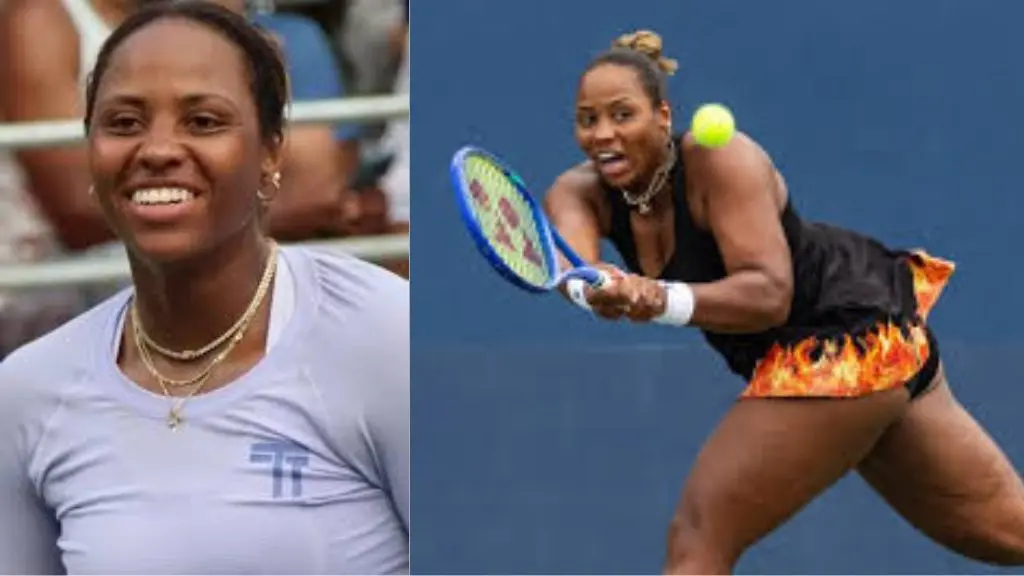
Taylor Townsend: From the South Side of Chicago to Grand Slam Champion, Single Mother, and One of Tennis’s Most Extraordinary Human Beings
Taylor Townsend: They told her she was too fat. They pulled her funding. They denied her a wildcard. They sent her to an eight-week fitness camp instead of the US Open. She was 16 years old and the number one junior tennis player in the world. This is the complete story of what happened next.
The Story Tennis Owes You
There are athletes whose stories are simply about sport. And then there are athletes whose stories are about something much larger — about race, about body image, about resilience, about the particular cruelty that institutions can inflict on young Black women who dare to be excellent in spaces that were not built for them.
Taylor Townsend is the second kind of athlete. Her story is about tennis, yes — about Grand Slam titles and world number one rankings and a playing style so distinctive and so joyful that it makes people fall in love with a sport all over again. But it is also about a girl from the South Side of Chicago who heard a mother say “look at her, she’s too big” when she was five years old and decided, somewhere in that moment, that she was not going to let the world’s opinion of her body determine the size of her life.
She has spent the last two decades proving that decision correct.
Taylor Townsend Early Life: Chicago and the Beginning of Everything
Taylor Townsend was born on April 16, 1996, in Chicago, Illinois, to Gary and Sheila Townsend.
Her parents are Gary Townsend and Sheila Townsend. Both work as high-school administrators, and her mother has also worked as a banker.
The South Side of Chicago — where Taylor grew up — is one of the most storied and most misunderstood neighborhoods in America. It is a place of extraordinary cultural richness, of deep community bonds, of music and art and basketball courts and corner stores, and also of the particular pressures that come with being Black and working-class in a country that has never quite decided what to do with either of those things. Taylor Townsend absorbed all of it — the warmth and the weight of the South Side — and it shaped her into someone who could not be broken, no matter what the tennis world later tried.
Townsend started playing tennis at the age of six and was one of the first junior players to participate in the XS Tennis program run by Kamau Murray — better known for coaching Sloane Stephens to a Grand Slam title.
She has an older sister, Symone, who was also a tennis player at the college level. In her Players Tribune essay, Taylor described chasing Symone relentlessly — her big sister beating her year after year, Big Sistering the life out of her on the court, and how that pursuit shaped the competitor she became.
Her parents got divorced when she was 12 years old. That loss — of the family unit she had known — arrived right in the middle of the years when she was beginning to understand herself as a tennis player and as a person. She has spoken about it with characteristic honesty and warmth, noting that she received messages from other young people dealing with parental divorce after she discussed it publicly.
The Journey to the Top of Junior Tennis: From Atlanta to Boca Raton to the World
When Townsend was eight years old, she moved to Atlanta to continue training with Donald Young’s father. Townsend’s mother is a close friend of Donald Young Sr., as they grew up together on the South Side of Chicago, where they trained at the same tennis center. At age 14, Townsend moved to Boca Raton, Florida, to join the USTA development program.
The moves — from Chicago to Atlanta to Boca Raton — chart the geography of a family that was willing to uproot itself repeatedly in pursuit of a daughter’s dream. That kind of sacrifice is rarely acknowledged loudly enough in sports narratives. Behind every junior champion is a family that moved cities, stretched budgets, reorganized everything around a racket and a belief.
What Taylor Townsend accomplished in juniors was nothing short of historic. As a junior, Townsend was named the ITF Junior World Champion in 2012 for finishing the year No. 1 in the girls’ rankings, making her the first American to do so since 1982. It came after she won the 2012 Australian Open titles in both girls’ singles and doubles, as well as the Wimbledon and US Open doubles titles.
She became the first American to sweep both singles and doubles events at a junior Slam since Davenport in 1992.
She was 16 years old. She was number one in the world. She had won junior Grand Slams on three different surfaces. She was, by every objective measure, one of the most talented young tennis players America had produced in a generation. And then the USTA decided she was too fat to play.
The USTA Betrayal: The Wound That Never Fully Healed
This is the chapter of Taylor Townsend’s story that matters most — not because it defines her, but because it almost ended her, and because understanding what happened illuminates everything about the systemic cruelty that young Black women encounter in sports.
“It was an official from the USTA. They said, ‘Taylor, you need to come to Florida. We’re putting you on an eight-week block of fitness training.’ I didn’t even have to do the math. I heard ‘eight weeks’ and my stomach just dropped. Eight weeks meant missing the U.S. Open,” she wrote in her Players Tribune essay.
She was the number one junior in the world. She had just won three junior Grand Slams. And she was being sent to a fitness camp instead of a wildcard into the US Open main draw. “This wasn’t the first time my fitness had come up. But I was still getting results where it mattered most. 2012 Australian Open juniors in singles and doubles. 2012 Wimbledon juniors in doubles. I was still winning grand slams,” she wrote.
What made the situation even more painful was that during this period, there was a medical explanation for some of her physical condition that the USTA either missed or ignored. She wrote that she had been under serious cardiovascular stress for an unknown period of time, had been playing sick, and that discovering this was “scary but also a relief. It’s not a fitness thing. It’s a health thing.”
Even after she informed the USTA of her diagnosis, the decision did not change. “They still said no. They couldn’t stop me from playing juniors — I’d qualified automatically with my ranking — but they were like, ‘Yeah, no main draw. We’re not giving you a wild card. It’s like we told you: You’re simply not fit to play,'” she recalled.
When the USTA decided not to fund Townsend’s expenses to compete at the 2012 US Open, Murray and XS Tennis organized a fundraiser to cover nearly $1,000 of the cost of the trip. She paid her own way. She played the juniors — because they could not take that from her. And she reached the quarterfinals in singles and won in doubles, lifting a US Open trophy on Arthur Ashe Stadium with a mouth full of braces, after everything that had been done to try to stop her.
She wrote later: “They punished me. They took away something I’d earned. I was fat, and I was black, so they took away my dream. Or at least they tried.”
She described her determination to never be humiliated again: “I decided I wasn’t gonna let myself be embarrassed anymore — I wasn’t gonna let myself be humiliated by this rich, white tennis world that I had spent my entire childhood scraping and crawling and bending over backwards to fit into.”
The Professional Career: A Long, Winding, Triumphant Road
Townsend turned professional by the end of 2012 and in 2014, she broke through on the ITF Women’s World Tennis Tour, after winning two titles. Her achievements ensured her top 100 singles debut in 2015.
The professional road was not a straight line upward. It was exactly the kind of career that requires a person to love the work more than the results — because the results, for years, were frustratingly inconsistent.
She posted her best year-end finish at No. 74 in 2018, up from No. 105 in 2017, and reached a career-high singles ranking of No. 61 in June 2018.
But it was in doubles that something extraordinary began to emerge. Known as one of the WTA Tour’s few players to frequently employ serve-and-volley tactics in her gameplay, Townsend built a doubles game of genuine distinction. Her instincts at the net — the fearlessness, the anticipation, the timing — made her a doubles partner that serious players wanted, and the results eventually reflected that.
Following her return to the sport in 2022 after maternity leave, she reached her first major final at the 2022 US Open.
And then, in 2024 and 2025, everything that had been building for a decade arrived simultaneously. Townsend won two major doubles titles — at the 2024 Wimbledon Championships and the 2025 Australian Open, both with Kateřina Siniaková.
She became a former WTA world No. 1 in doubles, achieved on 28 July 2025.
The woman they tried to send to a fitness camp instead of the US Open became the number one doubles player in the world. Let that land.
LIVE – Al Jazeera English | Watch 24/7 Global News Coverage Online
The Ostapenko Incident: When the World Finally Took Notice
The 2025 US Open introduced Taylor Townsend to a global audience that had not yet been paying attention — and it did so through one of the most disgraceful moments in recent tennis history.
After losing to Townsend, Latvian player Jelena Ostapenko made public comments stating that her opponent had “no education” and “no class” — remarks that were widely condemned as racist and that sparked an immediate, furious response across the sports world.
Said Coco Gauff, who is Black: “Knowing Taylor personally, she’s the opposite of that. She’s one of the nicest people that I’ve ever met. Whenever I’ve had a tough moment on court, she’s texting me, making sure, checking in on how I am. So yeah, I really hate to see that. Maybe this is some of the first people hearing who Taylor Townsend is, and I don’t want that to be the main focus of who she is, because she’s a lot more than that. She’s a mom. She’s a great friend. She’s a talented tennis player and a good person.”
Townsend herself responded with exactly the grace and fire that has defined her entire career. “You know, that has been a stigma in our community — of being ‘not educated’ and all of the things — when it’s the furthest thing from the truth. It’s OK to stand up for yourself. It’s OK to stand up and call people out,” she said. Then she went back on court and beat the fifth seed to advance to the fourth round.
She walked out of Louis Armstrong court in tears after a heartbreaking loss, and the crowd chanted: “Let’s go, Taylor! Let’s go, Taylor!”
Son Adyn Aubrey: Motherhood as the Greatest Transformation
Taylor gave birth to her son Adyn Aubrey on March 14, 2021.
She has chosen to keep the identity of her son’s father private and has not publicly disclosed details about a partner or relationship. What she has shared, generously and repeatedly, is what motherhood has meant to her — and what it demanded of her.
“When I found out that I was pregnant with my son, one of the things I realized was how much like generational trauma that existed within me. So I was like, it’s COVID, f— it. I’m unpacking because I don’t want to pour anything else on this young black boy, this new soul. He’s already going to have to deal with so much; I don’t want to add to it with my sh-t that I’m not dealing with unconsciously,” she said.
That act of deliberate self-examination — choosing to confront and dismantle generational trauma specifically because she did not want to pass it to her child — is one of the most profound things any parent can do. It is also extraordinarily difficult. Townsend acknowledged that letting go of this trauma allowed her to recognize that the critical voices in her head were not her own but those of her mother, grandmother, and others who had judged her based on her weight.
He asks her constantly, “How many days? How many days?” She has said: “The older he gets, the harder it is, because he understands.”
She has also spoken about the fact that motherhood gave her a perspective that fundamentally changed her relationship with winning and losing. She has said there is “something bigger than tennis” for her now — and that wins and losses matter, but not in isolation.
The Person Beyond the Player: Who Taylor Townsend Actually Is
Taylor Townsend loves music and dancing. She is left-handed. She played violin for two years. She started playing tennis right-handed and switched to left-handed. She has a dog named Sochi and a cat named Gilligan.
“I’m a 16-year-old girl from the south side of Chicago. I’m a Wiz Khalifa stan, my favorite athlete is Martina Navratilova, and I like to dance,” she wrote with characteristic humor and specificity in her Players Tribune essay.
The person she most wants to meet is Beyoncé.
These details are not trivial. They are the portrait of a person — not a brand, not a marketing construct, but an actual human being with favorite artists and rescue pets and a violin phase she eventually gave up and a deep love of dancing. Taylor Townsend has never pretended to be anything other than exactly who she is, and in a sports culture that often demands athletes minimize their personalities in favor of their statistics, that refusal to disappear is itself a radical act.
She has described herself as “thick and Black and proud and excellent.” Those four words — in that order — are the most accurate summary of Taylor Townsend that exists.
The Legacy She Is Building
Townsend wrote in her Players Tribune essay: “America hating fat Black women — it’s just part of life. It’s in the culture. It’s in the health-care system. You see it in Hollywood, you see it in sports.”
She wrote those words not to despair but to name a reality clearly — and in naming it, to begin dismantling it. Her essay sparked conversations about body image, race, and gatekeeping in tennis that are still happening. Her presence at the top of the WTA doubles rankings — her Wimbledon title, her Australian Open title, her world number one ranking — is a rebuttal written in trophies to everyone who ever told her she did not fit the mold.
She has said: “My purpose in tennis is to leave a legacy.” And from a career-high singles ranking of No. 46, to two Grand Slam doubles titles, to the loudest “Let’s go, Taylor” chant in recent US Open memory, that legacy is already written.
She is 29 years old. She is a Grand Slam champion. She is the former world number one. She is a single mother raising a five-year-old boy she is determined to raise free from the generational trauma she has spent years unpacking. She is a South Side girl who scratched and clawed her way into a world that did not want her — and then won it.
All she ever wanted, she wrote, was to play tennis. And the way she has played it — with joy, with fury, with grace, with honesty, with her whole entire self — is one of the great stories in the sport.
Taylor Townsend at a Glance
| Full Name | Taylor Townsend |
| Born | April 16, 1996 |
| Age | 29 |
| Birthplace | Chicago, Illinois |
| Raised | South Side of Chicago |
| Height | 5’7″ (1.70m) |
| Playing Hand | Left (started right-handed) |
| Parents | Gary and Sheila Townsend — both school administrators |
| Siblings | Older sister Symone |
| Son | Adyn Aubrey — born March 14, 2021 |
| Pets | Dog (Sochi) and cat (Gilligan) |
| Tennis Idol | Martina Navratilova |
| Celebrity She Wants to Meet | Beyoncé |
| Hobbies | Music, dancing, played violin for two years |
| Career High Singles Ranking | No. 46 (August 2024) |
| Career High Doubles Ranking | No. 1 (July 28, 2025) |
| Grand Slam Doubles Titles | 2024 Wimbledon, 2025 Australian Open (both w/ Siniaková) |
| Coach (former) | John Williams (parted ways late 2025) |
| Estimated Net Worth | $3 million — $4 million |
| Career Prize Money | $3.7 million+ |