
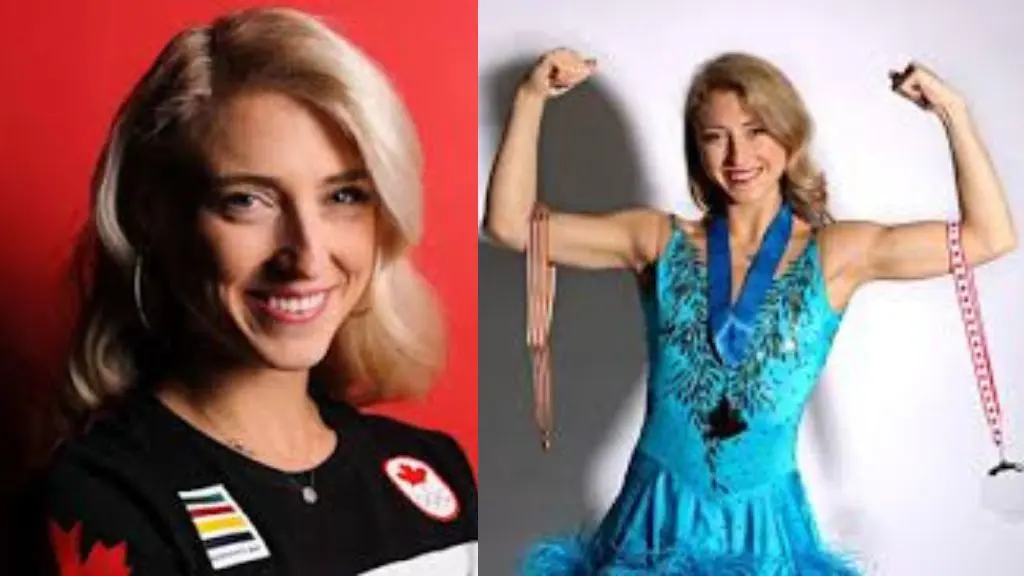
Piper Gilles: A Complete Life Story — The Ice Dancer Who Skated Through Everything
Born January 16, 1992, Rockford, Illinois
There are athletes who win medals. There are athletes who inspire. And then, very rarely, there are athletes who do both — not because winning and inspiring exist in the same space, but because the path they walked to the podium was so honest, so hard, and so full of the things that actually happen to people — loss, illness, reinvention, grief — that the medal itself becomes almost secondary to the story behind it.
Piper Gilles is that kind of athlete.
On February 11, 2026 — the same day this biography was being researched — Piper Gilles and her skating partner Paul Poirier stood on the Olympic podium in Milan, Italy, and received bronze medals in ice dance at the Milano Cortina 2026 Winter Olympic Games. It was their third Olympics together. It was their first Olympic medal. And the tears that came — from both of them, from the crowd inside the Milano Ice Skating Arena, from viewers watching in Canada and around the world — were not merely about a score. They were about everything the score represented: a mother’s death, a cancer diagnosis on a birthday, a hockey-stick-shaped trajectory through 15 years of elite sport, and the stubborn refusal of two people to let any of it stop them.
This is the complete story of Piper Gilles — from a figure skating family in Rockford, Illinois, to the Olympic podium in Milan.
Piper Gilles Early Life: Rockford, Illinois and a Family of Skaters
Piper Renae Gilles was born on January 16, 1992, in Rockford, Illinois — a city of roughly 150,000 people in Winnebago County, in the northwest corner of the state. She was born into a family for whom figure skating was not merely a hobby or a weekend activity but a way of life.
Her older brother Todd Gilles was the first member of the family to begin skating competitively, and his entry into the sport effectively opened the door for the rest of the family. Piper’s parents encouraged the children to follow, and all of them did. Her father would build an ice rink in the backyard every winter so the children could skate at home, a ritual of preparation and play that Piper has cited as one of her most formative early memories.
She entered her first competition at the age of five.
Piper also has a twin sister, Alexe Gilles, who became a serious competitive figure skater in her own right. Alexe would go on to become the United States Junior Ladies National Champion in 2008 — a remarkable achievement that placed the twins in the unusual position of both being nationally competitive in their respective disciplines at the same time. Alexe competed internationally until 2010. Todd, equally ambitious, became a competitive ice dancer who represented the United States internationally until 2011.
The Gilles family was, by any measure, one of the most seriously skating-focused families in American figure skating history — three siblings all competing at national and international levels simultaneously, all supported by parents who sacrificed enormously to make it possible.
At the center of it all was Piper’s mother, Bonnie Gilles. She was the woman who drove Piper to the rink before dawn. She was the one who sat in bleachers through the cold and the waiting. She was the one who, most beautifully, helped Piper design her skating costumes — a creative bond that the two of them built into one of the central rituals of their relationship. They would spend hours at the seamstress together, doing fittings, selecting fabrics, stoning costumes by hand, and flipping through fashion magazines for inspiration. Bonnie had a gift for making small things feel enormous and memorable.
And she always sewed a tiny gold ladybug into each of Piper’s costumes — a secret charm for good luck that traveled with her daughter onto every ice surface in the world.
Ali Wong and Bill Hader Walked Away with Respect, Friendship, and Grace
Moving to Colorado: Training at the Broadmoor Skating Club
As Piper’s talent became increasingly apparent and the competitive ambition of the family deepened, the decision was made to pursue a training environment befitting her ability. The family relocated from Rockford to Colorado Springs, Colorado, so that Piper could train at the prestigious Broadmoor Skating Club — one of the premier figure skating training facilities in the United States, situated at the foot of Pikes Peak and with a history of producing world-class skaters.
She attended Cheyenne Mountain High School in Colorado Springs — a school known for its strong academic and extracurricular programming — while training seriously. The combination of competitive skating at the Broadmoor and the educational demands of high school required the kind of time management and discipline that, in retrospect, was preparing her for the professional life to come.
Her coaches at Broadmoor included some of the most respected names in ice dance: Patti Gottwein, Christopher Dean (yes, the legendary British ice dancer of Torvill and Dean), and Rich Griffin.
It was at the Broadmoor that she formed her first serious ice dance partnership.
Timothy McKernan (2003–2008): First Partnership and Junior Grand Prix Success
Piper Gilles formed her first competitive ice dance partnership with Timothy McKernan in 2003, representing the United States. The pair trained primarily in Colorado Springs and achieved notable success at the junior level over their five seasons together, winning four medals on the ISU Junior Grand Prix series.
The Junior Grand Prix circuit is the primary development pathway for elite junior ice dancers in international skating, and earning four medals on it was a serious achievement that announced Piper as one of the most promising junior dancers of her generation.
The Break: Los Angeles, Simple Plan, and Almost Disney (2008–2011)
In 2008, Piper’s partnership with McKernan ended. She was 16. She was a nationally recognized ice dancer without a partner. And the process of finding a new partner at the elite level — a process that requires chemistry, compatibility, similar physical proportions, compatible skating skills, and mutual ambition — is far from simple or guaranteed.
With the likelihood of finding a new competitive partner unclear, and with the genuine possibility that her competitive career might be over before it had fully begun, Piper made a decision that speaks to both her practicality and her openness: she moved to Los Angeles to explore other opportunities.
In a brief but fascinating detour from elite sport, she appeared in a music video for the Canadian pop-rock band Simple Plan, for their song “Can’t Keep My Hands off You.” She was moving in entertainment circles, building a different kind of professional identity, testing whether the discipline and performance skills she had built on ice could translate into other worlds.
She was also offered a remarkable opportunity: the role of Rapunzel in Disney on Ice’s production of Tangled. A Disney on Ice Rapunzel role is not a minor thing — it means performing in major arenas across multiple countries, in front of enormous audiences of children and families, night after night. It is a serious professional position within the touring entertainment world.
Piper was on the verge of accepting the role and redirecting her life entirely. Then the phone rang.
Paul Poirier: The Partnership That Changed Everything (2011–Present)
Paul Poirier, a Canadian ice dancer from Unionville, Ontario, had just ended his own previous skating partnership with Vanessa Crone. He was looking for a partner. He had heard about Piper. He had seen her skate. He knew her history of Junior Grand Prix medals. He called her to arrange a tryout.
On July 27, 2011, after the tryout confirmed what Poirier had suspected — that their skating was compatible, their chemistry undeniable, and their potential significant — the two confirmed they had teamed up. Piper would now compete for Canada.
She moved to Toronto, away from Los Angeles, away from the Disney on Ice opportunity, away from everything she had been building in the absence of competition, and back to the rink. She began training at the Scarboro Figure Skating Club at the Ice Galaxy in Scarborough, Ontario, under coach Carol Lane.
The transition was not without complications. Their partnership’s first season was constrained by bureaucratic circumstances: Piper needed an official release from U.S. Figure Skating to compete internationally for Canada, and the process took time. They were unable to compete internationally in their first season together as a result. But even in those restricted early months, they were building something real — both competitively and personally.
They won the bronze medal at the 2012 Canadian Championships despite their ineligibility for international competition that season.
And their first free dance together had a significant pedigree: it was choreographed by Christopher Dean himself, in Colorado Springs — the same Christopher Dean who had been Piper’s coach at the Broadmoor years earlier, the same Christopher Dean who, with Jayne Torvill, had produced one of the most celebrated performances in ice dance history with their Bolero at the 1984 Sarajevo Olympics.
Is Milo Manheim Single or Secretly in Love? 💭💙Here’s What We Know—and What He’s Never Confirmed 👀
Canadian Citizenship (December 2013) and the Road to the Olympics
In December 2013, Piper Gilles was granted Canadian citizenship — a milestone that formalized what had been her competitive identity since 2011, and which opened the door to Olympic eligibility under the Canadian flag. The timing seemed to align perfectly for a first Olympic appearance at Sochi 2014. But the reality of competitive readiness intervened.
Paul Poirier had suffered a serious right ankle fracture and dislocation in spring 2013, requiring surgery and a significant recovery. Between his rehabilitation and the pair’s still-developing technical and artistic level, they were — as Piper would later put it — “not quite physically or technically ready” for the Sochi Olympics. They missed qualification for the Canadian Olympic team.
Missing Sochi fueled them. The 2013–2014 season ended with a silver medal at the Four Continents Championships — their first major international senior podium. The 2014–2015 season brought two Grand Prix silver medals and their first qualification for a Grand Prix Final. The 2015–2016 season brought further recognition when their partial step sequence from the short dance was adopted by the ISU as a new pattern dance, named the Maple Leaf March — a remarkable honor indicating that their creative contribution to ice dance was considered genuinely significant by the sport’s governing body.
Season by season, they were climbing.
The Loss of Bonnie Gilles: A Mother, a Legacy, and a Gold Ladybug
The build toward PyeongChang 2018 was shadowed by something that no athlete can train through: the illness and death of a parent.
Piper’s mother, Bonnie Gilles, had been diagnosed with glioblastoma — a form of aggressive, fast-growing brain cancer that is among the most devastating diagnoses in oncology. Glioblastoma is the most lethal of brain tumors, with a median survival of 14 to 16 months after diagnosis. Bonnie fought it for 15 months.
Throughout those months, Piper competed. She represented Canada internationally. She worked toward the Olympics. She carried the weight of her mother’s declining health and her own competitive obligations simultaneously — the kind of emotional compartmentalization that elite athletes perform and that nobody outside their world fully sees.
In February 2018, at the PyeongChang Winter Olympics in South Korea, Piper Gilles competed on the world’s largest sporting stage and finished eighth in ice dance — the best result of their career to that point, and a milestone achievement. She had done what 10-year-old Piper had dreamed of doing. She had made it to the Olympics and performed.
Her mother lived to see it. Bonnie Gilles watched her daughter compete at the Olympic Games.
On May 27, 2018 — just three months after PyeongChang — Bonnie Gilles died at the age of 63.
Piper wrote afterward: “As a mom, Bonnie was always there for me, supporting my dreams and eventually, my career. Helping me find my passion for fashion and costume design is something I will never forget. We used to spend hours at the seamstress, doing costume fittings, stoning costumes, and flipping through magazines. She had such a way of making something so small so memorable.”
The gold ladybug — the small charm Bonnie sewed into the hem of every costume — did not stop being part of Piper’s performance wardrobe after her mother’s death. If anything, it became more important. It traveled with her to every competition, an invisible companion from a woman who had always shown up.
“I fought to just live the life that she couldn’t see,” Gilles would say years later. “If she could see me and what I’m up to, she’d be proud. It just made me appreciate every moment in life.”
After her mother was gone, skating took on new meaning. She stopped shying away from strong emotions on the ice and began channeling them deliberately into her performances. The grief, the love, the loss — all of it became fuel.
Timothee Chalamet Dating History 2026: From Lourdes Leon to Kylie Jenner – All Girlfriends Revealed!
Building Toward Beijing 2022: Medals, Growth, and Resilience
The years between PyeongChang and Beijing were marked by steady, significant growth. Gilles and Poirier won back-to-back Canadian Championships titles, cementing their status as the dominant ice dance team in Canada. They earned medals at major international events with increasing consistency. At the 2021 World Championships, they won a bronze medal — their first World Championship podium and a major milestone in their partnership’s trajectory.
They had developed a reputation as one of the most artistically ambitious teams in international ice dance — teams not content to execute technically well but insisting on storytelling, emotional depth, and genuine creative risk in every program. In an era dominated by the technical perfection of Virtue and Moir and the athletic power of Chock and Bates, Gilles and Poirier carved their identity through creativity and artistic integrity.
Their step sequence from the 2015–16 season had already been enshrined as a pattern dance by the ISU. Their programs drew on literary, musical, and cinematic references — Wuthering Heights, Don Quixote, Greek mythology — and they worked with some of the most respected choreographers in the sport.
At the Beijing 2022 Winter Olympics, they competed in their second Olympic Games together, finishing seventh in ice dance and fourth in the team event — narrowly missing the podium in both. Canada finished fourth in the team event despite a strong showing from Gilles and Poirier. Another near-miss. Another Olympics without a medal.
But they won their second Canadian Championship title that year and carried a top-five finish at the 2022 World Championships. The pieces were in place for what would come next.
October 2022: The Nausea, the Pain, and the Diagnosis
In October 2022, heading into the first Grand Prix event of the 2022–23 season, Piper began feeling persistently unwell. She was tired in a way that didn’t respond to rest. She was nauseous. She had pain — a throbbing ache in her left side that initially felt like competition nerves but didn’t resolve.
“I thought it was normal competition jitters, but when it persisted and I started to feel a throbbing pain in my left side, I went to the doctor.”
What followed was a cascade of medical investigation. Elevated antigen levels were detected in blood work in late 2022, pointing toward something that needed surgical examination.
On December 19, 2022, Piper underwent surgery. Surgeons removed her left ovary, which contained a 3-centimeter tumor, along with her appendix as a precautionary measure. She was recovering from surgery, bandaged and in pain, when she had to wait for the biopsy results that would tell her whether she was facing something manageable or something devastating.
On January 16, 2023 — her 31st birthday — the biopsy results came back.
“When I got the news, I was lying in bed alone, and I started bawling. I had no idea if I would have to do chemotherapy or how the diagnosis would impact my skating.”
The diagnosis was Stage 1 ovarian cancer. The tumor was confined to the ovary. There was no evidence of spread. She would not require chemotherapy. But she had cancer. The woman who had already watched her mother die of cancer had cancer herself.
She has said, with remarkable clarity, what that coincidence felt like: “To experience my mom’s cancer battle and my cancer battle — I think I fought for her to live the life that she couldn’t see.”
Recovery, Return, and the Road Back (2023)
Gilles and Poirier withdrew from the 2023 Canadian Championships and the 2023 Four Continents Championships while Piper recovered from surgery and processed the diagnosis. They missed roughly two months of competition.
In late March 2023, she returned to competitive ice. Her body had been through surgery. She was still healing. The cancer had been caught early and treated, but the physical and emotional recovery from both the surgery and the diagnosis took far longer than any timeline she might have set for herself.
“It took about two and a half years for me to feel like myself,” she has said. “What I’ve learned was I had to be a little bit more patient with myself — I couldn’t expect myself to be 100 percent Piper, ’cause that 100 percent Piper isn’t there anymore.”
But she returned. At the 2023 World Championships, competing in their first major international event after the cancer interruption, Gilles and Poirier won the bronze medal — their second World Championship podium.
She was cancer free. She was back on the podium. She was skating for her mother.
The Grand Prix Final Gold (December 2023): The Highest Moment
The 2023–24 season brought the highest competitive achievement of their partnership to that point. As the top seed, Gilles and Poirier entered the Grand Prix Final in Turin as the presumptive favourites. They finished first in the rhythm dance and won the free dance as well, taking the gold medal — the most significant victory of their careers thus far, and the first Grand Prix Final victory for any Canadian competitor since Virtue and Moir in 2016.
Gilles would later recall this as “probably the highest moment in my life” to that point.
It was followed in February 2024 by a gold medal at the Four Continents Championships in Shanghai — their first Four Continents title, which Poirier called “a big milestone in our career.” And then came the 2024 World Championships, held in Montreal — the second home World Championships of their careers together, which they described as “a full-circle moment.” They won the silver medal, finishing behind Chock and Bates.
Their medal count was growing. Their legacy was being written.
The 2025 Season: World Silver Again and Setting the Table for Milan
The 2024–25 season continued the pattern. Gilles and Poirier won the 2025 Canadian Figure Skating Championships — their fifth national title. They won gold at the 2025 Four Continents Championships. At the 2025 World Championships, they won silver again — their second consecutive World silver — finishing behind Chock and Bates.
They entered the Milan-Cortina Olympic season as the second-ranked ice dance team in the world. The question was whether a third Olympics would finally bring them the podium that had eluded them in Pyeongchang and Beijing.
Glitter & Gold: Ice Dancing (Netflix, 2025–2026)
In the lead-up to Milan, Netflix released Glitter & Gold: Ice Dancing, a documentary series following Gilles and Poirier’s preparations for the 2026 Games. The three-episode docuseries became required viewing for anyone wanting to understand what the team had been through — the cancer, the grief, the decade and a half of near-misses — and what was driving them toward one final Olympic push.
In the documentary, Piper confirmed what she had been building toward publicly: “I’m doing well, like, I’m currently cancer-free.”
She spoke directly to camera about the connection between her mother’s cancer battle and her own: about fighting not just for herself but for the life her mother never got to see her live. The documentary was simultaneously a sports film and a meditation on grief, resilience, and what it means to keep going when the world has tried to stop you.
Reflecting on both her mother’s cancer battle and her own, Gilles said: “I think I fought for her to live the life that she couldn’t see. If she could see me, she would be proud. It made me appreciate every moment in life.”
February 11, 2026: The Olympic Bronze Medal — Milan
On February 9, 2026, the rhythm dance at the Milano Cortina 2026 Winter Olympic Games placed Gilles and Poirier in third position — just 0.71 points ahead of Great Britain’s Lilah Fear and Lewis Gibson. The margin was razor thin. The bronze medal position was theirs to lose.
The free dance, held on February 11, 2026, would determine everything.
They chose this season to go back to a free dance they had first used in the 2018–19 season, performed to the song “Vincent” — about Vincent van Gogh, inspired by Don McLean’s “Starry, Starry Night.” It had emotional resonance for them that no new program could match.
The British team skated before them. Fear made an obvious, visible mistake on their twizzle sequence — the audience gasped. Britain’s score: 204.32. The bronze medal was Gilles and Poirier’s to claim.
They skated onto the ice wearing costumes that reflected the night sky — Piper in a light blue dress with golden circles echoing Van Gogh’s Starry Night. They had performed this program dozens of times. But this was the Olympic Games. Their third and final Olympic appearance.
They were, in Poirier’s word, calm.
“Piper and I both felt so calm today, which was a little bit strange actually going into a competition of these stakes,” Poirier said afterward. “We really allowed ourselves to be vulnerable today and to just say: this is who we are, this is what we do. Here you go.”
What they produced was, by the unanimous verdict of everyone watching, the skate of their lives. As they entered their final spin after a flawless performance, many inside the Milano Ice Skating Arena were already on their feet. Their score: 217.74 — a season’s best, eight points ahead of the fourth-place Italian team.
They both cried. The crowd cried. The emotion that flooded out when they finished was the accumulation of everything — a mother’s death, a cancer diagnosis, 15 years of skating together, three Olympic Games, and the stubborn refusal to let any of it stop them.
France’s Cizeron and Fournier Beaudry ultimately won gold (225.82). The USA’s Chock and Bates won silver (224.39). Canada’s Gilles and Poirier stood on the Olympic podium for the first time with bronze (217.74).
At the press conference afterward, Gilles said: “Three years ago, when I was diagnosed with ovarian cancer, I don’t think I envisioned this moment. I think that’s what’s so amazing about Paul and I. We are people first, athletes second, and I think we’ve always led by that.”
“I think it’s a great example for anybody going through any sort of dark time, mental health or health issues, that you can do hard things no matter what,” she added.
“We’re so proud of ourselves,” Gilles told CBC Sports. “It was exactly what we had planned it to be, and I don’t know — I wish we could relive it, like three times so I could remember piece by piece, but what a moment we created.”
It was, in the words of the Team Canada official website, Canada’s fifth Olympic medal all-time in ice dance and the first since Virtue and Moir’s gold at PyeongChang 2018.
Nathan Kelly: Love Found in Grief
Piper Gilles’s personal life, away from the rink, found its center in a man she had not been looking for.
In 2018 — the year her mother died, the year of the PyeongChang Olympics — she met Nathan Kelly. He was a former professional race car driver who had since transitioned to a career as a photographer and videographer. Their meeting was not through skating circles or mutual industry contacts but through what can only be described as the unexpected way that people find each other.
Gilles later said she had been “expecting a 55-year-old guy” before realizing the person walking toward her was a peer, not a patron. That shift — from professional expectation to personal surprise — was the beginning of everything.
What drew them together, perhaps more than anything else, was a shared experience of loss. Gilles’s mother had died in 2018. Kelly’s father had died six years earlier in 2012 after his own cancer battle. “We connected on so many different levels, including grief, which is not something anyone should be going through so early on in a relationship,” Gilles told Hello! Canada. “This life-altering moment brought us closer. He could deal with me and empathize and he truly understood grief. It drew me to him.”
They dated for four years. In 2022, they were married — quietly, away from the public skating narrative that dominated coverage of Piper’s life.
Nathan Kelly does not skate. He is not part of the skating world. He sits in the stands, watches, supports, and takes photographs. “I love to see her compete,” he told Hello! Canada in 2024. “I’m definitely planning to be at the Olympics to support her. It’s such an important moment in her life, and I wouldn’t want to miss it.”
He was in Milan.
The Gilles Family Skating Legacy
Piper Gilles belongs to perhaps the most comprehensively skating-focused family in American skating history:
Todd Gilles — older brother, competitive ice dancer who represented the United States internationally until 2011.
Alexe Gilles — twin sister, competitive singles skater who was the United States Junior Ladies National Champion in 2008 and competed internationally until 2010.
Piper Gilles — the youngest to reach the highest level, winning Olympic bronze in 2026 as a representative of Canada.
Three siblings, three competitive international careers, one family.
Competitive Record: The Complete Picture
Piper Gilles’s competitive record spans three countries, two disciplines (competing as both a singles and ice dance skater in her early years), and more than two decades:
Under U.S. Figure Skating with Timothy McKernan (2003–2008): Four medals on the ISU Junior Grand Prix series, establishing her as a top junior dancer.
Under U.S. Figure Skating with Zachary Donohue (2008–2011): Continued junior-level competition and development.
Under Skate Canada with Paul Poirier (2011–2026): Five-time Canadian Ice Dance Champion. Four-time World Championship medallist (bronze 2021, silver 2024, silver 2025, plus bronze 2023). Grand Prix Final gold (2023). Four Continents gold (2024, 2025). Two-time Olympian (PyeongChang 2018 — 8th; Beijing 2022 — 7th). Olympic bronze medallist, Milan 2026.
Fashion, Design, and Life Beyond the Ice
Piper Gilles is not only an athlete. She has pursued interests and studies that reflect the full scope of who she is as a person.
She has taken courses in Creative Industries at Ryerson University (now Toronto Metropolitan University) — a program that encompasses design, media, and creative business. She has a genuine passion for fashion, regularly attending fashion shows, and has expressed the ambition to eventually design her own line of sports clothing and create costumes for other skaters. The hours she spent with her mother at the seamstress, stoning costumes and flipping through magazines, were not merely childhood memories — they planted a professional seed.
Her skating costumes themselves have always been notable for their visual sophistication and thematic integration. The Starry Night dress she wore at the Milan Olympics — light blue with golden circles, echoing Van Gogh’s most famous painting and connecting to the program’s “Vincent” theme — was a perfect example of how she thinks about the relationship between visual design and performance meaning.
Her role models in skating have always been Jayne Torvill and Christopher Dean — the British ice dancers whose Bolero performance at the 1984 Sarajevo Olympics remains the gold standard of the form — because, as Piper has put it, they “tested the sport with their creativity and strength,” something she and Poirier have always tried to emulate.
Her personal philosophy, which she has offered as her favorite motto, is simple: “Life is too short to not walk amongst the daisies.”
Advocacy: Brain Tumour Foundation of Canada and Ovarian Cancer Awareness
Following the death of her mother from glioblastoma, Piper became the National Spokesperson for the Brain Tumour Foundation of Canada, participating in the 2019 Annual Brain Tumour Walk in Toronto and serving as the face of the 2019 Hats for Hope campaign. She has used her public profile to raise awareness and funding for research into brain tumors — a cause that is deeply personal and that she has approached with the same commitment she brings to her skating.
Her own ovarian cancer diagnosis in 2022–23 added a second advocacy dimension to her public voice. She has spoken openly about the experience of being diagnosed young, about the importance of listening to your body, and about the specific symptoms — persistent nausea, pelvic pain, the feeling that something is wrong even when you can’t quite identify what — that led her to seek medical attention before the cancer could progress.
She has said, with characteristic directness: “For anybody going through any kind of dark time — if you can just get out of bed and keep believing in yourself, anything can happen.”
Who Is Piper Gilles Today?
As of February 13, 2026 — today — Piper Gilles is 34 years old. She is an Olympic bronze medallist, two days removed from the most significant performance of her skating career. She is the five-time Canadian ice dance champion. She is a four-time World Championship medallist. She is the wife of Nathan Kelly. She is the daughter of Bonnie Gilles, who sewed a gold ladybug into every costume and never missed a competition and died knowing she had watched her daughter compete at the Olympic Games.
She skated in Milan wearing a gold ladybug she couldn’t see. She always does.
After the free dance in Milan, when the cameras were pointed elsewhere and the formal press conferences were winding down, Paul Poirier said something to reporters that served as the most honest possible summary of what Gilles and Poirier had built over 15 years: “I think a lot of the feeling that’s coming out now just comes from that accumulation of everything we had to just push through and push past and believe that we could overcome that. I think it was just so special that we could have a skate like that on Olympic ice.”
Fifteen years. Two Olympic Games without a medal. A mother’s death. A cancer diagnosis on a birthday. A partnership between two people who, by the evidence of their performances and their tearful embrace at the end of their final skate, genuinely love each other — as artists, as partners, as humans who have been through the wringer together.
They pushed through. They skated “Vincent.” The crowd was on its feet before the music ended.
They got the medal.
Piper Gilles is an Olympic bronze medallist, five-time Canadian ice dance champion, and National Spokesperson for the Brain Tumour Foundation of Canada. She skates with partner Paul Poirier, representing Canada. She is married to Nathan Kelly and lives in Toronto, Ontario. All three episodes of Glitter & Gold: Ice Dancing are now streaming on Netflix.