Michigan Tornadoes Kill Four, Injure More Than a Dozen: Deaths, Destruction, Witnesses, and What Comes Next
On Friday afternoon, March 6, 2026, the sky above southwest Michigan changed color and the ground began to shake. A line of severe storms that meteorologists had been tracking since early that morning produced at least two confirmed tornadoes — and a possible third — that tore through three counties in the span of less than two hours.
In Union City, a tornado struck Union Lake and destroyed homes along the shoreline like they were made of paper. In Three Rivers, a twister ripped the roof off a Menards hardware store while customers and employees scrambled for their lives inside.
In Edwardsburg, a tornado cut a path from Conrad Road to M-62, destroying homes and pole barns and blocking roads with debris. When the storms cleared, four people were dead, more than a dozen were injured, thousands were without power, and the State Emergency Operations Center in Lansing was activated. This is the complete story of what happened.
Michigan Tornado Outbreak March 6, 2026 at a Glance
| Date | Friday, March 6, 2026 |
| Time of First Tornado | Approximately 3:15 p.m. — Cass County/Edwardsburg |
| Time of Three Rivers Tornado | 3:52 p.m. — US-131, Three Rivers |
| Time of Union City Tornado | Shortly after 4:30 p.m. — Union Lake area |
| Total Deaths | 4 confirmed |
| Deaths by County | Branch County (Union City): 3 / Cass County (Edwardsburg): 1 |
| Total Injured | 12+ confirmed — 3 hospitalized |
| Counties Affected | Branch County, Cass County, St. Joseph County |
| Cities/Communities Hit | Union City, Three Rivers, Edwardsburg |
| Number of Tornado Warnings | 10 issued by NWS starting 3:15 p.m. |
| Confirmed Tornadoes | At least 2 confirmed — possible 3rd in St. Joseph County |
| Major Structural Damage | Menards Three Rivers — roof collapsed; Dollar Tree destroyed; homes with walls and roofs torn off; hospital campus damaged |
| Hospital | Three Rivers Health Hospital — damaged, remained open; no staff/patient injuries |
| Power Outages — Indiana Michigan Power | 5,500+ customers without power |
| Power Outages — Consumers Energy | 3,000+ customers without power |
| Total Power Outages | 8,500+ customers combined |
| Consumers Energy Response | Mobile command center deployed to Union City |
| Red Cross Shelter | Riverside Church, 207 E. Michigan Ave., Three Rivers |
| Assistance Line | Dial 211 for unmet needs (shelter, food, assistance) |
| State Response | Gov. Whitmer activated State Emergency Operations Center |
| State Coordinating Agency | Michigan State Police Emergency Management and Homeland Security Division |
| County Sheriff — Branch | Fred Blankenship |
| County Sheriff — Cass | Clint Roach |
| Victim Names | Not yet released — next of kin notification ongoing |
| Storm Duration | More than 3 hours across southwest Michigan |
| Tornado Season Context | Unusually early — March tornadoes uncommon in Michigan |
| Emergency Contact | 911 for anyone unaccounted for |
Union City, Michigan Tornadoes
Four people were killed and 12 others injured when tornadoes ripped through southwest Michigan Friday afternoon, according to the sheriffs in Branch and Cass counties.
In southwest Michigan, the news was local and devastating: multiple tornadoes in a state that does not typically see major tornado activity in early March, striking communities that were not prepared for the particular violence of a late-winter twister.
The National Weather Service issued 10 tornado warnings starting at 3:15 p.m. The line of storms that spawned the tornadoes churned across the state for more than three hours.
Three hours of warnings. Ten tornado warnings in one afternoon. The system that produced them was not a brief, isolated event — it was a sustained severe weather outbreak that tracked across an entire region of Michigan, producing destruction at multiple points along its path and leaving four families without someone they loved.
Governor Gretchen Whitmer activated the State Emergency Operations Center to coordinate an all-hands-on-deck response to severe weather in Branch, Cass and St. Joseph counties. “Tonight, I am activating our State Emergency Operations Center to coordinate an all-hands-on-deck response to severe weather in southwestern Michigan,” Whitmer said in a statement. “By taking this action, we can ensure the state can monitor and respond to local requests. I want to thank all the first responders on the ground who reacted quickly to keep Michiganders safe.”
This is the complete story of those three hours, those four deaths, and the communities that are picking up the pieces.
Part One: Where Is Union City, Michigan?
Understanding the Geography of the Disaster
To understand what happened on March 6, 2026, you first need to understand the geography of southwest Michigan — a region that most Americans outside the Great Lakes area know primarily through its proximity to Lake Michigan and the city of Kalamazoo.
Union City is a small village in Branch County, Michigan — located approximately 100 miles west of Detroit and roughly 30 miles southeast of Kalamazoo. It sits in a rural part of southwest Michigan characterized by agricultural land, small lakes, tight-knit communities, and the particular quietness of a place where people know their neighbors and leave their doors unlocked.
Union Lake — the body of water west of Union City where the tornado did its worst damage on March 6 — is a small inland lake surrounded by residential properties. The homes along Union Lake are a mix of year-round residences and seasonal cottages — modest family homes built close to the water, with the kinds of large windows and lakeside decks that make lake living beautiful in the summer and that offer no protection whatsoever against a tornado.
Three Rivers is the county seat of St. Joseph County, located approximately 25 miles southwest of Kalamazoo. It sits along U.S. Highway 131 — one of the main north-south arteries of southwest Michigan — which is precisely where the most dramatic video footage of the March 6 tornadoes was captured.
Edwardsburg is in Cass County, in the extreme southwestern corner of Michigan near the Indiana state line. It is a small community that sits at the intersection of several rural roads and Michigan highways — the kind of place where a tornado’s damage is felt across a wide swath of farmland and scattered residential properties.
Together, these three communities tell the story of a tornado outbreak that tracked northeast across multiple counties, leaving a trail of destruction that covered dozens of miles.
March Tornadoes: Unusual But Not Unprecedented
The most immediately striking aspect of the March 6, 2026 tornado outbreak is its timing. March is early for significant tornado activity in Michigan — a state that sits north of the traditional Tornado Alley and that typically sees its most active severe weather season in May and June.
Early March tornadoes in Michigan are not unprecedented, but they are uncommon enough that many residents were caught genuinely off-guard by the speed and severity of what developed on Friday afternoon. The storm system that produced the tornadoes had been tracked by the National Weather Service throughout the day, but the transition from severe thunderstorm warning to confirmed tornado touchdown happened with the kind of rapid intensity that gives people very little time to move from awareness to action.
The National Weather Service had warned that flying debris was dangerous to anyone without shelter and that mobile homes could be damaged or destroyed. “TAKE COVER NOW!” the agency said in its Tornado Warning. “Move to a basement or an interior room on the lowest floor of a sturdy building. Avoid windows. If you are outdoors, in a mobile home, or in a vehicle, move to the closest substantial shelter and protect yourself from flying debris.”
Some people got to shelter. Some people did not.
Part Two: Union City and Union Lake — Where the Deaths Happened
4:30 p.m. — The Tornado Strikes
Tornadoes were also spotted in the areas of Edwardsburg and Juno Lake in Cass County around 3:15 p.m., as well as Union City in Branch County shortly after 4:30 p.m., according to the National Weather Service.
The Union City tornado — the one that killed three people and injured twelve more — struck just after 4:30 p.m. on Friday afternoon. It hit the area around Union Lake, west of the village center, and tore through the residential properties along the lakeshore with a violence that witnesses described as unlike anything they had ever seen or heard.
Three people were killed when a tornado hit the area around Union Lake west of Union City, the Branch County Sheriff’s Office said Friday night. Twelve people were injured in the same area. Of the 12 injured, three required hospitalization. The names of the dead were not released. “Our thoughts are with those who have lost family, friends, and property during this incident,” Branch County Sheriff Fred Blankenship’s office said in a statement.
Three people dead. Twelve injured. Three of the injured serious enough to require hospitalization. The Branch County Sheriff’s statement — careful, measured, acknowledging the loss without yet being able to name the dead — is the kind of statement that small county sheriff’s offices issue in the hours after a disaster when the scope of what happened is still being fully assessed and families are still being notified.
The Witnesses: “Picked Those Houses Apart Like Match Sticks”
The most powerful accounts of what the Union City tornado looked and sounded like came from people who were close enough to see it but far enough to survive it.
People near Union Lake recorded video of a huge spinning cloud tossing debris around as the wind roared. “I actually got confirmation of a tornado, so I ran upstairs to try and catch my dog … and just as I grabbed him, I looked and the tornado was across the lake behind me. And I just walked outside the door and filmed it,” Pamela Willison told News 8. “Sounded like a freight train. I’ve never been so scared in my life.”
The freight train comparison is one of the most consistent descriptions that tornado survivors use across every documented outbreak in American history — the deep, rolling, mechanical roar of a large rotating column of air moving over the ground at speeds that can exceed 200 miles per hour. It is not a sound that people who hear it forget. It is a sound that people who survive it describe for the rest of their lives.
She and her neighbor Chris Isbell watched as the twister destroyed structures across the lake. “The debris was flying everywhere,” Isbell described. “You just watched it pick those houses apart like match sticks,” Willison said. “It was crazy. I don’t ever want to experience that again.”
Pick those houses apart like match sticks. That description — from someone standing across a lake watching the tornado move through a residential neighborhood — is both vivid and precise. Tornado damage to residential structures is not the gradual deterioration of age and weather. It is instantaneous, violent, and complete. A house that was standing at 4:29 p.m. on Friday afternoon was match sticks at 4:31 p.m.
Lisa Piper, who lives on Union Lake in Union City, was sitting on her deck when a tornado developed. The NWS had been issuing tornado warnings throughout the afternoon — but the speed at which the storm materialized over Union Lake caught even people who were already outside and watching the sky by surprise.
The Damage Assessment: Trees on Houses, Roads Closed
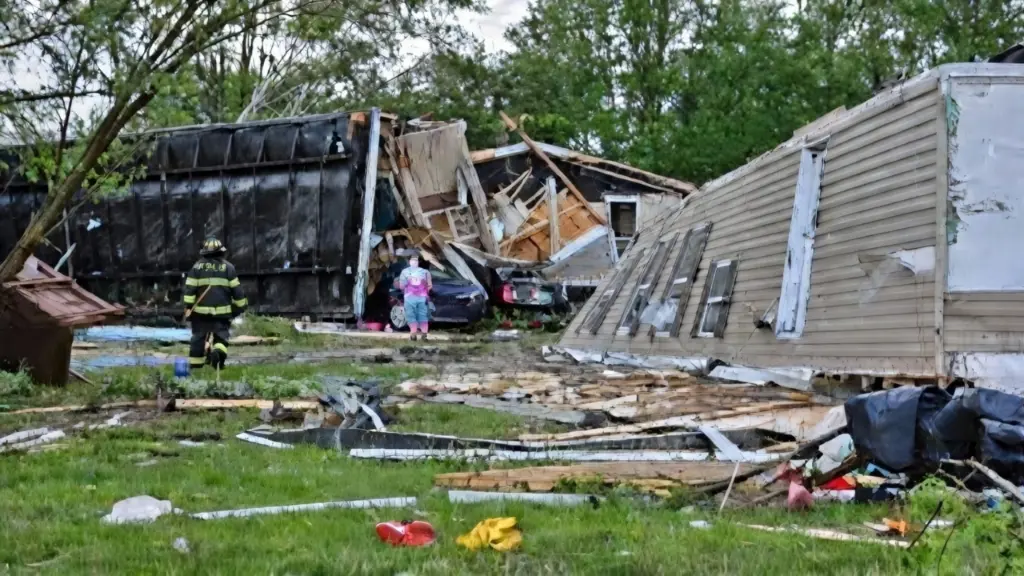
In the Union City area, the storm snapped trees, bringing them down on top of houses on Tuttle Road on the north side of Union Lake. Union City officials reported “significant storm damage” around the lake and downtown. “Village crews, emergency responders, and utility workers are actively working to assess damage and clear debris,” a post on the city’s Facebook page said.
Significant storm damage around the lake and downtown Union City. Trees snapped and brought down on houses. Roads closed with debris. Vehicular access to Union Lake, where the twister did its worst damage, remained closed Friday night, though lights from emergency vehicles could be seen in the distance.
The emergency vehicles visible across the lake in the darkness of Friday evening — their lights flickering through the debris-strewn landscape — represent the beginning of what will be a long recovery process for the Union Lake community. Damage assessment, debris removal, structural engineering reviews of surviving buildings, insurance claims, and the slower, deeper work of grief for three families whose members did not survive.
Part Three: Three Rivers — The Menards Roof, the Dollar Tree, and the Hospital
3:52 p.m. — Caught on Camera
The Three Rivers tornado became the most visually documented of the March 6 outbreak — captured on multiple cell phones by people who were close enough to see it clearly and fortunate enough to be in sturdy structures when it hit.
Social media users shared videos of a twister causing damage in the Three Rivers area in St. Joseph County, including ripping the roof off a Menards store, pulling apart a storage unit and lifting a car in the parking lot of a strip mall along US-131. Lindsey Whitaker of Goshen, Indiana, filmed a suspected tornado ripping through Three Rivers at 3:52 p.m. while her husband was driving south on US-131 on their way home from Grand Rapids.
Lindsey Whitaker and her husband were not supposed to be in Three Rivers on Friday afternoon. They were heading home to Indiana after a doctor’s appointment in Grand Rapids — a routine errand that placed them on US-131 southbound at precisely the moment a tornado crossed the same highway.
“We had gotten alerts on our phones that there were tornadoes coming, and at first we were like, ‘What? There’s nothing going on,'” Whitaker said. “We got a little further down the road and the clouds were moving in a weird way. And we got a little further, and we’re like, ‘Oh, that’s definitely a tornado.'”
That progression — from dismissal to concern to certainty — is one of the most common patterns in tornado witness accounts. The sky changes gradually and then suddenly. The clouds move in a way that does not make sense. And then, without further ambiguity, you are watching a tornado.
Kainan Hix of Three Rivers filmed the tornado ripping across US-131 through the parking lot of a commercial strip mall from inside a Cricket Wireless store on Friday, March 6, 2026 in Three Rivers.
From inside a Cricket Wireless store. That is where Kainan Hix watched a tornado cross one of southwest Michigan’s main highways — safe inside a commercial building, filming through the window as the storm moved through the parking lot outside.
The Menards: Roof Gone, Employees Safe
The most dramatic structural damage in Three Rivers occurred at the Menards hardware store on US-131 at Broadway Road — a large-format home improvement retailer whose massive roof proved no match for the tornado that crossed its parking lot on Friday afternoon.
In Three Rivers, the back of a Menards at US-131 and Broadway Road collapsed. Part of the roof and front sign were also torn away. Video shared with local news showed clouds swirling with debris in the sky before roofing was torn from the Menards and a nearby storage unit.
The roof of a Menards hardware store — a large commercial structure built to withstand normal weather loads — collapsed. Torn away. The video of the roofing being stripped from the building became one of the defining images of the March 6 outbreak, shared thousands of times on social media within hours of the storm.
A couple traveling through Three Rivers from northern Indiana said they watched the tornado rip the roof off the Menards hardware store. A manager at the store told MLive that people inside scrambled for cover, and he was not aware of any serious injuries.
People inside scrambled for cover and were not seriously injured. In a building whose roof was being torn off by a tornado, the employees and customers of the Three Rivers Menards found shelter and survived. That is not luck alone — that is the result of the kind of emergency preparedness training that retail employees receive and that, on March 6, 2026, made the difference between a structural collapse story and a mass casualty story.
The tornado also annihilated a Dollar Tree in the area, according to witnesses.
Three Rivers Health Hospital: Damaged But Open
One of the most concerning details to emerge in the early hours after the Three Rivers tornado was the damage sustained by the local hospital.
Three Rivers Health Hospital and several clinics on its campus sustained damage, Beacon Health System confirmed. No staff or patients were hurt. Beacon said its facility remained open without interruption while teams assessed the damage. “The safety of patients, visitors, and associates is our top priority, and our care teams are ready to serve those in need. Three Rivers Health extends its thoughts to all those in the community affected by today’s storm, and updates will be provided as additional information becomes available,” Beacon said in a statement.
A hospital with active patients, hit by a tornado, sustained damage to its building and clinics — and remained open without interruption to care for the community that had just been devastated by the same storm. That is the health care system doing exactly what it is supposed to do in the hardest possible circumstances.
Homes With Walls and Roofs Torn Off
News crews saw Three Rivers homes with major damage, including walls and roofs ripped off.
Not just roof damage. Not just broken windows or downed trees. Walls and roofs ripped off homes — the kind of damage that tells structural engineers a tornado passed directly overhead, that tells insurance adjusters the homes are total losses, and that tells families they are not going back inside tonight, or possibly ever.
One family, who bought their house in 2022 after moving to the area from Kentucky, was unharmed. They are hopeful homeowner’s insurance will cover all the damage. “I’m glad everyone’s OK,” the homeowner said. “We’re just going to have to rebuild.” “Tornado alley. Missed that our entire lives and then come up here and get slammed with a tornado. What’s going on with that?” she said. “It’s insane. It’s insane.” But she said she took heart after seeing an American flag in a nearby cemetery remained standing. “(It’s) a beautiful sight. It gives me hope,” she said.
Moved from Kentucky — traditionally associated with tornado risk — to Michigan, specifically because Michigan felt safer. And then a tornado. The American flag still standing in the cemetery while her house was being rebuilt from scratch. That detail — the flag, the grave markers untouched, the hope it represented to someone whose home was gone — is the kind of human moment that emerges from every disaster and that carries more meaning than any damage assessment.
Part Four: Edwardsburg — The Fourth Death
Cass County: The Indiana Border
A fourth person was confirmed dead after a tornado hit in the Edwardsburg area, Cass County Sheriff Clint Roach said in a statement. Roach said there were several injuries reported in the southern end of his county near the Indiana state line.
Edwardsburg sits in the extreme southwestern corner of Michigan — close enough to Indiana that the tornado that struck there on Friday afternoon was being tracked by weather stations in both states simultaneously. The Cass County tornado arrived earlier than the Union City event — at approximately 3:15 p.m. — making it the first confirmed tornado of the March 6 outbreak.
Officials in Cass County said they had confirmed one fatality and several injuries, along with blocked roads and damage to “multiple large structures” that ranged from “major structural impacts to complete destruction.”
Major structural impacts to complete destruction. That language — from official county reporting — describes a damage range that spans from “the building is significantly damaged but still standing” to “the building is gone.” Both categories existed in Cass County on Friday afternoon.
Cass County reported tornado damage from the area of Conrad Road west of Edwardsburg to M-62.
That is a damage path stretching across multiple miles of rural Cass County — the kind of ground track that indicates a tornado that stayed on the ground for a significant distance, moving through agricultural land and scattered residential properties without ever lifting back into the clouds.
Part Five: The Power Outages — Thousands Without Electricity
Indiana Michigan Power and Consumers Energy
The physical damage from the tornadoes — destroyed homes, collapsed roofs, snapped trees — was accompanied by massive power outages across the region that added urgency to the recovery effort and complexity to the search for survivors and injured.
Indiana Michigan Power said more than 5,500 of its customers in southwest Michigan, predominantly in the Three Rivers area, were without power as of Friday evening.
According to Consumers Energy, more than 3,000 customers were without power as of 9 p.m. on Friday. Consumers Energy said crews were on site in Union City and were “setting up a mobile command center in Union City to help coordinate our response.”
More than 8,500 combined customers without power across the region by Friday evening — representing tens of thousands of individual people in homes and businesses that went dark as the tornadoes passed through and took down power lines, transmission infrastructure, and utility poles along their paths.
A mobile command center in Union City. That is a power company treating this as a major incident — not a crew dispatched to fix a line, but a full operational command structure deployed to coordinate a multi-day restoration effort in a community where the power infrastructure sustained significant damage.
In March, in Michigan, a power outage is not simply an inconvenience. Temperatures in southwest Michigan in early March regularly drop below freezing at night. Families without power are families without heat — a situation that can become medically dangerous within hours for elderly residents, infants, and people with medical conditions that require temperature-sensitive equipment.
Part Six: The Emergency Response
Michigan State Police and the State Emergency Operations Center
The Michigan State Police Emergency Management and Homeland Security Division said Gov. Gretchen Whitmer activated the State Emergency Operations Center in response to the storms in Branch, Cass and St. Joseph counties. The department said the center would be supporting local requests for assistance.
The activation of the State Emergency Operations Center is not a routine response. It is the formal mobilization of Michigan’s statewide emergency management infrastructure — a signal that the governor and state leadership have determined that the scale of the damage exceeds what local and county resources can handle alone and that state-level coordination and resources are needed.
The state’s Emergency Operations Center near Lansing was activated in the wake of the storm. The agency said the operations center was monitoring the situation and prepared to respond if locals needed help.
Red Cross Shelter: Riverside Church
For the families whose homes were destroyed or rendered uninhabitable by the tornadoes — families who went to bed Friday night with nowhere to go — the American Red Cross provided immediate shelter.
The American Red Cross hosted a shelter for displaced residents at Riverside Church, located at 207 East Michigan Avenue in Three Rivers. Residents who have unmet needs such as shelter, food, or other assistance were directed to dial 211 to report their needs.
A church shelter in Three Rivers. That is where the families who watched their walls and roofs get torn off spent Friday night — in a community building opened by volunteers, staffed by Red Cross workers, providing cots and meals and the particular warmth of strangers taking care of strangers because that is what communities do when the sky falls.
Road Closures and Debris
The St. Joseph County Sheriff’s Office told people to avoid travel in the city of Three Rivers and Fabius Township, which neighbors the city to the west, and to call 911 to report anyone unaccounted for. “Citizens should anticipate power outages, closed roadways and/or neighborhoods, and cellular/internet disruptions,” the sheriff’s office said.
Closed roadways. Cellular disruptions. Downed power lines across roads that had not yet been assessed. The infrastructure of daily life in Three Rivers and Union City was disrupted not just by the physical damage of the tornadoes but by the secondary consequences — the downed lines, the blocked roads, the telecommunications outages that made it difficult for families to find each other, for rescue crews to communicate, and for emergency managers to build a complete picture of what had happened.
Part Seven: Witnesses Speak — What It Looked Like From the Ground
“Oh, That’s Definitely a Tornado”
The human accounts of the March 6, 2026 tornadoes in southwest Michigan are already accumulating — in news interviews, in social media posts, in the kind of raw, immediate testimony that people share in the hours after a disaster before the numbness sets in.
The Whitaker family from Indiana, heading home from a doctor’s appointment in Grand Rapids, filmed the Three Rivers tornado from their moving vehicle on US-131 at 3:52 p.m. Their account — from dismissal of the phone alerts to growing unease to the moment of certainty — captures the peculiar compressed timeline of tornado warning response.
Pamela Willison, who lives on Union Lake, ran upstairs to grab her dog, looked out the window, and found herself filming a tornado across the lake that was destroying her neighbors’ homes. “Sounded like a freight train. I’ve never been so scared in my life.”
Kainan Hix, sheltered inside a Cricket Wireless store in Three Rivers, filmed the tornado moving across US-131 through the parking lot of a commercial strip mall.
The Menards employees who scrambled for cover inside a building whose roof was being stripped away and emerged without serious injuries.
The family from Kentucky who moved to Michigan to escape tornado alley, watched their home get destroyed, and found hope in an American flag standing in a cemetery.
These are not statistics. These are the human faces of March 6, 2026 in southwest Michigan — people who woke up that morning expecting an ordinary Friday and went to bed that night in a fundamentally different world.
Part Eight: The National Weather Service — What the Warnings Said
10 Tornado Warnings in Three Hours
The National Weather Service issued 10 tornado warnings starting at 3:15 p.m. The line of storms that spawned the tornadoes churned across the state for more than three hours.
Ten warnings in three hours across a line of severe weather that stretched across multiple counties. The NWS system worked — the warnings were issued, the alerts went to phones, the sirens sounded. The question that will be examined in the weeks ahead is not whether the warnings were issued but whether they were issued early enough, widely enough, and specifically enough to give every person in the path of the tornadoes sufficient time to reach safe shelter.
At least two tornadoes were confirmed in Southwest Michigan, according to meteorologists. The tornadoes were reported in Union City in Branch County and Three Rivers in St. Joseph County, while a possible third tornado may have also been in St. Joseph County. Cass County officials later confirmed that a tornado touched down near Edwardsburg.
At least two confirmed tornadoes. A possible third. A confirmed fourth in Cass County. The full meteorological accounting of March 6, 2026 — the exact number of tornadoes, their paths, their intensities on the Enhanced Fujita Scale, their durations on the ground — will be completed by National Weather Service survey teams in the days ahead as they walk the damage paths and measure what they find.
Part Nine: Community Response — “We’re Just Going to Have to Rebuild”
Union City Facebook: Stay Away, Let Crews Work
The Village of Union City used its Facebook page — the primary public communication channel for small Michigan communities — to provide updates and direct residents in the immediate aftermath of the storm.
“Village crews, emergency responders, and utility workers are actively working to assess damage and clear debris,” the city posted. People were asked to stay away from affected areas so crews could do their jobs, as well as stay away from unstable buildings and downed power lines.
That request — stay away from the destruction so the professionals can work — is one that well-meaning community members sometimes struggle to honor. The impulse to go see, to help, to be present in the place where the damage happened is a deeply human one. But in the hours immediately after a tornado, the damaged area is genuinely dangerous: downed power lines that may still be energized, unstable structures that may collapse, gas leaks that have not yet been identified, debris that obscures hazards on the ground.
Consumers Energy: Mobile Command Center
The decision by Consumers Energy to deploy a mobile command center in Union City reflects the company’s assessment that restoration will take days rather than hours — a multi-phase effort requiring sustained operational coordination on the ground rather than a dispatch of repair crews.
The mobile command center is a logistical hub: a place where crews can check in, where supervisors can coordinate assignments, where the status of every circuit in the affected area can be tracked and updated in real time. In communities where the power infrastructure has sustained the kind of damage that tornadoes produce — poles snapped, lines down, transformers blown, underground equipment flooded — the mobile command center is the nerve center of the restoration effort.
Looking Ahead: Recovery Timeline
The recovery timeline for southwest Michigan following the March 6, 2026 tornado outbreak will unfold across multiple phases:
Immediate response (Day 1–3): Search for survivors and injured, debris clearance from roads, power restoration, shelter for displaced residents, damage assessment by county officials and state emergency management.
Short-term recovery (Week 1–4): Insurance assessments, structural engineering reviews of damaged buildings, debris removal from private property, temporary housing for displaced families, mental health support for survivors.
Long-term recovery (Months 1–12+): Home reconstruction, infrastructure repair, economic recovery for affected businesses, community resilience planning, and the slower, less visible work of processing grief and trauma in communities that lost four of their members on a Friday afternoon in early March.
Part Ten: The Four Who Did Not Survive
Names Not Yet Released — But Not Yet Forgotten
As of Friday night, March 6, 2026, the names of the four people killed in the Michigan tornado outbreak had not been publicly released. The Branch County Sheriff’s Office and Cass County Sheriff’s Office were still in the process of notifying next of kin — the solemn, painful work of sending law enforcement officers to someone’s door to tell them that the person they love is not coming home.
The names will be released. The stories will emerge. The poet. The farmer. The grandparent sitting in a lakeside house watching the weather change. The person who did not make it to shelter in time. Each of them had a name, a history, a family, a life that extended in every direction from the moment a tornado crossed their path on a Friday afternoon in March.
Four people. Three in Branch County, near Union Lake, west of Union City. One in Cass County, near Edwardsburg, near the Indiana state line. All of them gone before the emergency vehicles’ lights stopped flickering across the dark water of Union Lake on Friday night.
Southwest Michigan is a community that takes care of its own. It will grieve these four together and rebuild together — the way small communities always have, the way the American flag still standing in the Three Rivers cemetery suggested it would, the way the Beacon Health System hospital with its damaged roof stayed open to care for the injured while its own building was being assessed.
The tornado is over. The recovery is beginning.
If You Need Help
Displaced residents in Three Rivers and surrounding areas:
- Red Cross Shelter: Riverside Church, 207 East Michigan Avenue, Three Rivers
- Dial 211 for unmet needs including shelter, food, and assistance
- Call 911 to report anyone unaccounted for
Power restoration updates:
- Indiana Michigan Power: indianamichiganpower.com
- Consumers Energy: consumersenergy.com/outages
Stay away from:
- Downed power lines — treat every downed line as energized
- Damaged or unstable buildings
- Debris-covered roadways in affected areas
- Union Lake area — access remains restricted for emergency operations