
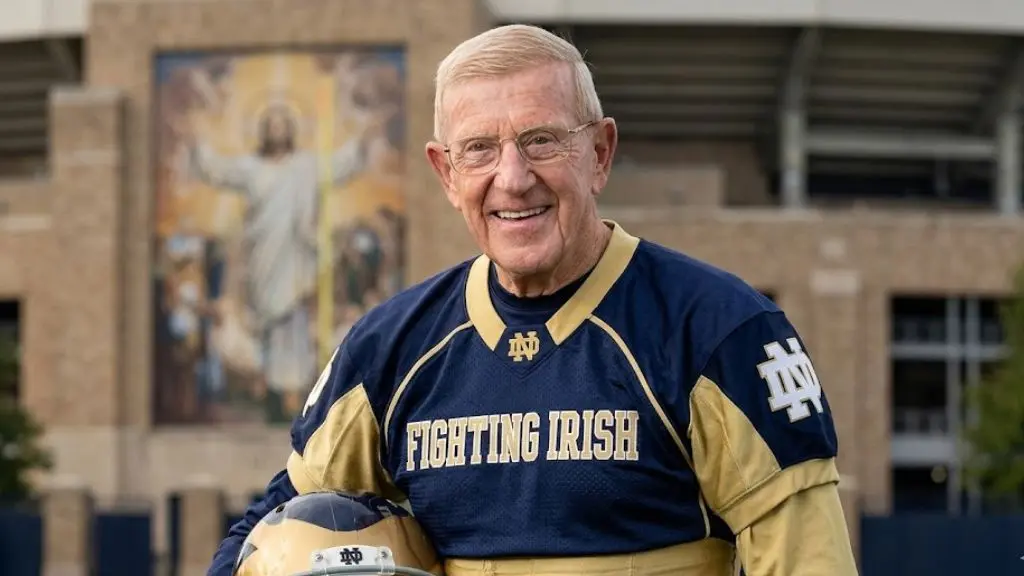
Lou Holtz: From a One-Bedroom West Virginia Cellar to Notre Dame Legend, Presidential Medal of Freedom Recipient, and One of the Greatest Coaches America Ever Produced
He was born in a cellar in Follansbee, West Virginia, during the Great Depression. One bedroom. A half bath. No welfare. No safety net. His father had a third-grade education. And from that beginning — that impossibly humble, gloriously American beginning — Louis Leo Holtz built one of the most extraordinary careers in the history of college football. On March 4, 2026, at 89 years old, surrounded by his family in Orlando, Florida, he passed from this world into the next. This is his complete story.
Lou Holtz at a Glance
| Full Name | Louis Leo Holtz |
| Born | January 6, 1937 — Follansbee, West Virginia |
| Died | March 4, 2026 — Orlando, Florida |
| Age at Death | 89 |
| Cause of Death | Not provided by family (battled prostate and throat cancer) |
| Education | Kent State University — BA History (1959), MA (1960) |
| Military Service | U.S. Army Reserve — Field Artillery Officer |
| Wife | Beth Barcus Holtz (married 1961 — died June 30, 2020) |
| Children | 4 (including coach Skip Holtz) |
| Grandchildren | 9 |
| Great-Grandchildren | 2 |
| Career Record | 249–132–7 |
| Schools Coached | William and Mary, NC State, New York Jets, Arkansas, Minnesota, Notre Dame, South Carolina |
| Notre Dame Tenure | 1986–1996 |
| National Championship | 1988 (12–0 season, Fiesta Bowl) |
| Bowl Games | Led all 6 college programs to bowl games — only coach to do so |
| Hall of Fame | College Football Hall of Fame (2008) |
| Presidential Honor | Medal of Freedom (2020) |
| ESPN Career | Studio analyst 2005–2015 |
| Books | Wins, Losses, and Lessons; Winning Every Day; Three Rules for Living a Good Life |
| Three Rules | Do the right thing; Do the best you can; Show people you care |
| Religion | Devout Catholic |
| Final Residence | Lake Nona Golf & Country Club, Orlando, Florida |
Part One: Lou Holtz Early Life — The Silver Spoon He Actually Had
Born in a Cellar in Follansbee
Louis Leo Holtz was born on January 6, 1937, in Follansbee, West Virginia. Lou Holtz was born to Anne Marie and Andrew Holtz, a bus driver. His father was of German and Irish descent, while his maternal grandparents were emigrants from Chernobyl, Ukraine.
Born in Follansbee, West Virginia, in the midst of the Great Depression, Holtz spent seven and a half years of his childhood in a house with a single bedroom that he shared with his sister and parents and a bathroom with no bath, shower, or sink. There were no food stamps, welfare checks, or financial safety net in those days.
And yet — in the framing that defined everything about how Lou Holtz approached his entire life — he did not experience that childhood as deprivation. He experienced it as privilege.
“I say I was born with a silver spoon in my mouth, not because of what we had — but because I was born in this country and I was told, if I was willing to work hard and have a strong faith in God, I could have a successful life,” Holtz said in a speech at Liberty University.
That reframe — taking genuine material poverty and finding in it not bitterness but gratitude — was not a performance. It was a philosophy. It was the operating system that ran every decision Lou Holtz made for 89 years, and it explains why people who played for him, worked for him, or simply heard him speak felt changed by the encounter.
East Liverpool, Catholic Schools, and the Nuns Who Shaped Him
The family moved from Follansbee to East Liverpool, Ohio, where young Lou attended Catholic grade school — and where the nuns who taught him left a permanent impression that he spoke about for the rest of his life.
The hire at Notre Dame fulfilled a childhood dream for Holtz, who grew up in the 1940s listening to Notre Dame football on the radio and attending Sisters of Notre Dame at St. Aloysius Grade School in East Liverpool, Ohio.
To this day, he credited the Sisters of Notre Dame St. Aloysius grade school for building his belief in God as a youngster in East Liverpool, Ohio. “The Sisters influenced my life tremendously,” he said. “This was due to the fact that they encouraged you always to make sure that God is the focus of your life, and they didn’t allow you to do anything except to the very best of your ability.”
God is the focus. Do everything to the very best of your ability. Those two principles — absorbed in an Ohio Catholic grade school in the 1940s, taught by nuns who were tough and caring in equal measure — became the twin pillars of Lou Holtz’s entire life and career. Everything else was built on top of them.
Kent State, the Army Reserve, and the Injury That Made Him a Coach
Holtz graduated from East Liverpool High School before attending Kent State University, where he earned a degree in history in 1959. During his time at Kent State, Holtz was a member of the Delta Upsilon fraternity and participated in the Army Reserve Officers’ Training Corps, earning a commission as a Field Artillery Officer in the United States Army Reserve upon graduation.
He had wanted to play football. He did play football — until the injury that ended that chapter and opened an entirely different and infinitely larger one.
“Then I had surgery the following spring and didn’t recover in time and so I could not play my senior year and ended up coaching the freshmen at Kent State and that’s how I ended up in college coaching,” Holtz recalled.
That injury was not a tragedy. It was a redirection. God did not put Lou Holtz on earth to play football. He put him on earth to teach it.
Drew Dalman: The Extraordinary Life Journey and Stunning Retirement of the NFL’s Smartest Center
Part Two: The Long Climb — From Graduate Assistant to Head Coach
Learning the Craft: Iowa to William and Mary
Holtz began his coaching career as a graduate assistant at the University of Iowa in 1960, where he also completed his master’s degree. He then served as an assistant coach at several institutions, including William and Mary, Connecticut, South Carolina, and Ohio State.
The assistant coaching years were the apprenticeship that shaped everything. Holtz moved from program to program, absorbing different systems and philosophies, developing his own voice and his own methods, building the toolkit that would later allow him to walk into broken programs and fix them with extraordinary speed.
Holtz began coaching at Iowa in 1960 as a graduate assistant and rose through the ranks quickly to become a head coach at William and Mary in 1969.
The Six Schools: A Record That Will Never Be Broken
Louis Leo Holtz served as the head football coach at the College of William and Mary, North Carolina State University, the New York Jets, the University of Arkansas, the University of Minnesota, the University of Notre Dame, and the University of South Carolina, compiling a career college head coaching record of 249–132–7. Holtz is the only college football coach to lead six different programs to bowl games and the only coach to guide four different programs to the final top 15 rankings.
That record deserves to be read slowly. Six different programs. Bowl games at all six. Four of them into the top 15. It is not just a statistic — it is proof of a system, a method, a philosophy that worked everywhere it was applied. Lou Holtz did not win because he had the best talent. He won because he changed cultures. He walked into programs where losing had become habitual, where players had been told — implicitly or explicitly — that they were not good enough, and he replaced that story with a different one.
Arkansas: The Foundation Years
Holtz went to the University of Arkansas in 1977. The Razorbacks were 11-1 in Holtz’s first season with the team and won the Cotton Bowl. Arkansas won 10 games again in 1979, and Holtz finished his Arkansas tenure with a 60-21-2 record.
Eleven wins in his first year at Arkansas. That was not luck. That was Lou Holtz arriving at a program, establishing his standards, communicating his expectations, and watching athletes rise to meet them because no one had previously believed in them enough to demand it.
Adin Ross: The Rise, Controversies, and Heartbreak of Streaming’s Most Polarizing Star
The New York Jets: The One That Got Away
Holtz’s lone foray into the professional ranks began when he was appointed head coach of the New York Jets on February 10, 1976. Holtz resigned ten months later with the Jets at 3–10 and one game remaining in the 1976 season. Upon his departure, he lamented: “God did not put Lou Holtz on this earth to coach in the pros.”
That line — “God did not put Lou Holtz on this earth to coach in the pros” — is pure Lou Holtz. Self-aware, honest, funny, and completely without bitterness. He tried the NFL. It did not fit. He said so plainly and moved on. Some people would have spent years defending that failed season or explaining it away. Lou Holtz turned it into a one-liner and went back to the college game where he belonged.
Part Three: Notre Dame — The Dream and the Dynasty
The Childhood Dream Made Real
Notre Dame hired Holtz in 1986 to restore a once-proud program that had stumbled under Gerry Faust. The hire fulfilled a childhood dream for Holtz, who grew up in the 1940s listening to Notre Dame football on the radio.
Think about that for a moment. A little boy in East Liverpool, Ohio, in the 1940s, lying on the floor near a radio, listening to Notre Dame football. And forty years later, that same boy — now a Hall of Fame coach with victories at four different programs — walks under the Golden Dome as the 25th head coach in Notre Dame history. The dream he carried from that radio in Ohio was the job he eventually earned.
Though Holtz came to be known for his one-liners and sense of humor, he was a disciplinarian as a coach and held his players to exceptionally high standards. That is a big part of why Notre Dame started to have success almost immediately. In 1987, receiver Tim Brown won the Heisman Trophy while Notre Dame finished 8-4 and went to the Cotton Bowl. It would only be the beginning.
David Montgomery: From Poverty to the Pros – The Inspiring Journey of an NFL Star and Eagle Scout
1988: The Perfect Season
The 1988 season was the finest year in Lou Holtz’s coaching career — and one of the finest years in the history of college football.
A victory over bitter rival Miami not only became a defining moment but remains one of the greatest college football games ever played.
Holtz’s 1988 Notre Dame team went 12–0 with a victory in the Fiesta Bowl and was the consensus national champion.
Twelve wins. Zero losses. A consensus national championship. The boy from Follansbee who grew up in a cellar listening to Notre Dame on the radio had just led Notre Dame to a perfect season. It was one of the most complete vindications of a coaching philosophy in the sport’s history.
In 2020, Holtz was awarded the Presidential Medal of Freedom — the highest civilian honor in the United States — awarded to a bus driver’s son from West Virginia who spent his career teaching young men to make good choices.
Eleven Years Under the Golden Dome
Lou Holtz is considered one of the best college football coaches in history. At Notre Dame he led the team to nine post-season bowl games and a national championship over his 11 seasons there.
Nine bowl games in eleven seasons. A national championship. A Heisman Trophy winner. And a program that, when Holtz arrived, had been stumbling — restored to the pinnacle of the sport with such thoroughness that his name became permanently attached to its identity.
Holtz left Notre Dame after the 1996 season. In 2008, he was elected into the College Football Hall of Fame. Holtz is known by many younger college football fans for his time at ESPN as a studio analyst for the network’s college football coverage. He left ESPN in 2015.
Part Four: The Man — Faith, Family, and the Three Rules
The Three Rules That Governed Everything
If you want to understand Lou Holtz in a single framework — the philosophy that drove his coaching, his speaking, his writing, and his personal life — it comes down to three rules that he articulated everywhere he went.
“I follow three rules: Do the right thing, do the best you can, and always show people you care. You’ve got to make a sincere attempt to have the right goals to begin with, then go after them with appropriate effort, and remember that you can’t really achieve anything great without the help of others.”
Three rules. Simple enough for a child to understand. Demanding enough to build a Hall of Fame career on. Do the right thing. Do the best you can. Show people you care. Every player who ever played for Lou Holtz heard those three rules repeatedly — and the ones who internalized them did not just become better football players. They became better people.
Faith: The Cornerstone of Everything
Lou Holtz was not casually religious. Faith was not an accessory to his life — it was its foundation.
“When we prayed, we acknowledged greatness. We confessed the things we’ve done wrong. We give thanksgiving for the things we’ve had, the opportunity to play the game, the opportunity to be at this school and the opportunity to be associated with the various people.”
“God has given us a lot of power — power to love, think, create, imagine, plan — but the greatest power we have is the power to choose,” Holtz said. “You choose whether you’re going to act or procrastinate, believe or doubt, pray or curse, help or hurt, succeed or fail. Life is a matter of choices, and the attitude you choose is by far the most important choice you make every day.”
He was a devout Catholic who brought his faith into every coaching environment he inhabited — doing so most openly and most freely at Notre Dame, where the university’s mission aligned perfectly with his own convictions. But even at secular institutions, the values were always present. The discipline. The accountability. The insistence that young men rise to be their best selves. That was all faith-driven, even when it was not labeled as such.
Beth Barcus Holtz: The Love of His Life
Holtz was married to Beth Barcus from July 22, 1961, until her death from cancer on June 30, 2020.
Nearly sixty years of marriage. Beth Holtz was not a public figure in the way that her husband was — she was the quiet, constant presence behind one of the most publicly demanding careers in sports. She was the woman who raised four children while her husband moved from program to program, city to city, job to job. She was the woman who turned a house fire that burned everything they owned into a statement of faith — “We didn’t lose anything we were going to take to heaven.”
Holtz spoke about his wife with deep love and characteristic humor. When asked the secret to 58 years of marriage, he said: “I’ve been married 58 years because I know four things: I was wrong. You were right. I’m sorry. Please forgive me. And I love you. Also, one thing you know about me — I’m an expert at following instructions.”
He lost Beth in June 2020 — the same year he received the Presidential Medal of Freedom. The two events, so close together, capture the particular bittersweet quality of the final chapter of his life. The nation’s highest civilian honor. And the absence of the person he most wanted to share it with.
His Children and Grandchildren
He and Beth had four children, three of whom are Notre Dame graduates. His children include head coach Skip Holtz. He is survived by his four children, nine grandchildren, and two great-grandchildren.
The family tradition Lou and Beth built was as structured and as intentional as any football program Holtz ever ran. At 9 p.m., the family had meetings. One night they talked about the family business. The second night about their Foundation. The third night about religious progress. “In 31 years, we’ve never had an argument or disagreement between a child and a spouse,” Holtz said.
A family run like a well-coached football team — with structure, with values, with love at the center of it all. That was Lou Holtz’s most important program.
Part Five: The Speaker, the Author, and the Broadcaster
Books That Changed Lives
Lou Holtz was not just a football coach. He was a teacher — and his classroom extended far beyond any locker room or practice field.
Holtz authored several books, including the widely acclaimed Wins, Losses, and Lessons, which chronicles his life and career. His books often blend his personal experiences with motivational advice, making them popular among readers seeking inspiration.
His book Winning Every Day became a genuine phenomenon in the motivational literature space — read by coaches, executives, athletes, parents, and anyone who wanted a framework for building a better life. It was structured around the same principles he taught on the field: clarity of purpose, personal accountability, genuine care for other people.
One reader wrote: “That book changed my life. It forced me to think about what I really wanted to do in life and what kind of sacrifices I was willing to make to get there. It made me realize the importance of every decision I make and that success isn’t an accident.”
Ten Years at ESPN
After retiring from coaching at South Carolina in 2004, Holtz joined ESPN as a studio analyst — and brought to the television desk the same energy, insight, and humor that had made him one of the most sought-after speakers in America.
After retiring from coaching, Holtz worked in television, including more than a decade with ESPN.
Younger college football fans know Holtz primarily from his ESPN years — from the Saturday morning desk, from the debates with Lee Corso and Kirk Herbstreit, from the one-liners and the predictions and the unashamed Notre Dame fandom that made him impossible not to watch. He left ESPN in 2015 but never left the public consciousness.
The Presidential Medal of Freedom
In 2020, Holtz was awarded the Presidential Medal of Freedom.
The citation acknowledged what anyone who had spent time in Lou Holtz’s orbit already knew: that his influence on American life extended far beyond the football field. He was not just a coach. He was an educator, a motivator, a builder of character, a man who spent fifty years teaching young people to make good choices and then watched those young people go out and change the world.
Part Six: Lou Holtz’s Most Memorable Quotes
The words of Lou Holtz are perhaps his most enduring legacy — because they captured, in pithy, unforgettable language, wisdom that took most people a lifetime to learn. Here are the most beloved:
On life and attitude: “Life is ten percent what happens to you and ninety percent how you respond to it.”
On ability and effort: “Ability is what you’re capable of doing. Motivation determines what you do. Attitude determines how well you do it.”
On adversity: “Adversity is another way to measure the greatness of individuals. I never had a crisis that didn’t make me stronger.”
On goals: “If you’re bored with life, if you don’t get up every morning with a burning desire to do things, you don’t have enough goals.”
On winning and losing: “You’re never as good as everyone tells you when you win, and you’re never as bad as they say when you lose.”
On quitting: “Quitting is a permanent solution to a temporary problem.”
On perspective: “Nothing is as good as it seems, and nothing is as bad as it seems. Somewhere in between lies reality.”
On promises: “Don’t ever promise more than you can deliver, but always deliver more than you promise.”
On complaining: “The man who complains about the way the ball bounces is likely the one who dropped it.”
On identity: “You were not born a winner, and you were not born a loser. You are what you make yourself be.”
On character: “The foundation blocks for a balanced success are honesty, character, integrity, faith, love and loyalty.”
On problems: “Remember, if you have a problem, it’s your problem. Solve it. Don’t blame other people.”
On life itself: “Life is like a grindstone. Whether it grinds you down or polishes you up depends on what you’re made of.”
On faith: “God didn’t put us on this earth to be ordinary.”
These are not the quotes of a motivational industry’s carefully crafted product. They are the distilled wisdom of a man who lived everything he said — who faced poverty and injury and career setbacks and health crises and the loss of a beloved wife and never once used any of it as an excuse. Who turned adversity into strength every single time because he had decided, somewhere in a one-bedroom West Virginia cellar, that life is a matter of choices and he was going to choose well.
The Tributes: A Sport in Mourning
“Notre Dame mourns the loss of Lou Holtz, a legendary football coach, a beloved member of the Notre Dame family and a devoted husband, father and grandfather,” Notre Dame president Rev. Robert A. Dowd said. “Among his many accomplishments, we will remember him above all as a teacher, leader and mentor who brought out the very best in his players, on and off the field, earning their respect and admiration for a lifetime.”
Current Fighting Irish coach Marcus Freeman said Holtz had offered him “great support” since he arrived in South Bend and praised the values Holtz emphasized to him: love, trust and commitment. “Lou’s values have gone well beyond the football field. He and his wife, Beth, are respected across campus for their generous hearts and commitment to carrying out Notre Dame’s mission of being a force for good.”
The tributes came from every corner of college football and beyond — from players he coached decades ago, from coaches whose careers he influenced, from ordinary Americans who had read his books or heard him speak or simply grown up watching him on the sideline or on television.
Because Lou Holtz was not just a football coach. He was a reminder — delivered with humor and faith and absolute conviction — that the choices you make determine the life you live. That attitude is more important than ability. That adversity is an opportunity in disguise. That God did not put any of us on this earth to be ordinary.
He proved it himself. Every single day of 89 extraordinary years.
Rest in Peace, Lou Holtz
He was born in a cellar in Follansbee, West Virginia, to a bus driver who had a third-grade education. He moved to Ohio and was shaped by nuns who would not accept anything less than your best. He played college football until an injury ended that dream and started a bigger one. He spent fifty years coaching, building, teaching, and transforming. He led Notre Dame to a perfect season and a national championship. He received the Medal of Freedom from the President of the United States. He buried his wife of nearly sixty years and carried that grief with the same faith and grace with which he carried everything else. And on March 4, 2026, surrounded by his children and grandchildren and great-grandchildren — the family he had built with the same discipline and love and three simple rules he brought to every football program — he passed from this world into the next.
God did not put Lou Holtz on this earth to be ordinary.
He was not.
Rest in peace, Coach. 🙏