Major Industrial Fire Breaks Out at Bouwcenter Vanhulle in Kruisem, Belgium — Full Report (March 6, 2026)
A massive blaze tore through one of East Flanders’ most well-known construction material companies on Friday afternoon, sending a towering smoke plume visible for dozens of kilometres and triggering a massive multi-zone emergency response.
Industrial Fire Erupts in Kruisem
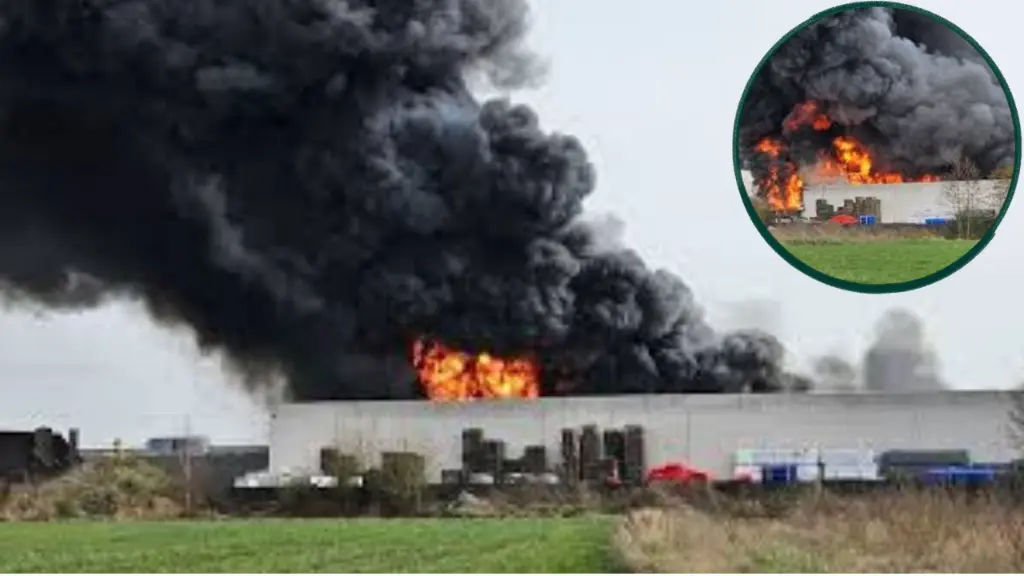
On the afternoon of Friday, March 6, 2026, a devastating industrial fire broke out at Bouwcenter Vanhulle, a well-established construction materials company located at Industriezone De Zaubeek, Industrial Zone 32, in the municipality of Kruisem, in the Belgian province of East Flanders. The fire, which began just after 1:00 p.m., quickly grew from what initially appeared to be a roof fire into a full-scale structural blaze that consumed large sections of the building and sent a massive black smoke plume rising high into the sky — visible from as far away as Roeselare and the wider Waregem region, covering distances of dozens of kilometres.
The incident triggered one of the largest emergency responses seen in the region in recent memory, drawing in multiple fire brigades from across both East and West Flanders and placing the local community on high alert throughout the afternoon.
How the Fire Started and Spread
Emergency services received the first call reporting the fire at approximately 1:00 p.m. on Friday afternoon. Units from the Flemish Ardennes fire zone (Brandweerzone Vlaamse Ardennen) were the first to arrive on the scene. What they found when they got there was far more serious than an ordinary fire call.
Jonathan Jouret, spokesperson for the Flemish Ardennes fire zone, described the situation clearly: the initial indication from the call was that a roof fire was underway — a serious but more contained type of blaze. When firefighters arrived and assessed the situation in person, however, it became evident that the fire had already spread well beyond the roof and had become a full structural company fire, meaning the entire fabric of the building itself was involved.
Jouret’s team immediately recognized that the scale of the blaze exceeded the capacity of a single fire zone to manage safely and effectively. Reinforcements were urgently requested from multiple neighbouring fire zones — specifically Brandweerzone Centrum and Brandweerzone Fluvia — and units from Midwest fire zone also responded. Crews from across West and East Flanders converged on the industrial zone to support the firefighting effort.
The company’s location within Industriezone De Zaubeek, situated close to the E17 motorway — one of the busiest arterial roads in the region — added logistical complexity to the response, as authorities needed to manage traffic and keep approach roads clear for emergency vehicles.
Smoke Visible for Kilometres
Perhaps nothing illustrated the severity of the Kruisem fire more vividly than the enormous smoke plume it generated. Thick, heavy black smoke billowed into the sky above the industrial zone and was reported as clearly visible from multiple surrounding municipalities and cities. Witnesses in and around Waregem — located across the provincial border in West Flanders — described a dramatic black cloud dominating the horizon. Reports also confirmed the plume was visible as far away as Roeselare, which is located over 30 kilometres from Kruisem — a stark indicator of just how intense the combustion was at its peak.
The black colour of the smoke was significant: it is characteristic of burning construction materials, plastics, roofing compounds, and similar industrial substances. Bouwcenter Vanhulle specialises in building materials, tiles, and roofing — meaning the facility contained substantial quantities of materials that, when burning, generate dense, sooty black smoke.
In addition to the smoke, residents living in the vicinity of the industrial park reported hearing several loud bangs coming from the direction of the fire. These explosions — consistent with the kinds of pressure-related events that can occur when fire reaches enclosed containers, gas lines, or sealed structural components — understandably heightened alarm in the surrounding community.
As the fire burned, black soot particles began falling from the sky in the surrounding area. Authorities confirmed this was the result of burning construction materials. Crucially, investigators confirmed that no hazardous or toxic substances were identified as having been released. The mayor of Kruisem, Joop Verzele of CD&V, was explicit on this point, though he did acknowledge the obvious: that smoke itself is inherently harmful, regardless of its chemical composition, and that the community needed to take precautions accordingly.
Emergency Response: A Multi-Zone Operation
The firefighting operation at Bouwcenter Vanhulle was a major multi-agency effort. Fire zones Vlaamse Ardennen, Centrum, Fluvia, and Midwest all deployed personnel and equipment to the scene. Police were also present in large numbers — both to manage road access to the industrial zone and to maintain a safety perimeter around the burning building.
Firefighters worked to achieve two primary objectives simultaneously. The first was to bring the fire itself under control — a challenging task given the structural nature of the blaze and the volume of combustible building materials stored within the facility. The second, equally important objective was to prevent the fire from spreading to neighbouring businesses on the industrial estate. This objective was successfully achieved: firefighting crews confirmed that the blaze did not jump to any adjacent properties, limiting the physical destruction to Bouwcenter Vanhulle’s own premises.
Crews also managed to protect a section of the company’s own building from total destruction — though authorities acknowledged that the overall damage to the structure was substantial. During the fire, at least one wall collapsed as a direct result of the structural damage inflicted by the blaze, raising serious concerns about the integrity of the remaining building.
By late afternoon, the fire was confirmed to be under control. Both the fire brigade and the mayor of Kruisem confirmed the development, bringing some relief to the community after hours of tension and alarm.
Casualties: One Worker Injured
In terms of human casualties, the fire resulted in one confirmed injury. A single employee of Bouwcenter Vanhulle sustained burn injuries during the incident and was transported by emergency services to UZ Gent — the University Hospital of Ghent — for treatment. The nature and severity of the burns were not immediately specified in official communications, though the fact that the injured worker required hospital treatment at a major university hospital suggests the injuries were significant enough to necessitate specialist medical care.
The fact that there was only one casualty in an industrial fire of this scale was broadly regarded as fortunate given the circumstances. Emergency response teams worked swiftly to evacuate the premises, and the relatively quick escalation of the response — with multiple fire zones arriving early in the incident — is likely to have played a role in limiting the human cost of the blaze.
No fatalities were reported.
Public Safety Warnings Issued
Throughout the afternoon, local and emergency authorities issued a series of urgent public safety instructions to residents living in the wider Kruisem area and beyond.
The central message was clear and consistent: residents were instructed to keep all windows and doors firmly closed, to switch off ventilation systems including air conditioning and heat recovery units, and to avoid the area around the industrial zone as much as possible. These are standard precautionary measures during significant industrial fires, designed to prevent people from inhaling smoke particulates or soot particles that may have been carried on the wind.
Mayor Joop Verzele personally confirmed and communicated these instructions to the public, both directly to media and through the municipality of Kruisem’s official website and Facebook page. The municipality made a public commitment to continue updating residents through both channels as the situation developed. Local authorities emphasised that the public safety warnings were precautionary in nature rather than indicative of a chemical or toxic hazard — no dangerous substances were identified as having been released by the fire.
The area around the industrial zone was cordoned off by police to keep the public away and to ensure emergency vehicles could operate without obstruction. Motorists in the area were advised to take alternative routes and to avoid driving near Industriezone De Zaubeek.
About Bouwcenter Vanhulle: A Pillar of the Kruisem Business Community
Bouwcenter Vanhulle is not simply another business on an industrial estate. It is a long-established and deeply embedded part of the commercial and construction landscape of the Kruisem region, with a history stretching back decades.
The company serves both professional tradespeople — including builders, contractors, roofers, and tilers — and private individuals undertaking construction or renovation projects. Its core specialisms are building materials, tiles, and roofing, making it a one-stop shop for both large-scale construction projects and smaller domestic renovations. It has built a reputation in the region for the breadth of its product range, the reliability of its service, and its investment in a capable logistics fleet.
In terms of delivery capacity, Bouwcenter Vanhulle has historically operated an extensive and varied fleet of vehicles, including semi-trailers for granulates, flat-bed semi-trailers for large deliveries of building blocks and facing bricks, specialist trucks for delivering concrete vaults, and a range of smaller delivery vehicles for more targeted and domestic deliveries. This fleet infrastructure allowed the company to fulfil customer orders comprehensively — not just dropping materials at the kerb, but providing a full-service delivery and supply capability.
The company is open Monday to Friday from 6:00 a.m. to 6:00 p.m. and on Saturdays from 7:00 a.m. to 12:00 p.m., reflecting the early-start culture of the construction industry and the importance of supply reliability for tradespeople operating on tight site schedules.
The fire’s impact on the company’s operations, its stock of building materials, and its physical infrastructure is expected to be severe. Given the structural damage confirmed by fire crews — including the collapse of at least one wall — it remains to be seen how quickly, or indeed whether, the facility can resume operations in the near term.
About Kruisem: The Municipality and Its Industrial Heritage
Kruisem is a relatively young municipality in the Belgian province of East Flanders. It came into existence on January 1, 2019, as the result of the voluntary merger of the previously separate municipalities of Kruishoutem and Zingem — a merger that was approved by both municipal councils in 2017 and ratified by Flemish decree in May 2018. The merged municipality covers an area of 71.59 square kilometres and has a population of approximately 15,876 residents as of 2022.
The municipality is made up of several sub-communities, known in Belgian administrative terminology as deelgemeentes: Huise, Kruishoutem, Nokere, Ouwegem, Wannegem-Lede, and Zingem. The municipal seat is located in Kruishoutem. Since the municipality’s first elections in October 2018, Mayor Joop Verzele of Christian Democratic and Flemish (CD&V) — the same mayor who confirmed and communicated today’s fire — has led the local government.
Beyond its industrial zone, Kruisem is perhaps best known internationally as the home of Hof van Cleve — one of Belgium’s most celebrated fine dining restaurants. Located in a converted farmhouse, Hof van Cleve has ranked among the World’s 50 Best Restaurants, placing at number 27 in 2022. The restaurant embodies a very different face of Kruisem — artisanal, gastronomic, world-class — from the industrial and construction heritage represented by Bouwcenter Vanhulle.
The Industriezone De Zaubeek, where today’s fire occurred, sits close to the E17 motorway, the major arterial road connecting Ghent and Kortrijk in Belgium and continuing into France. The zone is home to several businesses and serves as an important node in the regional economy. Its proximity to the E17 makes it well-connected for logistics but also means that industrial incidents there — like today’s fire — carry the potential to affect traffic and emergency response logistics across a wide area.
Investigation and Next Steps
As of the evening of March 6, 2026, the fire at Bouwcenter Vanhulle has been brought under control and the immediate crisis has passed. However, significant questions remain to be answered in the days and weeks ahead.
Investigators will need to determine the precise cause of the fire — whether it was the result of an equipment malfunction, an electrical fault, an accident involving the materials stored on site, or some other factor. The cause has not yet been officially confirmed or announced.
The full extent of the structural damage to the building will need to be assessed by engineers, and the collapsed wall will need to be evaluated to determine the stability of the remaining structure before any recovery or investigation work can safely proceed.
The injured worker at UZ Gent will need ongoing medical care, and the company will need to consider how to support its employees and customers in the aftermath of the destruction.
The municipality of Kruisem has committed to continuing to communicate with residents through its official website and social media channels as more information becomes available.
Conclusion: A Community Shaken but Resilient
The industrial fire at Bouwcenter Vanhulle on March 6, 2026, was a serious and dramatic event that tested the emergency response capabilities of multiple fire zones across East and West Flanders and sent alarm through the wider Kruisem community and beyond. The speed and scale of the firefighting response — drawing in four separate fire zones and preventing the blaze from spreading to neighbouring businesses — undoubtedly limited what could have been an even more catastrophic outcome.
The injury of one worker is a sobering reminder of the human stakes in industrial fire incidents, and the substantial damage to one of the region’s longest-established construction businesses will have real and lasting consequences for its employees, its customers, and the broader local economy.
Kruisem’s community has faced unexpected challenges before and found its footing. As the smoke clears above Industriezone De Zaubeek, that resilience — and the professionalism of the emergency services who responded — deserves to be acknowledged and remembered.