
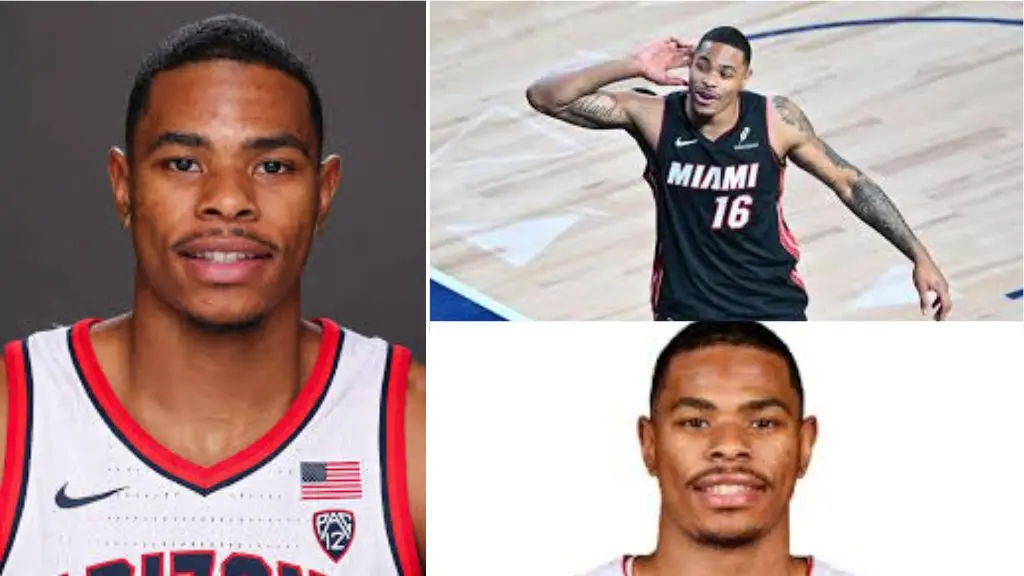
Keshad Johnson: A Complete Life Story — From West Oakland to the 2026 NBA Slam Dunk Champion
Born June 23, 2001, Oakland, California
On Saturday night, February 14, 2026 — Valentine’s Day — inside the Intuit Dome in Inglewood, California, a 24-year-old undrafted forward for the Miami Heat named Keshad Johnson threw down a running windmill dunk and lifted the Julius “Dr. J” Erving Trophy above his head as the 2026 NBA Slam Dunk Contest champion.
The 18,000 people in the arena had, just hours earlier, not known his name. By the end of the night, they were chanting it.
Johnson is a second-year forward for the Heat who was initially on a two-way contract with Miami, then inked a standard deal in December 2024. He went undrafted in the 2024 NBA Draft. His career NBA statistics — 3.1 points per game, 1.9 rebounds, 7.6 minutes per night — do not suggest a man on the verge of a national breakthrough. But statistics have never captured everything about a basketball player, and they have never captured anything about what it takes to arrive at the NBA at all when you grew up in West Oakland watching your older brother get shot ten times at the age of ten.
This is the complete story of Keshad Ray Johnson — from one of America’s most dangerous neighborhoods to the highest flight in one of the sport’s most celebrated traditions.
Keshad Johnson Early Life: West Oakland, Family, and a Brother Who Was Shot Ten Times
Keshad Ray Johnson was born on June 23, 2001, in Oakland, California — specifically in the West Oakland neighborhood, one of the most economically distressed and historically underserved urban communities in the United States. West Oakland is a neighborhood that has produced extraordinary people in the face of extraordinary hardship, and it has also claimed many young lives to gang violence, poverty, and the systematic failures that have concentrated both in specific zip codes for generations.
Johnson’s path to the NBA was forged through family tragedy, responsibility, and resilience, elements that continue to define who he is today. Johnson’s life changed overnight when his elder brother, Kenny Jr., was shot 10 times in an attack that left him fighting for his life. He was only 10 when he witnessed this incident that left his brother paralyzed for a year.
Being ten years old and watching your older brother be shot — not once, but ten times — is not a wound that heals or an experience that simply becomes part of the past. It shapes the neural architecture of childhood. It clarifies the stakes of everything that follows. It makes a young man understand, viscerally and permanently, that the world outside the gym is not safe, that the people he loves are vulnerable, and that getting out — truly out, to a place where the violence cannot follow — requires doing something extraordinary.
Basketball was that something for Keshad Johnson. Johnson’s mom and father, Kenny Sr., have been the two guiding forces in his life, along with his elder brother, too, of course. His sister Cassandra and nephew, Ralph, are also part of his crucial support system.
His father Kenny Sr. gave him not just support but a name that would matter: Kenny Jr. — the older brother who survived those ten gunshots, who spent a year paralyzed, who fought back — became a permanent reminder of both the fragility of life in West Oakland and the extraordinary resilience of the people who live it.
“In Oakland, a lot of players get slept on. We’re the underdogs most of the time, maybe all the time. All I needed was my shot to get on the circuit, and once I got on the circuit, I proved myself and proved that I belonged,” Johnson said in an earlier interview with the San Diego Union-Tribune.
That sentence — “I just needed my shot” — carries more weight coming from a kid who grew up watching what other kinds of shots can do.
High School: Envision Academy to San Leandro — Building the Foundation
Keshad Johnson began his high school career at Envision Academy of Arts & Technology in Oakland — a small, progressive charter school in the heart of the city that serves predominantly low-income students of color and has built a reputation for academic rigor and community engagement.
Before his senior season, he made a pivotal decision: he transferred to San Leandro High School in San Leandro, California — a move across the county line that put him in front of better competition, better coaching, and more exposure to college recruiting. The transfer was a calculated risk — leaving the familiar community of Oakland for a larger, more competitive athletic environment — and it paid off immediately.
Johnson averaged 14.4 points, eight rebounds, three assists, 2.3 blocks and 1.9 steals per game and was named the West Alameda County Conference Foothill League co-MVP in his lone season at San Leandro.
Those are extraordinary numbers at any level of high school basketball. A co-MVP designation from the West Alameda County Conference — a league that produces consistent college-level talent from the East Bay — confirmed that Johnson was not merely a good Oakland prospect but a genuinely elite athlete with the physical tools and competitive intelligence to play at the highest levels.
The combination — length, athleticism, defensive versatility, rebounding, shot-blocking — pointed toward the profile that college coaches prize in the modern game: a switchable, multi-position defender with offensive upside. It was enough to attract interest from college programs, and enough to earn him a commitment to San Diego State.
San Diego State Aztecs (2019–2023): Four Years of Development
Keshad Johnson enrolled at San Diego State University in 2019 and spent four years with the Aztecs — a program that had, under head coach Brian Dutcher, built one of the most respected mid-major programs in the country, consistently competing in the NCAA Tournament and developing NBA-level talent with a defensive identity and a culture of accountability.
He came in as a long, athletic forward with a defensive foundation from his West Oakland and San Leandro years — someone who could compete on that end of the floor immediately. The offensive development would take longer, which is not unusual for players who come from environments where individual survival on the court (defense, rebounding, blocking shots) is emphasized before the creative offensive skills (shooting, creation, scoring) that require more structured development.
2019–20 (Freshman year): Limited role, learning the system.
2020–21 (Sophomore year): Continued development in a COVID-disrupted season.
2021–22 (Junior year): He earned a regular starting role in his junior year, averaging 7.2 points per game in 2021-22. This was the season he became a genuine contributor at the mid-major level — a starting forward on a nationally competitive team, bringing the defensive intensity and athletic ability that had been his calling card since high school.
2022–23 (Senior year): He averaged 7.7 points and five rebounds per game during his senior season. More importantly, the Aztecs had their best season in program history. San Diego State made its first-ever NCAA Final Four appearance in 2023 — one of the most remarkable runs in tournament history. The Aztecs defeated Charleston, Furman, Alabama, Creighton, and Florida Atlantic before falling to UConn in the national semifinal. Johnson was part of a team that played at one of the highest stakes moments in college basketball.
The Final Four run generated significant national attention for the program and for its players. Johnson, however, faced a familiar ceiling: as a senior-year mid-major forward averaging under 8 points per game, the NBA draft was not looking at him seriously. He had one more college year of eligibility available through the graduate transfer portal — and he used it.
Stefon Diggs 2026: Net Worth, Career Stats, Cardi B Relationship, Contract, Family and More
Arizona Wildcats (2023–24): The Graduate Transfer That Changed Everything
In the summer of 2023, Keshad Johnson entered the transfer portal and committed to the University of Arizona Wildcats — one of the most prestigious basketball programs in the country, a Pac-12 powerhouse with a history of producing NBA talent, and a program operating under head coach Tommy Lloyd that had quickly become one of the nation’s elite.
The move from San Diego State to Arizona was, in basketball terms, a step up in competition, exposure, and professional development infrastructure. It was also a bet on himself — a decision that said: I have more to show, and I need a bigger stage to show it.
He joined Arizona as a graduate transfer and took his game to another level, averaging career highs in points (11.5), rebounds (5.9), assists (1.8), steals (1.0), blocks (0.7) and minutes (27.6) with the Wildcats while starting in each of his 36 Pac-12 appearances.
Every single statistical category reached a personal best in his one year in Tucson. The points-per-game nearly doubled from his San Diego State senior year. The rebounds, assists, steals, and blocks all climbed significantly. And he started all 36 conference games — meaning he wasn’t a role player or a situational piece, but a genuine starter on one of the best programs in the country.
The Arizona year was the proof of concept that his NBA future required: this is what Keshad Johnson looks like when given the opportunity and the development infrastructure of an elite program. He was a college basketball player in full, for the first time, at 22 years old.
It was enough to earn him an invitation to the 2024 NBA Combine. It was not enough — not quite — to earn him a draft selection.
The 2024 NBA Draft: Undrafted and Undeterred
On June 26, 2024, the NBA Draft was held. Keshad Johnson went undrafted in the 2024 NBA Draft.
Going undrafted after five years of college basketball, after a Final Four run, after a breakthrough graduate transfer year that saw him average career highs across every category — that is a specific kind of disappointment. It means that 30 NBA teams, with 60 collective selections, did not consider him worth the assurance of a draft pick. It is not the end. Many undrafted players have built significant NBA careers. But it is a door left ajar rather than swung open, and the work to push through it is all on you.
The Miami Heat made the call. They signed Johnson as an undrafted free agent and gave him the opportunity to compete for a roster spot.
Miami is, by the structure of its organizational culture under team president Pat Riley and the coaching legacy of Erik Spoelstra, a franchise that has historically been receptive to undrafted players with elite athletic ability, defensive competence, and the kind of internal motivation that does not require the external validation of being drafted. The Heat culture — well-documented, sometimes mythologized — demands a specific kind of player: coachable, hardworking, willing to accept a role without ego, and physically capable of competing at the league’s highest level on both ends of the floor.
Keshad Johnson fit that profile exactly.
Miami Heat: Two-Way to Standard Contract (2024–Present)
Johnson initially joined the Miami Heat on a two-way contract — the NBA’s mechanism for keeping players connected to both the G League and the NBA roster, allowing them to shuttle between the two levels while developing and earning a spot at the top.
Johnson was merely a bench alternative in his first two years with the Aztecs, but the Heat signed him to a one-year, $724,883 contract in December of 2024. The conversion from a two-way deal to a standard NBA contract in December 2024 was the formal confirmation: he had earned his place on the roster. He was an NBA player.
On January 24, 2025, he was assigned to the Sioux Falls Skyforce — the Heat’s G League affiliate — for additional development time before being recalled to Miami. The back-and-forth between the NBA roster and the G League is a normal part of development for young players on the fringe of rosters, and Johnson navigated it without complaint.
The Heat exercised his $1,955,377 team option for 2025-26 in June of 2025 — a vote of organizational confidence that confirmed he was part of their plans entering the current season.
Johnson is currently on a two-year, $2.68 million deal with the Heat that makes him an unrestricted free agent after the 2025-26 season, per Spotrac.
As a restricted free agent (RFA) after this season, the Heat will have the right to match any offer he receives — but his performance at the Slam Dunk Contest, combined with any strong end-of-season showings, could significantly change his market value going into free agency.
2025–26 Season: Limited Minutes, Elite Athleticism, and One Invitation
Through his 21 appearances in the 2025–26 season, Johnson was averaging 3.1 points and 1.9 rebounds across 7.6 minutes per game.
Those are the numbers of a player at the very bottom of a rotation — someone who comes in for specific defensive assignments, brings energy, and gets back to the bench. They are not the numbers of someone who is building a franchise around himself. They are the numbers of someone who is holding on to an NBA roster spot by demonstrating, every time he is on the floor, that he can do something at the elite level.
For Keshad Johnson, that something is his athleticism — specifically, his explosive vertical ability and his full-body coordination in the air. He can get up. He can finish at the rim with creativity and power. He can get from Point A to the basket in a way that makes NBA-level defenders look briefly confused.
The NBA noticed. Johnson will be one of four players who will feature in the 2026 All-Star Slam Dunk Competition, the league announced. He was invited alongside San Antonio Spurs rookie Carter Bryant, Indiana Pacers forward Jaxson Hayes, and Detroit Pistons guard Jase Richardson — the four competitors chosen to represent the next generation of NBA athleticism on basketball’s most theatrical stage.
The invitation was recognition. The contest itself was the opportunity. And Keshad Johnson did not waste either.
February 14, 2026: The 2026 AT&T Slam Dunk Contest — Champion
On Valentine’s Day night, inside the Intuit Dome in Inglewood, California, the 2026 AT&T Slam Dunk Contest took place as part of NBA All-Star Saturday Night.
Johnson scored 92.8 points in the first round and advanced to the final alongside Carter Bryant (94.8), beating Jaxson Hayes (91.8) and Jase Richardson (88.8). His first-round performance was strong enough to advance but placed him second — Bryant led going into the final.
In the final round, the calculus shifted. While Bryant delivered the only 50-point dunk of the night during the final round, Johnson impressed with two strong slams, totaling 97.4 points to Bryant’s 93.0. Johnson’s running windmill — athletic, clean, executed with full-body commitment — was the dunk that defined the night. He threw it down and the arena responded.
He won. The scores were read. The trophy was raised.
From his dunks to his dance moves, Johnson made a strong impression on fans, despite a limited track record in the league to this point. The dance moves — the energy throughout the night, the visible joy, the constant motion even when he wasn’t dunking — were as memorable as the dunks themselves. This was not a man performing for cameras. This was a man from West Oakland who had watched his brother nearly die, who had gone undrafted, who averaged seven minutes a game, standing in the center of one of the NBA’s biggest nights and thoroughly, genuinely enjoying every second of it.
Johnson becomes the third Heat player to win the contest, joining Derrick Jones (2020) and Harold Miner (1993, 1995). He raised the Julius “Dr. J” Erving Trophy — named for the man who invented modern above-the-rim basketball — and became, at least for this night, the most famous player in the NBA.
Playing Style and Physical Profile
Keshad Johnson stands 6 feet 7 inches and weighs approximately 220 pounds — the physical profile of a versatile NBA forward capable of guarding multiple positions. He wears number 16 for the Miami Heat.
His game is built on:
Athleticism: Elite vertical explosion and full-body coordination in the air — evidenced by the Slam Dunk Contest but also by his ability to finish at the rim against NBA-level competition.
Defense: The foundation of his game since high school — the ability to guard multiple positions, help on the glass, contest shots, and bring the energy and effort that Miami’s culture demands nightly.
Rebounding: A consistent contributor on the glass relative to his minutes — the 5.9 rebounds per game at Arizona reflected a player who competes for every possession.
Developing offense: His scoring numbers are limited at the NBA level, but the trajectory from San Diego State (7.7 points) to Arizona (11.5 points) to the NBA suggests an offensive game that has been consistently developing with each new environment.
His defensive versatility and athletic profile make him the kind of player that modern NBA teams value highly — the long, switchable wing who can guard 1-through-4, compete on the glass, and bring maximum effort in limited minutes. If his offensive game develops to match his defensive credentials, he could become a significant rotation piece.
The Oakland Identity: “We’re the Underdogs Most of the Time”
Keshad Johnson has not tried to put comfortable distance between himself and West Oakland. He carries it publicly, explicitly, and with what appears to be genuine pride rather than performance.
“In Oakland, a lot of players get slept on. We’re the underdogs most of the time, maybe all the time. All I needed was my shot to get on the circuit, and once I got on the circuit, I proved myself and proved that I belonged.”
The language of belonging — “I proved that I belonged” — is specific to people who have been told, implicitly or explicitly, that they do not. Going undrafted tells you something. Growing up in West Oakland tells you something. Watching your brother get shot ten times when you are ten years old tells you something. The message is always the same: this is not for you, this is not where you end up, this is not the room you get to walk into.
Keshad Johnson has walked into every room anyway. He walked into San Diego State when Oakland players were being overlooked. He walked into Arizona as a graduate transfer and outperformed everyone’s expectations. He walked into an NBA Slam Dunk Contest as a statistical footnote and walked out as a champion.
Raised in West Oakland, Johnson’s path to the NBA was forged through family tragedy, responsibility, and resilience, elements that continue to define who he is today.
Career Statistics at a Glance
College Career:
| Season | School | G | PTS | REB | AST | BLK | STL |
|---|---|---|---|---|---|---|---|
| 2019-20 | SDSU | — | — | — | — | — | — |
| 2020-21 | SDSU | — | — | — | — | — | — |
| 2021-22 | SDSU | — | 7.2 | — | — | — | — |
| 2022-23 | SDSU | — | 7.7 | 5.0 | — | — | — |
| 2023-24 | Arizona | 36 | 11.5 | 5.9 | 1.8 | 0.7 | 1.0 |
NBA Career (Miami Heat, 2024–present):
| Season | G | MIN | PTS | REB | AST |
|---|---|---|---|---|---|
| 2024-25 | — | — | — | — | — |
| 2025-26* | 21 | 7.6 | 3.1 | 1.9 | 0.1 |
Through February 14, 2026 (before Olympic break)
Honors:
- West Alameda County Conference Foothill League co-MVP (San Leandro HS, 2018-19)
- NCAA Final Four with San Diego State (2023)
- 2026 NBA Slam Dunk Contest Champion
Contract and Free Agency
Current contract: Two-year, $2.68 million deal with the Miami Heat 2025-26 salary: $1,955,377 (team option exercised June 2025) Free agent status: Restricted Free Agent (RFA) after 2025-26 season Agent: Aaron Turner
As an RFA after this season, Johnson is positioned for a significant pay raise regardless of where he plays. The Slam Dunk Contest win has raised his profile dramatically overnight — from a player most casual fans had never heard of to someone who will be remembered for the 2026 All-Star weekend. Whether the Heat match any outside offer or whether another team pursues him aggressively will be one of the more interesting minor free agency storylines of the summer.
Keshad Johnson Today: February 15, 2026
As of today — the day after the Slam Dunk Contest — Keshad Johnson is 24 years old, and he is the reigning 2026 NBA Slam Dunk Champion. He woke up this morning as a recognizably famous basketball player for the first time in his life. His Instagram, where he goes by @kj_showtime0, surely looks different this morning than it did 48 hours ago.
He is also, still, the same person who grew up in West Oakland. The same person whose brother was shot ten times when he was ten years old. The same person who went undrafted, who signed a two-way deal, who got assigned to the Sioux Falls Skyforce, who grinded back up to an NBA roster on a $724,883 contract and then a $1.9 million team option. One trophy does not change any of that. But one trophy, held in front of 18,000 people in Inglewood on Valentine’s Day night, says something that statistics cannot: that he belongs here, he is here, and he has been here all along.
“In Oakland, a lot of players get slept on,” he said. “I just needed my shot.”
He got his shot last night. He threw it down from the free-throw line with a running windmill, and the arena went up.
All Keshad Johnson has ever needed is his shot.
Keshad Johnson (number 16) plays forward for the Miami Heat of the NBA. He is represented by agent Aaron Turner. His Instagram handle is @kj_showtime0. He is the 2026 NBA Slam Dunk Contest champion, the third Miami Heat player to win the competition, following Derrick Jones Jr. (2020) and Harold Miner (1993, 1995).