At Least 13 Dead as Fire Engulfs Hong Kong High-Rise Residential Complex – Live Updates
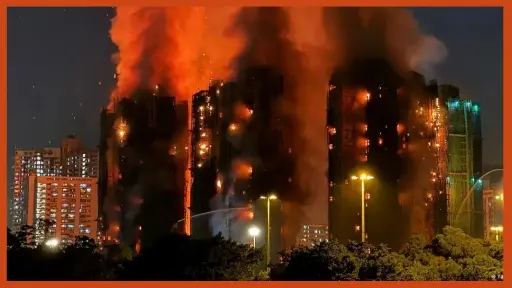
HONG KONG Fire – One of the worst fires in Hong Kong in decades broke out at Wang Fuk Court, a residential complex in the crowded Tai Po district, on Wednesday afternoon. The fire destroyed seven high-rise apartment towers, killing at least 13 people, including a firefighter, and injuring many others. Officials say that some residents are still trapped as flames and falling debris make rescue work very difficult, continuing into early Thursday.
The fire was declared a level-five alarm, the highest level of emergency, and started around 2:30 p.m. local time (1:30 a.m. ET). It spread quickly along bamboo scaffolding and the building exteriors. More than 700 terrified residents had to evacuate. Over 300 firefighters worked to control the blaze as thick black smoke filled the northern New Territories skyline.
This is the deadliest residential fire in Hong Kong since the 2008 Garley Building fire, which killed 54 people. The tragedy has raised serious questions about building safety, the use of temporary scaffolding, and whether fire escape routes in high-rise buildings are adequate.
Timeline of the Hong Kong Fire
The fire at Wang Fuk Court started around 2:30 p.m. on November 26. Smoke and flames were first seen coming from the bamboo scaffolding on the outside of Tower 3, a large public housing complex built in the 1980s that houses thousands of middle-class families. Emergency calls were immediately made to the Hong Kong Fire Services Department (FSD).
The fire spread very quickly. The highly flammable bamboo scaffolding helped the flames jump to nearby towers. By 3:00 p.m., four towers were on fire, and by 4:00 p.m., all seven towers were burning. Strong winds carried burning embers across the 30-story buildings. Eyewitnesses described a “wall of fire” climbing the buildings, with scaffolding collapsing and debris falling on residents trying to escape. 71-year-old Wong told reporters he escaped but fears his wife is trapped on the 15th floor, her cries for help drowned out by the flames.
By 5:00 p.m., the FSD raised the fire to a five-alarm emergency. They sent 52 fire engines, 14 breathing apparatus teams, and over 300 firefighters to fight the blaze. The peaceful estate became chaotic, filled with sirens, broken glass, and thick smoke spreading to the neighboring Fu Shin Estate.
At a press conference at 7:00 p.m., FSD Deputy Director Derek Armstrong Chan confirmed that 9 people died at the scene, mostly from smoke inhalation or falling, and 4 more died in hospitals, bringing the total to 13. Among the dead was 37-year-old firefighter Sgt. Lam Wai-keung, who died trying to rescue people from the rooftop. This was the FSD’s first line-of-duty death since 2019. At least 15 others were hospitalized, with three in critical condition due to burns and breathing problems.
Around 700 residents were evacuated, many in pajamas and holding pets. They were taken to temporary shelters in nearby schools and community halls, where Red Cross volunteers provided water, blankets, and emotional support. Many people were in panic, and some were separated from family members.
As of 6:00 a.m. Thursday, the fire still smoldered in Towers 2 and 5. Chan warned that falling debris and burning scaffolding were still dangerous. Full containment could take 12–24 more hours. Rescue operations continued at night using floodlights, drones, and thermal cameras to find up to 20 people still possibly trapped. The FSD asked the public to stay away from the area, which remains cordoned off, and issued air quality alerts due to hazardous smoke.
Victims and Heroes
Among the confirmed dead are both elderly residents and young families, showing that the fire affected everyone in Wang Fuk Court, which is home to over 4,000 people. This reflects the crowded living conditions of Hong Kong’s working-class communities.
Many heartbreaking stories appeared on social media:
- Ms. Lee, a 28-year-old mother, died protecting her toddler from falling debris on the 8th floor of Tower 4. Her final message on WeChat said, “The sky is on fire—tell my parents I love them.” Her child survived with minor burns and is now stable at Prince of Wales Hospital.
- Mr. Cheung, an 82-year-old retired teacher, died in his 22nd-floor unit after being overcome by smoke while trying to warn neighbors via the intercom. Many residents also tried to help by banging pots and flashing lights to guide rescuers.
The death of a firefighter deeply affected the city. Sgt. Lam Wai-keung, 37, a father of two and experienced firefighter, died while trying to save residents. FSD Director Andy Yeung called him a “true guardian” and promised a full review of safety equipment and rescue procedures.
Survivors shared stories of courage and quick thinking:
- Ah Ming, a 45-year-old office worker, jumped from a second-story balcony to escape Tower 6. He broke his leg but survived thanks to a neighbor’s mattress.
- A group of elderly tai chi practitioners in Tower 1 created a human chain to pass wet towels to trapped families, saving at least five lives.
By morning, grief mixed with gratitude. Community centers were full of donated clothes and hot meals. Online fundraisers for the victims’ families quickly surpassed HK$2 million ($256,000 USD), showing the city’s support and solidarity.
Hong Kong Fire Safety Concerns
The tragedy at Wang Fuk Court shows a major safety problem in Hong Kong’s high-rise buildings: the widespread use of bamboo scaffolding for renovations. Bamboo scaffolding is cheap and flexible, which is why it is so common in the city. However, it is very flammable, and previous fires show the danger. For example:
- April: Kwun Tong blaze, 3 people injured
- May: Yau Ma Tei fire, 2 dead
- October: Mong Kok fire, 5 people trapped
After the fire, the Association for the Rights of Industrial Accident Victims (ARIAC) warned that fire safety rules for temporary structures are not strictly enforced. They called for an urgent inspection of over 10,000 scaffold projects in the city. Early investigations suggest that the fire likely started from welding sparks on the scaffolding, although arson and electrical problems are still being checked by the Hong Kong Police Arson and Explosives Squad.
Experts have also spoken out. Dr. Li Wei, a fire safety engineer at the University of Hong Kong, said that while building codes have improved since the 1990s—with sprinklers in new towers and wider escape routes—older estates like Wang Fuk, built between 1987 and 1990, often lack proper fire safety systems. Only 60% of units have automatic fire suppression systems, and narrow stairwells make smoke spread faster.
The fire was extremely hot, reaching over 1,000°C, and was fueled by polyethylene sheeting on the scaffolding, showing a gap in safety regulations. Although the government promised in January 2025 to phase out bamboo scaffolding in public projects by 2028, private renovations like Wang Fuk’s HK$50 million exterior repaint were not included. This left the building highly vulnerable—a “tinderbox” where one spark could quickly spread fire across multiple towers.
In response, Chief Executive John Lee announced a midnight emergency review of scaffold regulations. He also allocated HK$100 million (about $12.8 million USD) for retrofits and promised zero tolerance for sites that don’t comply with safety rules. Housing advocates welcomed the move, but some critics said it is “too little, too late.”
Official Response
Hong Kong’s government acted quickly after the fire. By 6:00 p.m., the Home Affairs Department had opened 12 relief centers to help people who lost their homes. These centers offered temporary housing and psychological counseling for those traumatized by the fire. At the same time, the Social Welfare Department provided emergency aid packages worth HK$10,000 (about $1,280) to each affected family.
Chief Secretary Paul Chan visited the site at 10:00 p.m. to comfort evacuees. He promised a full investigation into the fire, with forensic teams searching through the rubble by dawn. Support also came from abroad: Beijing sent 50 firefighters and medical experts to help, showing “one-country solidarity” despite past tensions in Hong Kong.
Amid the chaos, stories of human bravery and resilience have emerged. Neighbors in towers not affected by fire organized food drives, sending porridge and diapers to people trapped on higher floors using ropes. Young volunteers from the Tai Po Community Network even used drones to deliver masks and water bottles, with videos going viral on social media under #TaiPoFireHeroes, trending with 500 million views.
As the sun rose over the smoke-filled skyline, impromptu vigils appeared around the estate. Candles burned next to photos of the victims, and people chanted “Together Strong” in both Cantonese and English. This showed Hong Kong’s resilient spirit, even as the death toll may rise and the city faces a difficult day ahead.
This tragedy is a wake-up call for fire safety in big cities worldwide. Authorities are continuing rescue and investigation efforts. Our thoughts are with the Wang Fuk Court community—may the victims rest in peace, and may the survivors find comfort and support quickly.
Conclusion
This tragic fire is a wake-up call for urban safety in densely populated cities worldwide. While authorities continue rescue operations and investigations, Hong Kong mourns its loss and celebrates the bravery of firefighters, neighbors, and volunteers who risked their lives. Our thoughts are with the victims and survivors of Wang Fuk Court.