
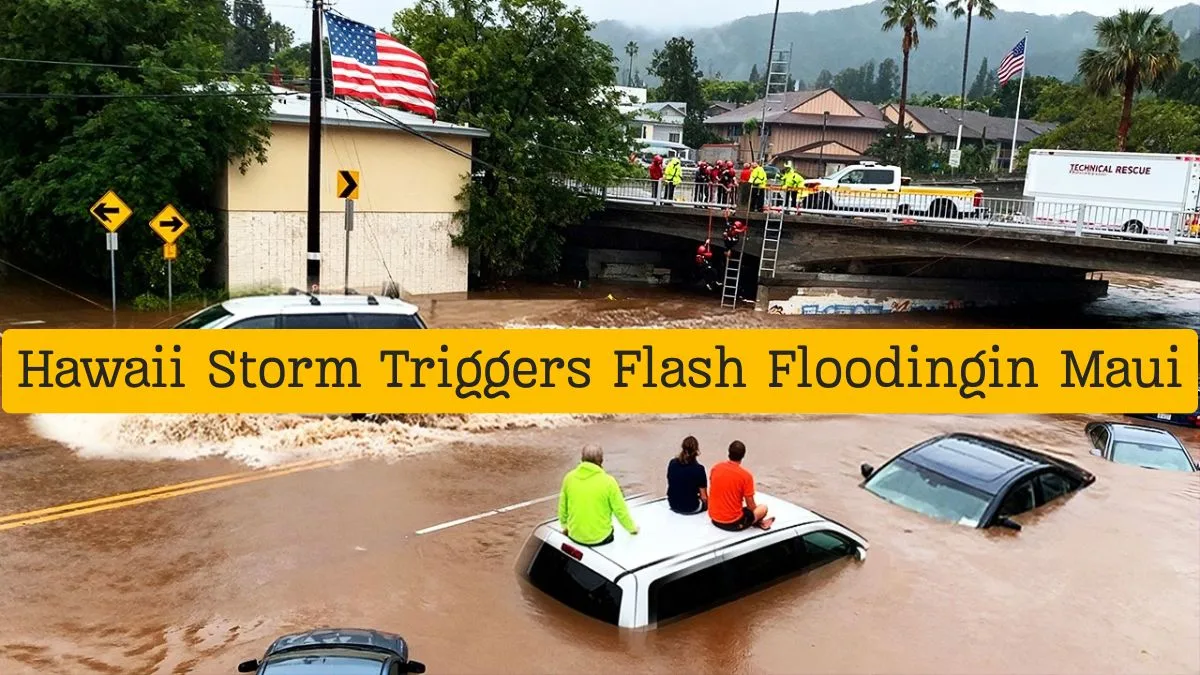
Hawaii Storm Triggers Flash Flooding in Maui: Latest Weather Updates — March 15, 2026
Hawaii Flash Flooding: A powerful Kona low storm system is battering the entire state of Hawaii with devastating flash flooding, hurricane-force wind gusts, widespread road closures, floodwater rescues, and more than 111,000 customers without power across multiple islands.
Maui County is at the center of the disaster — with more than 20 inches of rain recorded in some areas, dozens of people cut off in Hana due to road washouts, and the entire Hana Highway into East Maui blocked by multiple landslides.
This is the complete, up-to-date story of the Hawaii storm and what authorities are telling residents right now.
Hawaii Storm — March 2026 at a Glance
| Storm Type | Kona Low — powerful counterclockwise low-pressure system |
| Storm Start | Thursday, March 12, 2026 |
| Expected End | Sunday evening — extending into Monday for Big Island |
| Rainfall Record | 20+ inches in Kula, Maui |
| Wind Gusts | 70+ mph in Kaunakakai; 75+ mph along Big Island Kona coast; 100+ mph possible on summits |
| Power Outages | 114,000+ customers statewide — Oahu 70,000 / Big Island 28,300 / Maui 15,700 |
| Islands Affected | Oahu, Maui, Molokai, Lanai, Big Island, Kauai |
| Active Warnings | Flash Flood Warnings — Maui / Molokai / Big Island |
| Statewide Alert | Flood Watch through Sunday night into Monday morning |
| High Wind Warning | Maui County through Sunday evening — gusts 60+ mph |
| Winter Storm Warning | Big Island summits — blizzard conditions, 12–20 inches snow |
| Emergency Declaration | Signed by Maui County Mayor Richard Bissen — March 10 |
| Road Closures | Hana Highway (multiple blockages); South Kihei Road; North Kihei Road; Kamehameha Highway Molokai (mile marker 6); Kula Highway (mile markers 15–15.5); Highway 11 Big Island |
| Haleakala National Park | CLOSED — summit and Kipahulu districts |
| Maui Bus Service | SUSPENDED until further notice |
| Floodwater Rescues | Conducted in South Maui overnight; multiple rescues in Honolulu |
| People Cut Off | Dozens in Hana — later evacuated to shelter |
| Damage Reports | crisistrack.juvare.com/public/mauiHI/request.html |
| Emergency Hotline | 911 for emergencies — county Civil Defense for non-emergency |
| NWS Core Message | “Turn around, don’t drown” |
Hawaii Flash Flooding After Severe Storm
A large and powerful Kona low storm system — one of the most severe to hit the Hawaiian islands in recent years — began battering the state on Thursday March 12, 2026 and has continued through the weekend with no sign of letting up until at least Sunday evening.
The storm has brought an extended period of flash flooding, damaging winds, and strong thunderstorms, extending east to Maui County and Hawaii Island.
The system is what meteorologists call a Kona low — a counterclockwise rotating low-pressure system that develops near the Hawaiian islands and pulls deep tropical moisture across the entire state simultaneously, producing the kind of sustained, multi-day rainfall that overwhelms drainage systems, fills rivers and streams to capacity, and triggers landslides on steep terrain.
According to the National Weather Service, some areas have received more than 20 inches of rain, including Kula, and wind gusts over 70 mph were recorded in Kaunakakai.
Twenty inches of rain. Wind gusts exceeding 70 miles per hour. These are not ordinary Hawaii weather numbers. These are the numbers of a genuinely dangerous, genuinely destructive storm system that has turned the streets of Maui into rivers and the slopes of Haleakala into active landslide zones.
Heavy rain and dangerous flooding conditions intensified across parts of Hawaii on Saturday afternoon as the National Weather Service extended a flash flood warning for Maui, posted a new flash flood warning for Molokai, and warned that a powerful Kona-low storm continues to bring severe weather across the islands.
The power outage numbers tell the scale of the destruction clearly. Hawaiian Electric said that, as of Saturday night, about 70,000 customers were without power on Oahu; 15,700 customers in parts of Maui County; and 28,300 customers on Hawaii Island.
That is more than 114,000 households without power across the state — families without lights, without refrigeration, without the ability to charge the devices they need to receive emergency alerts, in the middle of a storm that is still producing dangerous conditions.
On Oahu, a majority of those without electricity are in the windward and east Honolulu areas due to storm-damaged high-voltage transmission lines that traverse the Koʻolau Mountain Range. A helicopter crew inspected the damaged lines. Repairing damage from the storm could take anywhere from hours to days or even longer as crews will need to navigate mountainous terrain.
Maui Flooding: Areas Most Affected
Maui County — encompassing the islands of Maui, Molokai, and Lanai — has been the hardest hit area in the current storm system, with flooding, landslides, sinkholes, downed power lines, and road closures affecting virtually every major road artery across the county.
Maui County Civil Defense Administrator Kono Davis said heavy rain and flooding have affected major roadways across Maui County. Officials said flooding, landslides, sinkholes and downed power lines have forced widespread road closures. Emergency crews conducted floodwater rescues overnight in South Maui, and officials said dozens of people were cut off in Hana due to road washouts.
Dozens of people cut off in Hana. That community — located on the remote eastern tip of Maui, accessible only via the winding Hana Highway — was completely isolated from the rest of the island by the storm, with multiple road washouts making it impossible for vehicles to enter or exit. Those residents were eventually evacuated to a shelter.
The specific road closures affecting Maui County as of the latest updates include:
Hana Highway into East Maui is currently inaccessible due to multiple blockages. South Kihei Road is closed north of Waipuilani, and North Kihei Road is also closed. Haleakala National Park’s summit and Kipahulu districts are closed according to the National Park Service.
Kula Highway on Maui between mile marker 15 and 15.5 was closed due to thick mud.
Various areas of Upcountry, South, Central and East Maui are impacted by power outages. Damage assessments and potential repairs are being stalled due to flash flooding, downed trees, and road closures.
On Molokai — the smaller island in Maui County located to the northwest of the main island — the flooding created its own set of dangerous conditions. Emergency Management reported that high water continues to flow over Kamehameha Highway near mile marker 6, and that it is currently closed to vehicular traffic.
On the Big Island, at 4:04 p.m. Saturday, the NWS radar indicated heavy rain continuing to fall over the Puna and Kau districts along the southeast slopes of the Big Island, with rain falling at a rate of 1 to 2 inches per hour.
Areas that potentially might experience flash flooding include Hawaiian Paradise Park, Hawaii Volcanoes National Park, Wood Valley, Pahala, Volcano, Glenwood, Punaluu Beach, Mountain View, Naalehu, Pahoa, and Waiohinu.
On Oahu, the state capital Honolulu faced its own flooding crisis. Debris and brown water were seen in the Ala Wai Canal during the aftermath of the Kona-low storm system. Rescue crews responded to a series of water rescues Friday morning as streams swelled in Honolulu.
The entire state of Hawaii is saturated. Every stream is running high. Every drainage ditch is full. Every slope that receives additional rain is a potential landslide. This is what a Kona low does to a chain of volcanic islands in the middle of the Pacific Ocean.
Weather Alerts Issued Across Hawaii
The National Weather Service has issued the most comprehensive package of weather alerts across the Hawaiian islands in recent memory — covering every island in the chain simultaneously with overlapping warnings, watches, and advisories.
Flash Flood Warnings — the most serious alert level, indicating flash flooding is occurring or is imminent — have been in effect for:
Hawaii Island until 8 p.m., Molokai until 8:30 p.m. and Maui County until 8:00 p.m. on Saturday, March 14. Possible impacts include flooding in drainages, streams, rivers, roads, properties, and other low-lying areas. Public road closures may be in effect in some areas. Landslides are possible in steep terrain.
Statewide Flood Watch — a lower-level alert indicating conditions are favorable for flooding to develop — remains in place across the entire state. The entire state is under a flood watch through Sunday night into Monday morning. Officials say additional rain on already saturated grounds could lead to sudden flooding.
High Wind Warning — a high wind warning continues for Maui County through Sunday evening with southwest winds of 30 to 40 mph and gusts exceeding 60 mph, while summit areas of Haleakala and Hawaii Island could see gusts above 100 mph.
Winter Storm Warning — yes, in Hawaii — a winter storm warning is in place until 6 a.m. Monday for Hawaii Island summits. The same system is bringing extreme conditions to the highest elevations of Hawaii island, where forecasters say blizzard conditions are possible with 12 to 20 inches of additional snow and winds that could gust over 100 mph through early Monday morning.
Snow blizzards on the Big Island summits. Flash flooding in Maui valleys. Floodwater rescues in Honolulu. Wind gusts of 70 mph on Molokai. This is one storm system producing every category of weather disaster simultaneously across a 1,500-mile island chain.
The flooding threat will start to decrease for Kauai and Oahu throughout Sunday. However, the ground will be so saturated that any additional rainfall could lead to quick runoff and flash flooding. Flash flooding and breezy southwest winds are still expected for Maui County and Hawaii Island on Sunday, potentially extending into Monday for Hawaii Island.
What Authorities Are Saying About the Storm
Hawaii officials at every level of government have been communicating urgently and consistently since the storm began — issuing emergency declarations, opening shelters, deploying rescue crews, and delivering one message above all others: stay off the roads.
Maui County Mayor Richard Bissen acted decisively at the beginning of the storm event. Mayor Richard Bissen signed an emergency proclamation on March 10 allowing the county to access state and federal assistance and streamline procedures to deploy resources.
That emergency proclamation — signed before the worst of the flooding arrived — gave Maui County the legal authority to access state and federal disaster resources immediately, without the delays that typically accompany bureaucratic approval processes. It was the right call.
Maui County Civil Defense Administrator Kono Davis has been the public face of the county’s response, providing regular updates on road conditions and rescue operations. His words on Saturday captured the scale of what the county was dealing with: “Over the past day and a half, Maui has been experiencing a lot of rain and wind inundation across the entire county, including Molokai and Lanai. A lot of the major thoroughfares or critical infrastructure roadways have been inundated or blocked.”
His top priority was clear. “Our top priorities today are to open up those transportation arteries,” Davis said. “So our service workers and our emergency services can get to the places where we need to work.”
Transportation arteries. The roads that connect Maui’s communities to each other and to emergency services — the same roads that are blocked by landslides, covered in mud, washed out by flooding — are the critical infrastructure that must be restored before the full recovery effort can begin.
MEMA said residents and businesses impacted by the storm can submit damage reports online at crisistrack.juvare.com/public/mauiHI/request.html.
For residents and visitors who need shelter, the shelters provide cots, food and water, and are operated by the Maui Emergency Management Agency and the American Red Cross. People are advised to bring their own bedding, essential supplies and medications. Pets are permitted if they are in crates.
All Maui Bus services are suspended until further notice due to hazardous road conditions from the storm.
Crews with the Hawaii Department of Transportation and contractors have been working to clear trees, rocks, and other debris from roadways on all islands.
The NWS message to every resident and visitor in Hawaii is the same simple, potentially lifesaving instruction that emergency managers repeat during every flood event: “Turn around, don’t drown.”
Michigan Public Do not attempt to cross flooded roadways. Do not underestimate the power of moving water. Fast-moving floodwater just 6 inches deep can knock a person off their feet. Two feet of rushing water can carry away most vehicles. No destination is worth the risk.
Hawaii Flash Flooding Safety: What Every Resident Needs to Know Right Now
If you are in Hawaii during this storm, here is the essential safety guidance from the National Weather Service and county emergency management officials:
Do not drive through flooded roads. Road surfaces may be completely gone beneath floodwater — washed out, undermined, or covered with debris that is invisible underwater. Officials strongly advised the public not to drive through pooling or moving water. Roadways remain hazardous due to debris, flooding and limited turnaround space.
Stay away from streams and drainage ditches. As a precautionary measure, stay away from streams, rivers, drainage ditches, and culverts, even if they are currently dry. Flash flooding can send a wall of water down a dry streambed in minutes with no warning.
Treat malfunctioning traffic lights as four-way stops. Officials reminded drivers to treat any traffic light that is out or malfunctioning as a four-way stop.
Stay informed. The National Weather Service is updating its alerts continuously as the storm evolves. Download the HNN Weather app or monitor NWS Hawaii for the latest warnings and watches for your specific island and area.
Submit damage reports. MEMA said residents and businesses impacted by the storm can submit damage reports online at crisistrack.juvare.com/public/mauiHI/request.html.
Emergency shelter locations are available across all major islands — contact your county emergency management agency for the nearest open shelter.
Latest Hawaii Weather Update — March 15, 2026
This article is being updated in real time as the storm continues.
As of Sunday morning March 15, the Kona low continues to produce dangerous conditions across Maui County and the Big Island. The flooding threat is beginning to decrease for Oahu and Kauai — but the ground across the entire state is saturated, meaning any additional rainfall will produce immediate runoff and renewed flooding risk.
Maui County crews are working to reopen road arteries blocked by landslides, mud flows, and debris. Power restoration is underway across all islands — but repairs to the high-voltage transmission lines damaged in the Koʻolau Mountain Range on Oahu may take days due to the mountainous terrain that crews must navigate.
If you are in Maui, on Molokai, or on the Big Island — continue to monitor National Weather Service alerts, stay off flooded roads, and follow the instructions of local emergency management officials.
Note: All data reflects official reporting from the National Weather Service, Maui County Emergency Management, Hawaii Public Radio, and Hawaiian Electric as of time of publication.