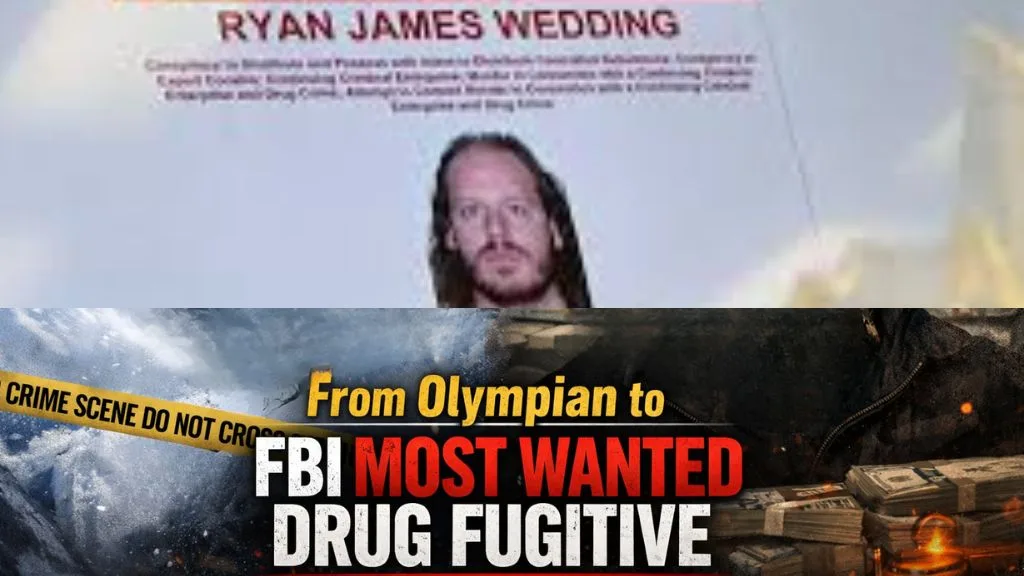
Former Olympic Snowboarder Ryan Wedding Arrested: From Olympian to FBI Most Wanted Drug Fugitive
Ryan Wedding Arrested: The winter darkness had settled over Mexico City on the evening of January 22, 2026, when a man walked through the doors of the U.S. Embassy. He wasn’t there for a visa application or routine consular services. The 44-year-old Canadian who surrendered himself that night was Ryan James Wedding—a former Olympic snowboarder who had spent over a decade evading justice, transformed from an athlete who once represented his country on the world stage into what FBI Director Kash Patel would call “a modern-day El Chapo.”
Within hours, Wedding was on a plane bound for Ontario, California, flanked by FBI agents. The man who had once carved through Olympic slopes in Salt Lake City was now walking down airplane stairs in handcuffs, wearing jeans, a grey sweatshirt, black vest, and a baseball cap—a far cry from his Team Canada uniform. Behind him lay a trail of cocaine, corpses, and shattered families. Ahead of him: federal court and a reckoning with justice he’d managed to avoid for more than ten years.
This is the story of how an Olympic dream became a criminal nightmare.
Ryan Wedding: From Olympian to FBI Most Wanted Drug Fugitive
Chapter One: The Making of an Olympian
Ryan James Wedding was born on September 14, 1981, in Thunder Bay, Ontario, as the eldest of three children. From the beginning, winter sports were woven into the fabric of his life. His maternal grandparents owned the Mount Baldy ski resort in Thunder Bay. His uncle directed a ski school and coached the Canadian women’s National Alpine Ski Team. His father, an engineer and former competitive skier, gave young Ryan every opportunity to excel on the slopes.
When Ryan was just 12 years old, the family relocated to Coquitlam, British Columbia, a Greater Vancouver suburb where he would begin his snowboarding career in earnest. The young athlete showed immediate promise. He won the very first snowboarding race he entered, a feat that would prove prophetic. By age 15, Wedding had already made the Canadian National Ski Team—an achievement most athletes spend their entire careers chasing.
The medals started coming. A bronze in parallel giant slalom at the 1999 Junior World Championship. Silver at the 2001 Junior World Championships. Then came the ultimate prize for any winter sports athlete: selection to represent Canada at the 2002 Winter Olympics in Salt Lake City, Utah.
Wedding competed in the men’s parallel giant slalom event. Olympic records show he finished 24th—not a medal-winning performance, but an accomplishment few athletes ever achieve. At just 20 years old, Ryan Wedding had reached the pinnacle of his sport. He was an Olympian, representing his nation on the world’s greatest athletic stage.
But instead of being the beginning of a storied athletic career, the 2002 Olympics would mark the end of Wedding’s legitimate pursuits. After Salt Lake City, he gave up competitive snowboarding entirely. What came next would shock everyone who knew him.
Ex-Nickelodeon Child Star Kianna Underwood Killed In NYC Hit-And-Run on Friday morning
Chapter Two: The First Fall
After the Olympic flame was extinguished, Wedding returned to Vancouver and enrolled at Simon Fraser University. On the surface, he appeared to be following the typical path of a retired athlete—pursuing education, planning for life after sports. But Wedding was restless. He developed an interest in bodybuilding and started working as a bouncer, his athletic frame proving useful in the nightlife industry.
After just two years at university, Wedding made a fateful decision: he dropped out. His next venture would be real estate speculation, but the way he financed this pursuit would set him on an irreversible path toward criminality.
Wedding started growing marijuana at a massive operation called Eighteen Carrot Farms—a 6,800-plant warehouse on a suburban property. In 2006, the Royal Canadian Mounted Police raided the facility. What they found painted a disturbing picture: a shotgun, ammunition, and marijuana worth an estimated $10 million Canadian.
But marijuana cultivation was just the beginning. In 2008, two years after the farm raid, Wedding became involved in a drug deal that would change the trajectory of his life forever. In San Diego, Wedding and two other men agreed to meet with a dealer to complete a transaction. What they didn’t know was that the dealer was working undercover for the FBI.
Wedding was arrested, charged, and ultimately convicted of conspiracy to distribute cocaine. In 2010, he stood before a federal judge and apologized. According to the court transcript, he said: “I knew it was wrong, and I did it anyway. In the past 24 months I’ve spent in custody, I’ve had an opportunity to see firsthand what drugs do to people, and honestly, I’m ashamed that I became a part of the problem.”
The judge sentenced him to prison. During his incarceration in 2011, Wedding married an Iranian-born woman. It seemed, perhaps, that imprisonment might have been the wake-up call he needed. After his release, he could have turned his life around, returned to coaching or working in the sports industry, used his Olympic experience for good.
Instead, Ryan Wedding disappeared.
Chapter Three: Rebirth as “El Jefe”
When Wedding emerged from the U.S. prison system, he didn’t return to Canada to rebuild his life. According to federal prosecutors, he fled directly to Mexico, where he would find protection under one of the most notorious criminal organizations in the world: the Sinaloa Cartel.
Under the cartel’s protection, Wedding didn’t just resume his criminal activities—he built an empire. The former Olympian transformed himself into a transnational drug trafficking kingpin, adopting multiple aliases: “El Jefe” (The Boss), “Giant,” “Public Enemy,” and “James Conrad King.” The boy who had once represented the best of Canadian athletics had become a figure who would be compared to Pablo Escobar and Joaquín “El Chapo” Guzmán.
The operation Wedding allegedly masterminded was staggering in its scope and sophistication. According to federal indictments, his organization moved cocaine on an industrial scale—approximately 60 metric tons annually through Southern California and into Canada. To put that in perspective, that’s about 132,000 pounds of cocaine per year, worth billions of dollars on the street.
The logistics were complex and carefully orchestrated. Cocaine would originate in Colombia, then be transported by boat and plane to Mexico. From there, Wedding’s organization used long-haul semi-trucks to move hundreds of kilograms at a time from Mexico across the U.S. border into Southern California. The drugs would be stored in stash houses in the Los Angeles area before being loaded onto trucks bound for Canada and other U.S. locations.
Between January 2024 and August 2024 alone, authorities estimated that Wedding’s network had moved massive shipments through this pipeline. The operation ran like a legitimate business, complete with transportation networks, logistics coordinators, and financial operatives who laundered the enormous proceeds through cryptocurrency and other means.
Law enforcement would later reveal that Wedding and his associates had made billions of dollars through this criminal enterprise. Authorities seized over 2,300 kilograms of cocaine, 44 kilograms of methamphetamine, 44 kilograms of fentanyl, eight firearms, and more than $55 million in illicit assets during their investigation.
But the drugs were just part of the story. What truly marked Wedding as one of America’s most dangerous fugitives was his alleged willingness to use extreme violence to protect his empire.
Renee Nicole Good Killed by Federal Agent Amid Immigration Crackdown – Full Details and Controversy
Chapter Four: The Bodies Start to Pile Up
If the drug trafficking charges painted Wedding as a criminal, the murder allegations revealed him as something far more sinister—a man willing to order the deaths of anyone who threatened his operation, including innocent people caught in cases of mistaken identity.
The Caledon Massacre: November 20, 2023
The most heartbreaking case began with a stolen shipment. Wedding and his alleged second-in-command, Andrew Clark (a 34-year-old fellow Canadian), believed that a drug trafficker had stolen 300 kilograms of cocaine from them—a shipment that had passed through Southern California.
They ordered a retaliatory hit.
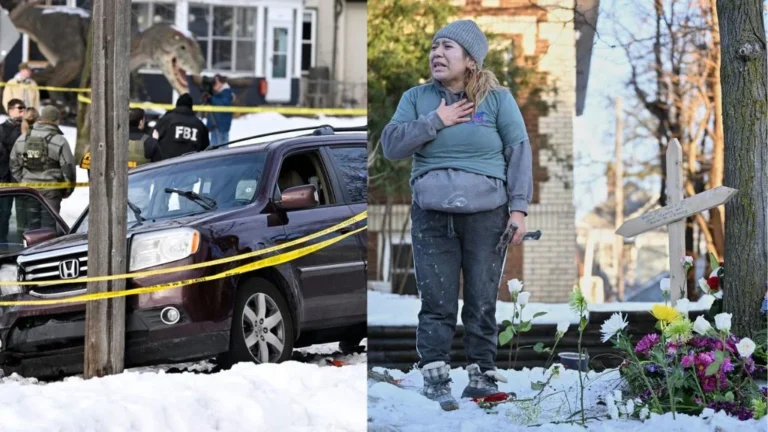
What happened next would haunt a Canadian family forever. On November 20, 2023, in Caledon, Ontario, assassins broke into a house where a family was renting. They were looking for family members of the co-conspirator they believed had stolen from Wedding’s organization.
But they had the wrong house.
Jagtar Sidhu, 57, and his wife Harbhajan Sidhu, 55, were in their home when the gunmen burst in. In front of their 28-year-old daughter, Jaspreet Kaur Sidhu, the couple was executed. Jaspreet herself was shot 13 times as she witnessed her parents’ murders.
Somehow, miraculously, Jaspreet survived. But she was left with what police described as “life-altering injuries”—physical wounds that will heal slowly, if at all, and psychological scars that may never heal. The Sidhus weren’t involved in drug trafficking. They weren’t criminals. They were simply a family, in the wrong place at the wrong time, killed because of a drug debt they knew nothing about.
According to federal indictments, Wedding and Clark had ordered the murders based on faulty intelligence. Two innocent people died, and a daughter was left permanently disabled, all because of a mistaken identity in Wedding’s war over stolen cocaine.
Additional Murders: April and May 2024
The Caledon massacre wasn’t Wedding’s only alleged killing. Federal prosecutors charged Wedding and Clark with orchestrating additional murders:
- April 1, 2024: Another victim was killed in Ontario, Canada, allegedly on the orders of Clark and Malik Damion Cunningham, a 23-year-old dual Canadian-American citizen. Court documents indicate this murder was related to the drug trafficking operation.
- May 2024: Mohammed Zafar, 39, was killed over a drug debt, allegedly at the order of Wedding and Clark.
Each murder served a purpose in Wedding’s world: eliminating threats, settling debts, sending messages. Human lives were reduced to business calculations in a billion-dollar cocaine enterprise.
The Ultimate Betrayal: Killing a Federal Witness
But perhaps the most calculated and cold-blooded alleged act came in January 2025, when Wedding allegedly orchestrated the murder of a federal witness who was set to testify against him.
The witness was living in Medellín, Colombia, trying to stay safe from Wedding’s reach. But Wedding allegedly placed a multimillion-dollar bounty on his head. He enlisted an attorney named Deepak Balwant Paradkar, 62, from Thornhill, Ontario, who allegedly advised Wedding to murder the witness to avoid extradition to the United States.
Wedding needed to find his target. So he allegedly used a Canadian website called “The Dirty News,” operated by a man named Bal. In exchange for payment, Bal agreed to post a photograph of the witness on the website so that he could be identified and located.
Wedding also enlisted others to help track down the witness. Basora-Hernandez, a reggaeton musician and citizen of the Dominican Republic, allegedly provided co-conspirators with the witness’s contact information. Carmen Yelinet Valoyes Florez, 47, of Bogotá—identified by U.S. Treasury officials as “a Colombian national who runs a high-end prostitution ring in Mexico”—allegedly assisted with the murder. Valoyes had also introduced Wedding to his Colombian girlfriend, Daniela Alejandra Acuna Macias.
With the photograph posted and the witness’s location identified, assassins followed him to a restaurant in Medellín in January 2025. There, in broad daylight, the witness was shot in the head and killed.
It was witness intimidation of the most extreme kind—a message to anyone who might consider cooperating with U.S. authorities: We can reach you anywhere. We will find you. We will kill you.
Chapter Five: The Investigation Closes In
While Wedding believed he was operating with impunity from Mexico under Sinaloa Cartel protection, law enforcement agencies across multiple countries were building a case against him.
The FBI dubbed their operation “Operation Giant Slalom”—a nod to Wedding’s Olympic event, but also a reference to the giant nature of his alleged criminal enterprise. The investigation was truly international in scope, involving:
- The FBI’s Los Angeles field office
- The Los Angeles Police Department
- The Drug Enforcement Administration (DEA)
- The Royal Canadian Mounted Police (RCMP)
- Mexican law enforcement authorities
- Colombian authorities
- Dominican Republic authorities
For over a year, these agencies worked together, sharing intelligence, tracking money flows, intercepting communications, and slowly unraveling Wedding’s network.
The first major breakthrough came in September 2024, when a superseding indictment was filed in Los Angeles federal court against Wedding, Clark, and 14 others. The 16-count indictment included charges of:
- Running a continuing criminal enterprise
- Conspiracy to distribute and export cocaine
- Murder in connection with a continuing criminal enterprise
- Attempted murder
- Money laundering
- Witness intimidation
In October 2024, authorities made their first wave of arrests. Sixteen defendants were charged with allegedly running and participating in Wedding’s transnational drug trafficking operation. Wedding’s alleged second-in-command was arrested in Mexico. By the end of October, 36 people had been arrested for their roles in the organization.
In November 2024, authorities in Mexico seized dozens of motorcycles believed to be owned by Wedding—with an estimated value of approximately $40 million. They also seized two Olympic medals (presumably Wedding’s Junior World Championship medals), two vehicles, drugs, artwork, and other items at various locations in Mexico City.
That same month, the FBI seized a rare 2002 Mercedes CLK-GTR Roadster valued at approximately $13 million. The U.S. Treasury Department sanctioned 19 people associated with Wedding’s organization.
Then came another wave of arrests in November 2025. Ten defendants were arrested in connection with a superseding indictment that charged Wedding with ordering the murder of the federal witness in Colombia. Those arrested included:
- Deepak Balwant Paradkar, the attorney who allegedly advised Wedding to kill the witness
- Bal, the operator of “The Dirty News” website
- Basora-Hernandez, the reggaeton musician
- Rolan Sokolovski, 37, of Toronto
- Several others connected to the organization
Authorities also took immigration action against associates of Wedding’s enterprise, including Latin pop artist Samantha Melissa Granda-Gastelu, 38, a Canadian national residing in Aventura, Florida, whose husband Nahim Jorge Bonilla, 37, had been indicted on separate murder conspiracy charges.
But through it all, Wedding himself remained a ghost.
Imani Dia Smith Death at 25: Facts About the Killing of the Former Lion King Child Star
Chapter Six: The Most Wanted
On March 6, 2025, the FBI took an extraordinary step. Ryan James Wedding was added to the FBI’s Ten Most Wanted Fugitives list—the 535th person to receive this dubious honor. He replaced Alexis Flores on the list, joining the ranks of America’s most dangerous and elusive criminals.
The FBI initially offered a reward of $10 million for information leading to Wedding’s arrest. This alone was extraordinary—one of the highest rewards the FBI had ever offered. But in November 2025, after Wedding was indicted on charges of witness intimidation, murder, and money laundering, the reward was increased to $15 million.
Think about that number for a moment. $15 million. That’s more than most people will earn in multiple lifetimes. The U.S. government was willing to pay an amount that could set someone up for life, just for information that could help capture this former Olympic snowboarder turned drug kingpin.
FBI Director Kash Patel and other officials held press conferences, displaying Wedding’s photograph alongside bricks of cocaine. They detailed his aliases, his methods, his violence. They made it clear: Ryan Wedding was a priority target.
“Wedding went from shredding powder on the slopes at the Olympics to distributing powder cocaine on the streets of U.S. cities and in his native Canada,” said Akil Davis, the assistant director of the FBI’s Los Angeles field office.
The pressure mounted. Mexican authorities seized Wedding’s assets. His network was being dismantled piece by piece. Associates were being arrested, assets frozen, safe houses raided. The walls were closing in.
Canadian authorities also wanted him. Wedding faced separate drug trafficking charges in Canada dating back to 2015. Gary Anandasangaree, Canada’s minister of public safety, called the eventual arrest “a significant step forward” in the international fight against illegal drugs.
But where was Wedding? Somewhere in Mexico, protected by the Sinaloa Cartel, he had managed to evade capture for more than a decade. The man who had once competed in front of thousands at the Olympics had learned how to become invisible.
Until he couldn’t anymore.
Chapter Seven: The Surrender
According to Mexican security analyst and sources close to the investigation, by January 2026, Ryan Wedding was running out of options.
The faction of the Sinaloa Cartel controlled by the sons of Joaquín “El Chapo” Guzmán—who is currently serving a life sentence in a U.S. prison—had reportedly withdrawn their protection from Wedding. Without the cartel’s shield, Wedding faced a stark choice: be captured by Mexican authorities and face Mexican justice, or turn himself in to U.S. authorities and face American courts.
In what appears to have been weeks of negotiation, Wedding made contact with U.S. authorities. FBI Director Kash Patel happened to be in Mexico City on a preplanned trip—though Mexican security analyst Alejandro Saucedo told CBC News that Patel had actually “planned this lightning visit to Mexico to coincide with the surrender of Ryan Wedding, to bolster the perception that, thanks to him, he obtained this major victory with the arrest of the No. 1 fugitive of the United States.”
On Thursday night, January 22, 2026, Ryan Wedding walked into the U.S. Embassy in Mexico City and surrendered.
The FBI’s Hostage Rescue Team was part of the effort to take him into custody. In a statement, Mexico’s Security Secretary Omar Garcia Harfuch confirmed that a Canadian citizen had turned himself in at the U.S. embassy and that someone on the FBI’s most-wanted list had been detained by Mexican authorities.
The surrender, according to the U.S. Embassy in Mexico, was “a direct result of pressure applied by Mexican and U.S. law enforcement working in close coordination and cooperation.”
Wedding was placed in handcuffs. After more than ten years as a fugitive, after building a billion-dollar drug empire, after allegedly ordering multiple murders, the former Olympic snowboarder was finally in custody.
Chapter Eight: Return to Face Justice
On Friday morning, January 23, 2026, a U.S. government plane touched down at Ontario International Airport, about 40 miles east of Los Angeles. FBI Director Kash Patel was waiting, along with a phalanx of federal agents, LAPD Chief Jim McDonnell, and members of the media.
The rear door of the aircraft opened. Down the stairs, flanked by FBI agents, came Ryan James Wedding. Wearing jeans, sneakers, a grey sweatshirt, a black vest, and a baseball cap, the 44-year-old former Olympian walked across the tarmac in handcuffs, his face expressionless.
The FBI released video footage of the moment. It’s a stark image: the plane taxiing to a stop, agents surrounding it, Wedding being led down the stairs and across the tarmac like any common criminal. The man who had once represented Canada at the highest level of international athletics was now being paraded as one of America’s most wanted criminals, finally brought to justice.
At a press conference, Patel didn’t hold back in his characterization of Wedding.
“Just to tell you how bad of a guy Ryan Wedding is, he went from an Olympic snowboarder to the largest narco-trafficker in modern times,” Patel said. “He is a modern-day El Chapo, he is a modern-day Pablo Escobar, and he thought he could evade justice.”
The comparison to El Chapo and Pablo Escobar wasn’t hyperbole. Wedding’s alleged operation had moved 60 metric tons of cocaine annually—rivaling the output of major cartel operations. The violence he allegedly orchestrated, including the murder of a federal witness, mirrored the tactics of history’s most notorious drug lords.
Akil Davis, the assistant director of the FBI’s Los Angeles field office, spoke about the victims.
“Ryan Wedding tormented several people and several families that will never be the same, but today they get the justice that they sought,” Davis said.
Los Angeles Police Chief Jim McDonnell emphasized the international cooperation that made the arrest possible: “This has been a coordinated, intelligence-driven investigation into Wedding’s global drug trafficking organization which used Los Angeles as its primary point of distribution.”
In a social media post, U.S. Attorney General Pam Bondi declared: “At my direction, Department of Justice agents @FBI have apprehended yet another member of the FBI’s Top Ten Most Wanted List: Ryan Wedding, the onetime Olympian snowboarder-turned alleged violent cocaine kingpin. Wedding was flown to the United States where he will face justice.”
Wedding was transferred to a federal detention center in Southern California. He was scheduled to make his initial appearance in federal court in downtown Los Angeles on Monday, January 26, 2026.
Chapter Nine: What Awaits
As Ryan Wedding sits in a federal detention facility awaiting his court appearance, the charges against him paint a grim picture of what lies ahead.
If convicted, Wedding faces:
- Mandatory minimum sentence of life in federal prison on the continuing criminal enterprise charge
- Mandatory minimum penalty of 20 years on each murder and attempted murder charge
- Mandatory minimum penalties of 10 to 15 years on various drug trafficking charges
Given that he’s charged with multiple murders, running a criminal enterprise, witness intimidation, and trafficking tons of cocaine, Wedding could realistically be looking at multiple life sentences without the possibility of parole.
The evidence against him appears substantial. Authorities have:
- Seized over $55 million in assets
- Arrested 36 people in his alleged organization
- Recovered thousands of kilograms of drugs
- Documented cryptocurrency transactions worth billions
- Collected testimony from cooperating witnesses (those who weren’t murdered)
- Built a paper trail spanning multiple countries and years
Wedding’s attorneys—though none were listed in federal court records at the time of his arrest—will have their work cut out for them. The charges span multiple jurisdictions, involve international conspiracy, and include some of the most serious crimes in the federal code.
Even if Wedding somehow avoids conviction in the U.S., Canada is waiting with separate drug trafficking charges dating back to 2015. There is virtually no scenario in which Ryan Wedding walks free again.
John Wayne Gacy: The Killer Clown Who Murdered 33 Boys in the 1970s
Epilogue: The Victims Left Behind
While Ryan Wedding’s capture makes for dramatic headlines and satisfies a hunger for justice, it’s important to remember the human cost of his alleged crimes.
Jaspreet Kaur Sidhu, who watched her parents die and was shot 13 times herself, will carry physical and psychological scars for the rest of her life. Her parents, Jagtar and Harbhajan Sidhu, were innocent people killed because of mistaken identity in a drug war they never chose to be part of.
Mohammed Zafar, allegedly killed over a drug debt, left behind family and friends who will never get him back.
The federal witness murdered in Medellín was trying to do the right thing by cooperating with authorities, only to pay the ultimate price.
Thousands of families across Canada and the United States have been affected by the 60 metric tons of cocaine that Wedding’s organization allegedly moved each year—addiction, overdoses, broken homes, destroyed lives.
The $15 million reward offered for Wedding’s capture was money well spent if it prevents even a fraction of the harm his organization allegedly caused. But no amount of money, no length of prison sentence, can undo the damage or bring back the dead.
Final Thought
Ryan Wedding’s journey from Olympic glory to FBI’s Most Wanted is a story almost too dramatic to believe. How does someone go from representing their nation at the Olympics at age 20 to allegedly running a billion-dollar cocaine empire by age 40? How does an athlete transform into someone accused of ordering the murder of innocent parents in front of their daughter?
The answer lies in a series of choices. The choice to drop out of university and grow marijuana. The choice to get involved in cocaine distribution. The choice, after being caught and serving time, to not change course but to double down. The choice to flee to Mexico and align with one of the world’s most dangerous cartels. The choice to allegedly order murders to protect drug profits.
Each choice led to the next, a downward spiral from Olympic athlete to fugitive to accused murderer. Wedding had every advantage: athletic talent, Olympic experience, family support, opportunities. He could have been a coach, a motivational speaker, a role model for young athletes. Instead, according to prosecutors, he chose a path that left bodies in his wake and billions in drug money in his accounts.
As Wedding appears in federal court, handcuffed and facing life in prison, one can’t help but wonder if he thinks back to that day in Salt Lake City in 2002. Does he remember standing at the start of his Olympic run, representing Canada, the possibilities of life stretching out before him like an open slope?
Does he wonder, in the quiet of his cell, where it all went wrong?
On Monday, January 26, 2026, Ryan James Wedding will enter a federal courtroom to face charges that he is a modern-day Pablo Escobar, that he orchestrated murders and moved billions in cocaine, that he terrorized families and corrupted everyone around him in pursuit of drug profits.
The former Olympian will enter his plea. And then, finally, after more than a decade of running, the American justice system will decide his fate.
The Olympic dream that began in Thunder Bay, that soared in Salt Lake City, has ended in a federal courtroom in Los Angeles, in handcuffs, facing life in prison.
It’s a fall from grace unlike any other in Olympic history—and a stark reminder that talent, opportunity, and Olympic glory mean nothing if you choose the wrong path.
Epilogue Note: Ryan Wedding is scheduled to appear in federal court on January 26, 2026. He is presumed innocent until proven guilty. The charges against him are allegations, and he will have the opportunity to defend himself in court.