
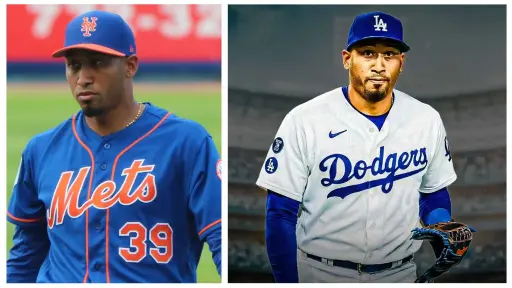
Edwin Diaz’s Shocking Move to Dodgers: Contract, Stats, Injury, Net Worth, Wife, Kids and Hobbies
On December 9, 2025, baseball fans were shocked when All-Star closer Edwin Diaz made a huge career move. He signed a three-year, $69 million deal with the Los Angeles Dodgers, who had just won the World Series. This contract set a new MLB record, giving him the highest yearly salary ever for a relief pitcher.
The news surprised almost everyone. Mets fans believed he would stay in New York, especially after the team made big offseason moves. Dodgers fans were also caught off guard because they thought their bullpen was already strong with Tanner Scott. The signing immediately changed the balance of power in Major League Baseball, as one of the best closers in the sport switched from the Mets to the Dodgers, intensifying their National League rivalry even more.
Edwin Diaz was born on March 22, 1994, in Naguabo, Puerto Rico. He was drafted in the third round by the Seattle Mariners in 2012 and quickly became known for his powerful arm. He reached the major leagues at just 22 years old. His big breakout came in 2018, when he had an incredible 1.96 ERA, an MLB-leading 57 saves, and 124 strikeouts in 73⅓ innings. That season earned him the AL Reliever of the Year award and his first All-Star selection.
Must Read: Chris Henry Jr. | The Rising Star WR Carrying a Legacy into College Football’s Spotlight
Who Is Edwin Diaz?
| Category | Details |
|---|---|
| Full Name | Edwin Orlando Díaz Laboy |
| Nickname | Sugar |
| Date of Birth | March 22, 1994 |
| Age | 31 (as of 2025) |
| Birthplace | Naguabo, Puerto Rico |
| Nationality | Puerto Rican |
| Height | 6 ft 3 in (1.91 m) |
| Weight | 195 lbs (88 kg) |
| Position | MLB Pitcher (Closer) |
| Bats / Throws | Right / Right |
| Current Team Status | New York Mets (Signed; Dodgers rumors) |
| Brother | Alexis Díaz (MLB pitcher, Cincinnati Reds) |
| Famous Entrance Song | “Narco” by Blasterjaxx & Timmy Trumpet |
| Entrance Style | Trumpet entrance; viral walkout moment at Citi Field |
| Injury | 2023 WBC knee injury (patellar tendon tear) |
| Return | Returned to MLB in 2024 |
| Net Worth | Estimated $20–25 million |
| Relationship Status | Married to Nashaly Mercado |
| Children | Two |
| Hobbies | Fishing, music, workouts, spending time with family |
| Religion | Christian |
| Favorite Music | Reggaeton & Latin trap |
| Notable Trait | One of MLB’s fastest fastballs + iconic trumpet entrance |
Díaz was traded to the New York Mets before the 2023 season, and he soon became a fan favorite in New York. He is famous for his triple-digit fastball, often hitting 101–102 mph, and a sharp 90–94 mph slider that causes many missed swings. His strikeout rate, a career 15.2 K/9, is one of the best in baseball history for a closer.
Around the world, fans know him for his iconic entrance music “Narco,” which makes the stadium feel like a party every time he runs in. Over his career, Díaz has earned three All-Star nods, two Reliever of the Year awards (2018 AL and 2025 NL), and has established himself as one of the best and most feared closers in modern baseball when he is healthy.
Edwin Diaz’s Injury
Edwin Díaz’s most serious injury happened on March 15, 2023, during the World Baseball Classic quarterfinals in Miami. After pitching a perfect ninth inning to help Puerto Rico upset the Dominican Republic 5–2, Díaz tore his right patellar tendon while celebrating with teammates. He landed awkwardly in the pile-on, and the injury required immediate surgery the next day. This freak accident kept him out for the entire 2023 MLB season, despite aggressive rehab attempts.
At the time, Díaz had just signed a record five-year, $102 million deal with the Mets. His recovery was slow and cautious, with minor setbacks along the way. He returned in 2024 with a strong performance, posting a 1.31 ERA over 62 innings. A midseason right shoulder impingement landed him on the IL for two weeks in May, his first arm problem, causing a brief slump with some blown saves. By September, however, Díaz was dominant again, converting saves with precision and earning NL Reliever of the Year. At age 31, he proved his resilience and looks ready for a healthy tenure with the Dodgers.
Edwin Diaz’s Career With the New York Mets
Edwin Díaz came to the Mets in a big trade in December 2022, a deal that sent Robinson Canó, Jarred Kelenic, and cash to the Mariners. He was seen as the main piece of owner Steve Cohen’s first major move. His start in New York was rough. In 2023, he struggled with a 4.02 ERA and 10 blown saves, which made many fans question whether the trade was worth it.
Things completely changed in 2024, when Díaz delivered one of the best seasons of his career. He posted a 1.31 ERA, 34 saves, and 110 strikeouts in 62 innings. His entrance song “Narco” became a huge hit, and he quickly turned into a cult hero at Citi Field.
However, tragedy hit earlier during the 2023 World Baseball Classic. While celebrating Puerto Rico’s upset win over the Dominican Republic, Díaz tore his patellar tendon, costing him the entire 2023 MLB season. He returned in 2024 stronger than before, putting together two straight seasons with an ERA under 2.00 (a combined 1.75 in 2024–25), averaging over 15 strikeouts per nine innings, and becoming the backbone of a Mets bullpen that finally became one of the most trusted groups in the league.
Across his three healthy seasons in Queens, Díaz recorded 96 saves, a 1.63 ERA, and 315 strikeouts in 198⅔ innings. He went from being a controversial trade piece to the emotional leader of the Mets’ playoff runs — and the closer many fans believed would stay in orange and blue for the rest of his career.
What Happened in 2024–2025?
The New York Mets’ 2024 season was full of ups and downs. They started very badly at 22–33, but then made a huge comeback and finished 89–73, earning a wild-card spot. They shocked everyone by beating the Phillies in the NLDS and reaching the NLCS, where they finally lost to the Dodgers.
Much of their success came from Francisco Lindor, who played at an MVP level, and a tough pitching staff that refused to give up. Even though Edwin Díaz was coming back from his 2023 knee injury, he still gave the Mets stability. He had a 3.52 ERA, 20 saves, and fought through a midseason shoulder issue. Despite seven blown saves, he was crucial in a bullpen that often struggled.
But in 2025, the magic disappeared. The Mets finished 83–79 and missed the playoffs, even though they had their most expensive payroll ever. After the All-Star break, they collapsed with a 38–55 record, one of the worst in baseball. Injuries to key players like Sean Manaea and Francisco Alvarez hurt them badly.
The rotation used far too many pitchers, set unlucky records, and the team went 0–70 in games where they trailed in the eighth inning. Without Díaz’s usual dominance, the bullpen also suffered. Ironically, Díaz himself had an incredible season: a 1.63 ERA, 28 saves, and 98 strikeouts in 66⅓ innings, earning the NL Reliever of the Year.
After the season, Díaz chose to opt out of his five-year, $102 million contract, giving up $38 million that he could have earned. Contract talks with the Mets fell apart because Díaz wanted more years and more security. The Mets offered three years and $66 million, but with deferrals, and it wasn’t enough. The situation got worse when the Mets signed Devin Williams to a three-year, $51 million deal, which looked like they were preparing for life without Díaz. His camp didn’t like that.
Meanwhile, new president David Stearns, brought in from Milwaukee, focused on a “run-prevention” rebuild. He traded veterans like Brandon Nimmo for more infield depth, such as Marcus Semien, and tried to build a more steady pitching staff instead of spending heavily on stars.
There were even rumors that the Mets wanted Dodgers reliever Tanner Scott, who was struggling on a four-year, $72 million deal with poor results, but nothing happened. In the end, all these moves and mixed signals played a part in why Edwin Díaz eventually left the Mets, marking one of the biggest departures in team history.
Edwin Diaz Contract Breakdown — Why the Dodgers Wanted Díaz
At the Winter Meetings, the Los Angeles Dodgers made a huge move by signing elite closer Edwin Díaz to a three-year, $69 million contract. The deal includes $4.5 million in yearly deferrals, which lowers the team’s luxury-tax hit to about $21.1 million per year. Even with the deferrals, the contract breaks the MLB record for highest yearly salary for a reliever, beating Díaz’s own previous Mets deal. It also shows that the Dodgers are willing to spend big, even though they are already paying a massive 110% competitive balance tax on the contract.
The Dodgers went after Díaz hard because their bullpen fell apart in 2025. Their relievers had a 4.27 ERA (21st in MLB), blew 27 saves, and were charged with 33 losses, which nearly cost them their championship run. Their biggest problem was high-priced signee Tanner Scott, who had a terrible year with a 4.74 ERA and 10 blown saves, tied for the most in the league. It exposed how weak the ninth inning had become for a team that still managed to win back-to-back World Series titles thanks to a dominant rotation.
With Díaz now locked in as the new closer, the Dodgers’ bullpen looks much stronger. Scott will shift into a setup role, joining reliable arms like Alex Vesia (whose option was picked up), Blake Treinen, Anthony Banda, Brock Stewart, and a returning Brusdar Graterol, who is coming back from injury. The team also has promising young pitchers such as Will Klein, Jack Dreyer, and Ben Casparius, giving them one of the deepest bullpens in baseball. Díaz’s triple-digit fastball and unhittable slider should give the Dodgers the late-game weapon they were missing.
This addition boosts the Dodgers’ 2026 championship hopes in a big way. With stars like Shohei Ohtani, Mookie Betts, and Freddie Freeman already leading the roster, Díaz helps turn close games into shorter ones by locking down the final innings. The Dodgers are now in a strong position to chase a historic three-peat, potentially becoming the most dominant MLB team since the late-1990s Yankees.
Why Did Edwin Díaz Leave the Mets?
Edwin Díaz’s exit from the New York Mets and move to the Los Angeles Dodgers happened because of several connected reasons. The Mets did make a strong offer—three years and $66 million, with room to increase it—but their front office had a different long-term plan.
President of baseball operations David Stearns, known for his analytical, budget-balanced style from Milwaukee, wanted to rebuild the roster in a run-prevention, spread-the-money way instead of spending a huge amount on one reliever.
The Mets had just finished 2025 with a disappointing 83–79 record despite a $340 million payroll, and injuries plus pitching problems convinced Stearns that the team needed more balance, not another top-heavy roster. Moves like trading Brandon Nimmo for Marcus Semien showed this shift toward flexibility and sustainability.
The Mets also signed Devin Williams to a three-year, $51 million deal before finishing negotiations with Díaz. They meant it as bullpen insurance and as a possible setup man, but Díaz’s camp saw it differently. It felt like a sign that the Mets were preparing for him to leave, which weakened their overall pitch.
Díaz also felt unhappy about the firing of his trusted pitching coach Jeremy Hefner, and he was encouraged by his brother Alexis Díaz, who praised the Dodgers’ facilities and environment. Because of all this, Díaz did not return to the Mets for a counteroffer. He saw the Dodgers’ three-year, $69 million deal as a clearer path to winning right away, especially with Los Angeles in the middle of a dynasty-level run.
The reaction from Mets fans was intense. Social media filled with heartbreak, anger, and disappointment. Some called it “a sad day for Mets fans,” while others accused Díaz of choosing rings over loyalty. A few even called it “a spit in the face of Mets fans,” adding to the pain after the Mets’ tough NLCS loss in 2024. Emotionally, it felt like another crushing blow.
On the baseball side, the loss is huge. Díaz had a 1.63 ERA and 28 saves in 2025, numbers that are extremely hard to replace. But Stearns quickly shifted the plan. He named Devin Williams as the new closer and highlighted his past success and motivation to bounce back.
The Mets will now use the freed-up money to target starting pitching upgrades such as Corbin Burnes or explore trades to strengthen the rotation, which was only average last year. The team’s path forward will look different—no trumpets, no Díaz—but the goal is a stronger and more balanced 2026 contender.
What This Move Means for the Dodgers: Edwin Díaz Entrance
Edwin Díaz fits perfectly as the Dodgers’ top closer, solving the team’s 2025 bullpen problems. Last year, the Dodgers had 27 blown saves and a 4.27 ERA in relief pitching. Díaz brings his own dominance with a 1.63 ERA and over 15 strikeouts per nine innings, giving them a reliable ninth-inning arm.
He joins a strong late-inning group with Tanner Scott in setup, Alex Vesia, and Brusdar Graterol. This allows manager Dave Roberts to use pitchers more strategically and move converted starters like Roki Sasaki back to the rotation for deeper games. Late innings now become safer, reducing the risk of comebacks, even in high-scoring stadiums like Dodger Stadium.
Díaz’s presence could give the Dodgers 1–2 extra regular-season wins and an advantage in the playoffs, where consistent closers are crucial. With back-to-back World Series wins, he boosts Los Angeles’ three-peat chances, strengthening a roster led by Shohei Ohtani and Mookie Betts.
His move also intensifies the NL rivalry with the Mets, taking their former closer and “Narco” star away, while showing the Dodgers’ financial power compared to New York’s careful rebuild strategy.
What This Move Means for the Mets
Edwin Díaz’s departure leaves a big gap in the Mets’ bullpen, but team president David Stearns quickly named Devin Williams as the new closer. Stearns praised Williams for his All-Star 2024 season and said he has the talent and drive to bounce back after a rough 2025 with a 4.79 ERA for the Yankees. The Mets are also looking at other relievers, like Robert Suárez or Pete Fairbanks, to strengthen late-inning pitching, though rumors about Dodgers pitcher Tanner Scott never went anywhere.
This plan fits Stearns’ careful rebuild strategy after the 83–79 2025 season, focusing on pitching depth and long-term stability instead of big, flashy contracts. The Mets offered $66 million to keep Díaz, but it fell short of Los Angeles’ deal. Some tension reportedly came from firing pitching coach Jeremy Hefner and poor communication about Williams’ signing.
Fans have been angry online, posting messages like “Fire David Stearns” and calling the situation a betrayal. Players like Williams say they are surprised but motivated, while analysts note the urgent roster needs and pressure on Stearns to fix the bullpen before Opening Day.
MLB Reactions — Analysts, Fans, and League Impact
Edwin Díaz’s signing with the Dodgers caused a huge reaction across MLB. Media outlets like ESPN and The Athletic called it a “dynasty-defining” move that fixes Los Angeles’ struggling bullpen, especially after Tanner Scott’s $72 million flop. Meanwhile, the Mets were criticized for not matching the $69 million deal, with SNY’s Todd Zeile saying he was “shocked” the difference was only $3 million.
Social media exploded. Mets fans posted angry messages and memes, calling it a betrayal and saying Díaz “spit in our faces for a ring.” Dodgers fans celebrated, calling the team “three-peat locked.” Neutral voices joked about the salary gap with lines like “MLB Avengers incoming.”
Rival teams also reacted. NL West fans of the Padres and Diamondbacks complained about L.A.’s dominance, while AL East teams like the Blue Jays regretted missing out. The Dodgers’ $330 million+ payroll has raised concerns about fairness.
For the 2026 playoffs, Díaz’s signing changes the predictions: the Dodgers are now the clear NL favorites for a historic three-peat, the Mets are wild-card hopefuls relying on Devin Williams, and the league faces bigger debates about competitive balance and salary disparities.
Stats Breakdown — Why Díaz Is Worth the Money
Edwin Díaz’s 2025 performance shows why he is so valuable. He had a 1.63 ERA, an MLB-leading 13.3 strikeouts per nine innings, and a 0.87 WHIP, making it very hard for batters to reach base. His high-90s fastball and sharp slider created swings-and-misses on nearly 40% of pitches, well above the league average for relievers.
In important moments, Díaz is nearly untouchable. He converted 28 of 31 saves (a 90% success rate) and had a 1.66 ERA in high-pressure situations, including 12 straight scoreless outings midseason. He doesn’t just close games—he locks them down when other pitchers might fail.
Compared to peers like Emmanuel Clase and Devin Williams, Díaz combines high efficiency with heavy strikeout volume, which makes him the best closer in baseball and justifies his record $23 million average yearly salary. The Dodgers plan to rely on him to secure 35+ saves with a sub-2.00 ERA, turning shaky ninth innings into reliable finishes and helping push for a three-peat.
FAQs
What does Edwin Diaz do in the offseason and how does he give back to his community?
During the offseason, Edwin Díaz spends time in his hometown of Daguao in the Naguabo Municipality, Puerto Rico, where most of his family lives. He also runs baseball clinics for local children through his Edwin Díaz Baseball Academy. Notable MLB players like Robinson Canó and Martín Maldonado have attended these clinics.
Does Edwin Díaz have any family in professional baseball and where does his nickname “Sugar” come from?
Yes, his younger brother, Alexis Díaz, is also a professional MLB pitcher. On May 17, 2022, they became the third set of brothers in MLB history to both record a save on the same day. Edwin’s nickname, “Sugar,” was given by school teammates who thought he resembled the fictional pitcher Miguel “Sugar” Santos from the 2008 movie Sugar.
Why did Edwin Díaz leave the Mets and sign with the Dodgers?
Díaz opted out of the two-year, $38 million guarantee remaining on his Mets contract to test free agency. He declined the $22.025 million qualifying offer from New York and chose the Dodgers’ three-year, $69 million deal, which set a record for the highest average annual value for a relief pitcher. The move also triggered a compensatory draft pick for the Mets.
How will Díaz fit into the Dodgers’ bullpen?
Díaz is expected to solidify the ninth inning as the team’s top closer. Tanner Scott is lined up as his setup man, while other relievers like Alex Vesia, Blake Treinen, Anthony Banda, and Brusdar Graterol provide depth. The Dodgers had major bullpen struggles in 2025, with a 4.27 ERA and 27 blown saves, so Díaz fills a clear need and allows manager Dave Roberts to use high-leverage arms more strategically.
Why did Edwin Díaz agree to take a setup role with the Dodgers instead of being the main closer?
While Díaz is one of the best closers in baseball, the Dodgers already have a strong bullpen setup and had recently signed Tanner Scott. Díaz’s role in 2026 will primarily be as a closer, but he may occasionally pitch in setup situations to maximize matchups and manage workloads, keeping him fresh throughout the season.
How does Díaz’s deferred salary work in his Dodgers contract?
Díaz’s three-year, $69 million contract includes $4.5 million in deferred salary each season. This means a portion of his annual pay will be delayed and paid out in future years rather than immediately, which helps the Dodgers manage payroll while still giving Díaz a record-setting total contract value.