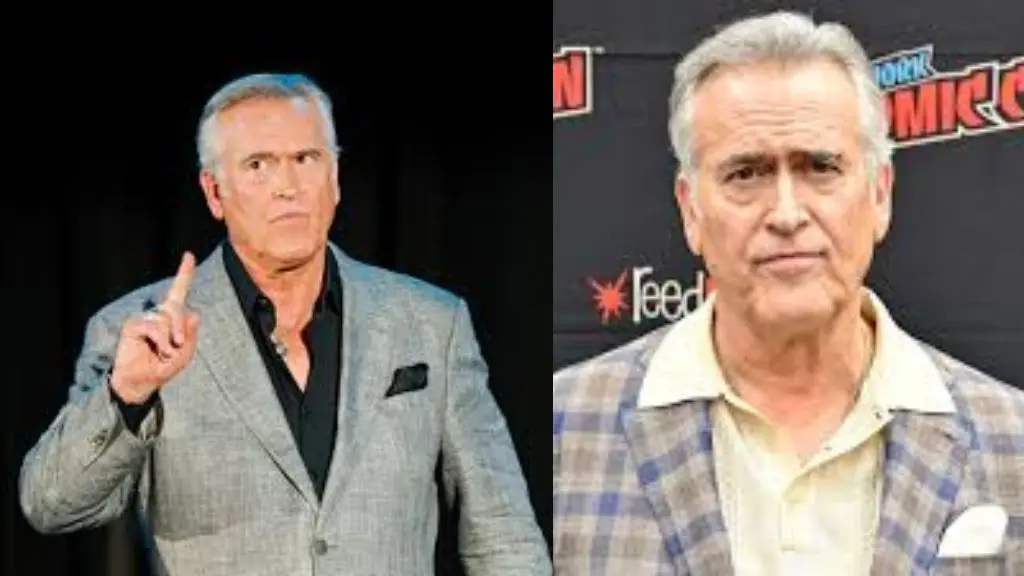
Hail to the King: Bruce Campbell’s Complete Life Story & 2026 Cancer Fight”
On March 3, 2026, beloved actor Bruce Campbell shared news that shocked his legions of fans worldwide. The 67-year-old star of the Evil Dead franchise revealed on social media that he has been diagnosed with cancer—a type that is “treatable, not curable.” With characteristic humor and frankness, Campbell wrote: “These days, when someone is having a health issue, it’s referred to as an ‘opportunity,’ so let’s go with that—I’m having one of those.”
This diagnosis represents the latest chapter in the remarkable life of an actor who has spent nearly five decades entertaining audiences, building one of the most dedicated fan bases in cinema history, and proving that success doesn’t always require big budgets or A-list billing.
Bruce Campbell Early Life: Michigan Roots and Suburban Dreams
Bruce Lorne Campbell was born on June 22, 1958, in Royal Oak, Michigan—coincidentally, the same hospital where his future lifelong collaborator Sam Raimi was born. He was the youngest of three brothers (Don and Michael), growing up in Birmingham, Michigan, in what he would later describe as a “damn near idyllic” upper-middle-class suburban environment.
His childhood home was surrounded by woods and nature, where young Bruce would dig tunnels in his backyard and run around dressed as Zorro. He played hockey as a kid and watched Lost in Space on television—the typical American boy of the 1960s.
But Bruce’s childhood had one element that set it apart: his father, Charles Newton Campbell, was both an advertising executive and an aspiring actor who performed in local community theater. Charles had wanted to be an artist, but his own father had forbidden it, pushing him into marketing instead. Only later in life did Charles get to pursue his theatrical passion—and he made sure his son would never face the same restrictions.
Charles not only encouraged Bruce’s interest in acting but actively supported it, directing him in plays and investing in his early film projects. Bruce’s mother, Joanne Louise (née Pickens), was a homemaker who created a stable, nurturing environment for the family.
Tom Steyer: The Billionaire Who Chose Principle Over Profit
The Acting Bug Bites
The “acting bug” bit Bruce at age 8 when he saw how much fun his father was having performing in community theater. He wanted in on the action. His first official acting job came at age 14 when the actor playing the young prince in The King and I became ill, and Bruce stepped into the role. He even had to sing—a sight, he later joked, “you don’t see every day.”
Bruce went on to appear in several community theater productions, including South Pacific and Fiorello. His father directed him as Chance Wayne in Tennessee Williams’ Sweet Bird of Youth—heavy dramatic material for a teenager, but it gave Bruce a foundation in serious acting that would serve him throughout his career.
During the summer of 1976, Bruce volunteered as an apprentice at Traverse City’s Cherry County Playhouse, a summer stock company in northern Michigan. He worked 18-hour days putting up sets, serving as assistant stage manager, running errands—all without making “a stinkin’ nickel,” as he later recalled. But it was an invaluable, eye-opening experience that gave him his first real taste of professional theater.
Meeting Sam Raimi: A Partnership for the Ages
In 1975, Bruce met Sam Raimi in a high school drama class at Wylie E. Groves High School. As Campbell tells the story, Raimi performed a “lame-o pantomime” in class, and Bruce followed it with an equally lame one. They consoled each other over their mutual failure and became fast friends.
The friendship was immediate and intense. Soon, Bruce, Sam, and a group of high school friends—including Scott Spiegel, Josh Becker, and Sam’s brother Ivan Raimi—began making heaps of Super 8 movies. They would eventually make about 50 films together during their high school years.
Their relationship, however, was also famously dysfunctional. Raimi delighted in tormenting Campbell, even in high school—sitting behind him and pressing a pencil into his back while Bruce tried to answer teachers’ questions. This sadistic dynamic would continue throughout their careers, with Raimi drowning Campbell in fake blood, subjecting him to physical punishment on set, and generally using his friend as a human punching bag for the camera. Campbell took it all in stride, understanding that the abuse was always in service of the film.
College Dropout and Early Hustles
After high school, Bruce briefly attended Western Michigan University to study theater, but he dropped out after just six months. He was too “darn antsy” to sit in classrooms when he could be making movies. Sam Raimi, meanwhile, went to Michigan State University to study English but was similarly restless.
To support himself, Campbell took a series of odd jobs. He worked as a production assistant for local Detroit-area commercials, learning the technical side of filmmaking. He also spent a year working the overnight shift for Southfield Cab, a taxi company. The job gave him colorful experiences—including encounters with prostitutes who would offer their services instead of paying the fare. Campbell, ever the professional, declined these arrangements and stuck to driving.
By 1978, Campbell and Raimi decided it was time to make their move. They would create a feature film.
David Montgomery: From Poverty to the Pros – The Inspiring Journey of an NFL Star and Eagle Scout
The Birth of The Evil Dead
First, they needed a proof-of-concept—something to show potential investors that they could make a horror movie worth financing. In 1979, Campbell, Raimi, and producer Rob Tapert (Raimi’s friend from Michigan State who would go on to co-create Xena: Warrior Princess) made a 32-minute short film called Within the Woods.
Shot in Michigan on a shoestring budget, Within the Woods was a horror film about demonic possession in a cabin in the woods. Campbell starred, Raimi directed, and they used the short to raise money for their feature. The gambit worked: through a network of family, friends, doctors, lawyers, dentists, and local investors, they raised $375,000—an enormous sum for first-time filmmakers.
Production on The Evil Dead began in 1979 and stretched over four years, filmed piecemeal whenever they had money. Campbell not only starred as Ashley “Ash” Williams but also served as co-executive producer and even did camera work. The shoot was brutal—cold Tennessee locations, grueling schedules, physical punishment for Campbell, and the constant pressure of trying to make their limited budget work.
The film was initially called Book of the Dead, but distributor Irvin Shapiro—who had helped George Romero find his audience—dismissed the title, insisting people would think they’d have to read. After considering alternatives like Blood Flood and Death of the Dead, they settled on The Evil Dead, which Campbell called “poor” but “the least worst of the bunch.”
Cult Classic and Unexpected Success
When The Evil Dead was released in 1981, it didn’t immediately set the world on fire. But it got an unexpected boost when horror legend Stephen King dubbed it “the most ferociously original horror film of the year” after seeing it at Cannes. The film became a massive hit in the UK, becoming the best-selling video of 1983 and beating out The Shining. New Line Cinema then stepped forward to distribute it in the United States.
The Evil Dead became a cult phenomenon. Its combination of genuine scares, slapstick comedy, innovative camera work, and Campbell’s charismatic performance as Ash Williams struck a chord with audiences. The film made back many multiples of its modest budget and launched both Campbell’s and Raimi’s careers.
For Campbell, the role of Ash Williams—the everyman hero who finds himself fighting demons with a chainsaw hand and a “boomstick”—would become his signature role, the part he’s still most associated with over four decades later.
The Lean Years and Soap Opera Stint
Flush with the success of Evil Dead, Campbell returned to Michigan and got himself hired on the regional soap opera Generations, where he played a teacher named Alan Stuart and received $35 per scene. It was during this production that he met his first wife, co-star Christine Deveau. Campbell later recalled it was “the first time a woman had openly expressed an interest” in him—he’d been a late bloomer in high school, going on fewer than five dates before graduation.
Campbell and Deveau married in 1983 and had two children together before divorcing in 1989.
Building a B-Movie Empire
Throughout the mid-1980s, Campbell worked steadily in low-budget genre films, building his reputation as a reliable, charismatic lead who could elevate even the cheapest material. He appeared in Crimewave (1985), a comedy written by Sam Raimi and the Coen Brothers that bombed despite the pedigree behind it. Campbell had assumed he would play the lead but was rejected by the studio after a screen test—a humiliating experience that taught him the harsh realities of the film business.
He bounced back with the Maniac Cop series (1988-1990), Moontrap (1988), Sundown: The Vampire in Retreat (1989), and Lunatics: A Love Story (1991). These films didn’t make him a household name, but they built a devoted following of fans who appreciated his blend of physical comedy, timing, and willingness to commit fully to even the most ridiculous material.
Evil Dead II and Army of Darkness
In 1987, Campbell reunited with Raimi for Evil Dead II, which was part sequel, part remake of the original. With a bigger budget and more refined filmmaking technique, Evil Dead II perfected the formula: horror-comedy with Campbell’s Ash as the put-upon hero fighting demonic forces. The film introduced Ash’s iconic chainsaw hand and catchphrases like “Groovy!”
Then came 1992’s Army of Darkness, the third installment that took Ash back to medieval times. Released theatrically to a wider audience, Army of Darkness solidified Campbell’s cult icon status. The film’s quotable dialogue (“This is my boomstick!”), creative practical effects, and Campbell’s swaggering performance made it a fan favorite, even though it underperformed at the box office.
During the filming of Army of Darkness, Campbell met costume designer Ida Gearon while working on another project called Mindwarp. They married in 1991 and have remained together ever since, residing in Jacksonville, Oregon. Campbell is also an ordained minister and has officiated weddings, adding another quirky detail to his already colorful biography.
Television Success: Brisco County Jr. and Hercules/Xena
In 1993, Campbell landed the lead role in The Adventures of Brisco County, Jr., a science fiction comedy western created by Jeffrey Boam and Carlton Cuse. Campbell played a lawyer turned bounty hunter in the Old West, combining action, humor, and steampunk elements. The show demonstrated Campbell’s ability to carry a series and showcase his comedic timing.
Although Brisco County Jr. only ran for one season, it earned a devoted following and proved Campbell could be a television leading man. The role also led to more mainstream visibility.
Through his friendship with Raimi, who was producing Hercules: The Legendary Journeys and its spinoff Xena: Warrior Princess, Campbell became a recurring character on both shows as Autolycus, the self-proclaimed “King of Thieves.” The role was perfect for Campbell—a charming rogue with comedic flair—and he also got the opportunity to direct several episodes of both series, expanding his skills behind the camera.
In 2000, Campbell starred in and co-produced Jack of All Trades, a swashbuckling adventure series set on a fictional Caribbean island occupied by the French in 1801. Though it only ran for two seasons, the show gave Campbell another chance to flex his comedic muscles and work closely with Raimi as a producer.
Raimi’s Right-Hand Man: The Spider-Man Era
When Sam Raimi was hired to direct Spider-Man (2002) for Sony Pictures, he made sure to include his old friend. Campbell had a memorable cameo as the wrestling announcer who gives Peter Parker’s alter ego his name: “The Amazing Spider-Man!” It was a small role, but Campbell made it count with his distinctive voice and energy.
Campbell would appear in all three of Raimi’s Spider-Man films, becoming an Easter egg for fans to spot. In Spider-Man 2 (2004), he played a snooty theater usher who refuses to let Peter Parker into Mary Jane’s play because he’s late. In Spider-Man 3 (2007), he played a French maitre d’ at a restaurant. Each cameo was brief but memorable, and Campbell’s appearances became a beloved tradition for fans of the trilogy.
Campbell also had small roles in other Raimi projects, including Darkman (1990)—where Raimi wanted him for the lead but the studio refused, relegating him to a cameo as “Final Shemp” and voiceover work—and The Quick and the Dead (1995).
Mainstream Success: Burn Notice
Campbell’s biggest mainstream success came in 2007 when he was cast as Sam Axe in USA Network’s Burn Notice. The show, about a blacklisted spy trying to clear his name in Miami, ran for seven seasons (2007-2013) and was USA’s #1 cable show for much of its run.
Campbell played Axe, a former Navy SEAL and the best friend of protagonist Michael Westen (Jeffrey Donovan). Sam was a beer-drinking, Hawaiian shirt-wearing ladies’ man with a heart of gold—exactly the kind of role Campbell excels at. The part brought him to a wider audience than ever before and provided steady, well-paying work for seven years.
The role led to a TV movie prequel, Burn Notice: The Fall of Sam Axe (2011), which gave Campbell his first starring television movie and explored his character’s backstory.
Author and Renaissance Man
In June 2001, Campbell published his autobiography, If Chins Could Kill: Confessions of a B Movie Actor. The book became a New York Times bestseller, showcasing Campbell’s wit, self-deprecating humor, and insider knowledge of “Blue-Collar Hollywood.” He described his career making low-budget movies and provided insights into the struggles and rewards of working outside the mainstream.
The book’s success surprised even Campbell, and it led to extensive book tours where he connected directly with fans. He followed it up with Make Love! The Bruce Campbell Way (2005), a comedic novel about a fictionalized version of himself trying to break into A-list movies. The book also became a bestseller, and Campbell even recorded an audio play adaptation with fellow Michigan actors, including Ted Raimi.
In 2017, Campbell published Hail to the Chin: Further Confessions of a B Movie Actor, which picked up where the first autobiography ended and detailed his life and career through the Ash vs. Evil Dead years.
Campbell has also written columns, comic books, and introductions to filmmaking guides, establishing himself as a multi-hyphenate talent: actor, director, producer, author, and raconteur.
Return to Ash: Ash vs. Evil Dead
More than two decades after Army of Darkness, Campbell finally returned to his most iconic role. On Halloween 2015, Starz premiered Ash vs. Evil Dead, a series that brought back Ash Williams for new adventures fighting Deadites. Campbell not only starred but also served as executive producer, giving him creative control over the character and franchise that defined his career.
The show ran for three critically acclaimed seasons (2015-2018), with Campbell delivering a performance that showed Ash had aged but hadn’t mellowed. The series was a love letter to fans, combining horror, comedy, and genuine heart. It also featured Campbell’s daughter in a guest role and brought back many collaborators from the original films.
When the show was cancelled after three seasons, Campbell announced his retirement from the role of Ash Williams. At age 60, the physical demands of the part—the stunts, the fighting, the makeup—had become too much. He wanted to go out on top, with fans wanting more rather than watching the character decline.
Convention King and Fan Favorite
Throughout his career, Campbell has embraced his status as a cult icon and become one of the most accessible and beloved figures in genre entertainment. He regularly attends comic conventions around the world, where he signs autographs, takes photos, and participates in panel discussions and Q&A sessions with his trademark combative humor.
Campbell’s convention appearances are legendary. He playfully spars with fans, delivering zingers like “You’re a dumbass!” with affection and wit. Far from being aloof or treating fans as beneath him, Campbell genuinely enjoys the interaction and has built a reputation as one of the most fan-friendly actors in the business.
There’s even a BruceFest in Detroit, Michigan, dedicated to celebrating his work. Campbell has organized the Bruce Campbell Horror Film Festival since 2014, curating and presenting horror films to fans in the Chicago area.
Director and Producer
Campbell hasn’t limited himself to acting. He’s directed numerous television episodes, including many episodes of Hercules and Xena. He’s also directed feature films, including:
- Man with the Screaming Brain (2005), which premiered on the Sci-Fi Channel
- My Name Is Bruce (2007), a spoof of his own B-movie career where he played a fictionalized version of himself
- Ernie & Emma (2026), a road-trip comedy about a widowed pear salesman’s journey to scatter his wife’s ashes, which Campbell wrote, directed, produced, and starred in alongside his wife Ida Gearon
Voice Work and Versatility
Campbell has lent his distinctive voice to numerous projects, demonstrating his versatility:
- Mayor Shelbourne in Cloudy with a Chance of Meatballs (2009)
- Rod “Torque” Redline in Cars 2 (2011)
- Multiple Evil Dead video games, including Evil Dead: Hail to the King, Evil Dead: A Fistful of Boomstick, Evil Dead: Regeneration, and Evil Dead: The Game
- Call of Duty video games
- Various animated series including The Legend of Tarzan
Recent Work and Continued Relevance
Even in his 60s, Campbell has remained active. He appeared in Sam Raimi’s Doctor Strange in the Multiverse of Madness (2022) in a memorable cameo as “Pizza Poppa,” delighting fans with his presence in the MCU. He’s served as executive producer on the Evil Dead franchise’s continued expansion, including Evil Dead Rise (2023), where he provided a voice role.
In 2019, Campbell took on hosting duties for a revival of Ripley’s Believe It or Not! on the Travel Channel, bringing his personality to a new audience and format. He’s also appeared in various films and shows, always willing to take quirky roles that play to his strengths.
Most recently, his film Ernie & Emma, which premiered on February 14, 2026, represents a new chapter—a more personal, smaller-scale project that he had complete creative control over.
The Cancer Diagnosis: March 3, 2026
On March 3, 2026, Bruce Campbell shared the news that stopped his fans in their tracks. In a detailed post on X (formerly Twitter), he revealed:
“Hi folks, these days, when someone is having a health issue, it’s referred to as an ‘opportunity,’ so let’s go with that—I’m having one of those. It’s also called a type of cancer that’s ‘treatable,’ not ‘curable.’ I apologize if that’s a shock—it was to me too.”
Campbell, true to form, approached the announcement with characteristic humor and directness. He did not specify the type of cancer, noting: “The good news is, I’m not gonna go into any more detail.”
He explained that he was sharing the information to get ahead of potential misinformation and because his work schedule would need to change significantly:
“I’m posting this, because professionally, a few things will have to change—appearances and cons and work in general need to take back seat to treatment. My plan is to get as well as I possibly can over the summer so that I can tour with my new movie Ernie & Emma this fall.”
Campbell announced he would have to cancel several convention appearances scheduled for summer 2026, expressing “big regrets” about disappointing fans. He acknowledged that “treatment needs and professional obligations don’t always go hand-in-hand.”
But he ended his message on a defiant, hopeful note:
“That’s about it. I’m not trying enlist sympathy—or advice—I just want to get ahead of this information in case false information gets out (which it will). Fear not, I am a tough old son-of-a-bitch and I have great support, so I expect to be around a while. As always, you’re the greatest fans in the world and I hope to see you soon! Much love, Bruce Campbell.”
The response from fans, fellow actors, and the entertainment community was immediate and overwhelming. Thousands of messages of support poured in, demonstrating the deep affection people have for Campbell—not just as an actor, but as a person.
Legacy and Impact
Bruce Campbell’s career defies easy categorization. He’s never been a traditional movie star, never had the leading role in a major studio blockbuster (aside from the TV series Burn Notice). Yet he’s built a career that has lasted nearly 50 years, spawned multiple bestselling books, inspired countless filmmakers and actors, and created a legacy that will endure.
Campbell represents something rare in Hollywood: authenticity. He’s never pretended to be something he’s not. He’s embraced his status as the “King of the B-Movies,” turned limitations into advantages, and built direct relationships with fans rather than relying on traditional publicity machinery.
His partnership with Sam Raimi is one of the longest and most productive in cinema history, spanning from high school Super 8 films to Marvel blockbusters. Their friendship has survived decades, creative differences, physical punishment on set, and the pressures of Hollywood success.
Campbell has influenced generations of actors and filmmakers who admire his work ethic, his willingness to take risks, his commitment to genre filmmaking, and his respect for fans. Directors like Edgar Wright, Kevin Smith, and countless others cite Campbell and the Evil Dead films as major influences.
The character of Ash Williams has become an icon—the everyman hero who rises to the occasion, delivers one-liners while fighting demons, and never takes himself too seriously. It’s a perfect reflection of Campbell himself.
Looking Forward: The Fight Continues
As Bruce Campbell faces his cancer diagnosis and treatment, he does so with the same qualities that have defined his career: toughness, humor, honesty, and the support of people who love him. His plan to recover over the summer and tour with Ernie & Emma in the fall shows his determination to keep working, keep creating, and keep connecting with fans.
Whether he ultimately wins this fight against cancer—and based on his description of it as “treatable”—there’s reason for optimism. But regardless of the outcome, Campbell has already secured his place in film history and in the hearts of millions of fans.
From a kid making Super 8 films in Michigan to a cult icon whose face is instantly recognizable to genre fans worldwide, Bruce Campbell has lived a remarkable life. He’s made people laugh, scream, and cheer. He’s created memorable characters, written bestselling books, and proven that you don’t need to be in Marvel or DC franchises to build a meaningful career (though his cameos in Raimi’s Spider-Man and Doctor Strange films certainly didn’t hurt).
Most importantly, he’s remained Bruce Campbell—the self-deprecating, wise-cracking, chin-having, groovy son-of-a-bitch who never forgot where he came from or who supported him along the way.
As he wrote to his fans: “Fear not, I am a tough old son-of-a-bitch and I have great support, so I expect to be around a while.”
Here’s hoping he’s right. The world needs more Bruce Campbell.
Hail to the king, baby.