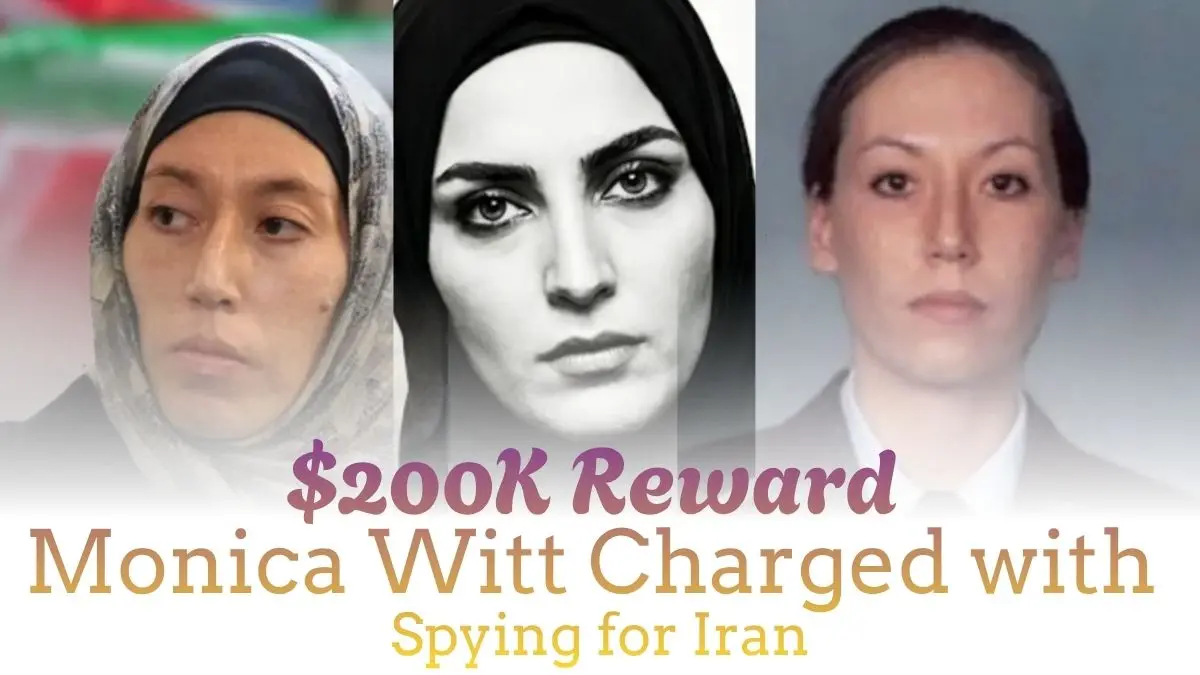
FBI Offers $200,000 Reward for Former Air Force Intelligence Specialist Monica Witt Charged with Spying for Iran
The Federal Bureau of Investigation (FBI) has started searching again for Monica Witt, a former Air Force intelligence worker who moved to Iran in 2013 and allegedly shared secret national defense information with the Iranian government. The FBI is offering a large reward of $200,000 for information that helps authorities arrest and prosecute her. This reward shows how serious this espionage case remains, even after more than ten years.
Who Is Monica Witt?
Monica Elfriede Witt was born on April 8, 1979, in El Paso, Texas. She is now 47 years old. Her career in U.S. intelligence changed dramatically when she later betrayed her oath and defected to Iran.
Witt’s personal life included several struggles that may have made her vulnerable to foreign recruitment. According to reports from The New York Times, her mother died shortly before Witt entered active military service in 1997. Over time, she also became distant from many of her relatives.
By 2011, Witt faced serious financial problems. She lived in low-quality government-supported housing in Falls Church, Virginia. At one point, she was also homeless. These personal and financial difficulties may have made it easier for foreign intelligence agents to influence and recruit her.
For more than ten years, Witt worked as a trusted member of America’s intelligence community. Her positions gave her access to some of the country’s most sensitive and highly classified information.
Physical Description and Aliases
The FBI has released the following identifying details for Monica Witt.
47 years old
White
Brown
Brown
5 feet 10 inches
120 pounds
Fatemah Zahra, Narges Witt
These aliases may be used while moving through Iran or maintaining contact with operatives abroad.
How to Report Information
The FBI is encouraging anyone with knowledge of Witt’s whereabouts or activities to come forward.
1-800-CALL-FBI
Contact any nearby FBI field office with counterintelligence divisions.
tips.fbi.gov
Individuals outside the United States can report information to the nearest U.S. Embassy or Consulate.
$200,000 Reward
Offered for information leading to capture and prosecution.
Her Military Background
Monica Witt served in the United States Air Force from 1997 to 2008. During that time, she built a strong career in counterintelligence work. She served as an intelligence technical sergeant and also worked as a counterintelligence officer for the Air Force Office of Special Investigations (AFOSI).
During her military service, Witt received several awards and honors. These included an Air Medal, three Air Force Commendation Medals, and three Aerial Achievement Medals.
Witt received special training in the Farsi language at the Defense Language Institute in Monterey, California, from February 1998 to April 1999. Because of her language skills and intelligence training, the military sent her on several overseas classified missions. She worked in countries including Saudi Arabia, Diego Garcia, Greece, Iraq, and Qatar, mainly focusing on Middle Eastern operations.
Between 2003 and 2008, Witt worked on many classified assignments. These missions gave her direct access to highly sensitive intelligence information. She learned details about secret operations, the real names of recruited agents, and the identities of U.S. intelligence officers involved in recruiting sources.
After leaving active military duty in 2008, Witt continued working in intelligence as a Defense Department contractor. She worked in Maryland for Booz Allen Hamilton, where she advised officials on Iranian-related subjects and provided language and cultural expertise.
Later, she worked for Chenega Federal Systems as a Middle East Desk Officer. In this role, she supervised and coordinated highly sensitive counterintelligence operations against foreign intelligence agencies around the world.
Until 2010, Witt continued to have access to highly classified special access programs (SAPs). These programs contained information about ongoing intelligence operations, the real identities of secret sources, and the names of undercover U.S. intelligence personnel.
The Road to Defection: A Turning Point
In 2012, Monica Witt went through a major change in her personal beliefs and thinking. This period became a turning point in her life and later influenced her decision to leave the United States.
During this time, she converted to Islam while she was in Iran. Iranian television recorded and broadcast her conversion. In a 2013 interview with the International Quran News Agency, Witt said she had been a “non-practicing Christian” before joining the military.
She also explained that her interest in converting to Islam, along with the resistance she faced, played a role in her decision to leave the United States Air Force.
Education and Radicalization
While working as a contractor, Monica Witt studied for a master’s degree at George Washington University. During her studies, she completed a final capstone presentation at graduation.
Some classmates described her presentation as strongly supportive of Iran. They said it sounded like a “love letter to Iran” and that she downplayed concerns about Iran’s nuclear program while praising the country.
When faculty members questioned her views, she strongly defended her position. She reacted as if people should not doubt that Iran was a peaceful nation.
After returning from Iran, classmates noticed a clear change in her behavior and opinions. She began wearing a hijab and spoke more positively about Iran than before. Some peers felt her views had become very extreme compared to earlier.
The Role of Marzieh Hashemi
During this period, Monica Witt became connected with Marzieh Hashemi, who is believed to have ties to Iranian intelligence activities. Her birth name is Melanie Franklin, and she worked as a journalist and TV presenter for Press TV.
Within a month after graduating from George Washington University, Witt was reportedly hired by Hashemi. This work was linked to the production of an anti-American film that later aired in Iran.
From June 2012 to August 2013, Witt stayed in regular contact with an Iranian-American individual who had dual citizenship. Reports later suggested this person acted in a way consistent with an intelligence handler, and court documents identified this individual as Marzieh Hashemi.
During these communications, Witt openly discussed her situation and possible future actions. She mentioned ideas such as going public with classified information, similar to Edward Snowden. She also suggested she might travel to Russia and then contact WikiLeaks while hiding her location.
These statements later became part of the investigation into her intentions and contacts with Iranian-linked individuals.
The Hollywoodism Conferences
Monica Witt reportedly defected to Iran after attending conferences organized by the New Horizon Organization. This organization is said to have links with the Islamic Revolutionary Guard Corps.
These events were often called “Hollywoodism” conferences. They focused on criticizing Western culture and promoting anti-American messages.
In February 2013, Witt attended one of these conferences in Tehran at the Parsian Azadi Hotel. During the event, she met and spoke with commentator Kevin Barrett. While in Iran, she expressed regret about her past military service and said she felt guilty about being involved in what she described as “war crimes” during her time in the United States Air Force.
She also took part in several videos that promoted anti-American messaging during her visits. These activities later became part of the broader investigation into her actions and connections in Iran.
The Defection: How It Happened
Final Steps Before Leaving
On August 25, 2013, Monica Witt sent a detailed email to Marzieh Hashemi. In that email, she shared her DD Form 214 (military discharge record), her personal “conversion story,” her job history, and other documents showing her background and skills.
Shortly after receiving the email, Hashemi forwarded it to an email address believed to be linked with Iran. This quick response raised concerns and suggested possible coordination with Iranian contacts.
A few days later, on August 28, 2013, Witt traveled from Dubai to Tehran. Before leaving, she sent a message saying, “I’m signing off and heading out! Coming home!”
Earlier, in May 2012, the Federal Bureau of Investigation had already questioned Witt about her travel and her connections to Iran. She told officials that she would not share sensitive information with Iran. However, despite these warnings, she still left the United States about a year later and went to Iran.
What Did She Reveal? The Charges and Accusations
In February 2019, Monica Witt was formally charged by a federal grand jury in the United States with several espionage-related crimes. These are some of the most serious charges in U.S. law because they involve national security and classified information.
The case was first sealed on July 9, 2018, and later made public on February 13, 2019. According to the indictment, she allegedly carried out a planned and intentional effort to harm U.S. national security by sharing sensitive information.
The case was handled by a Federal Bureau of Investigation and presented to a United States federal grand jury.
Officials accused her of exposing classified defense information and helping a foreign government gain access to U.S. intelligence secrets. The charges suggested that her actions were not accidental but part of a long-term and deliberate plan.
Classified Intelligence Disclosed
According to the indictment, Monica Witt allegedly worked with Iranian operatives between January 2012 and May 2015. During this time, she is accused of sharing classified documents and sensitive information related to the national defense of the United States.
Prosecutors say she did this knowing that the information could harm the United States and benefit Iran.
The intelligence she allegedly exposed was highly sensitive. Reports stated that she revealed details about a Pentagon special access program, which is one of the most tightly protected types of intelligence programs in the United States.
This program reportedly included information about ongoing counterintelligence operations, the real names of recruited sources, and the identities of undercover U.S. intelligence officers involved in recruiting those sources.
Officials also said she exposed the existence of a highly classified intelligence collection program. She allegedly revealed the identity of a U.S. intelligence officer, which placed that person in serious danger.
U.S. officials described this as a major security breach that could have long-term consequences for intelligence operations and personnel safety.
Creating “Target Packages”
According to the indictment, Monica Witt did more than just share documents. She is also accused of creating “target packages” for Iran. These packages reportedly included detailed information about her former U.S. colleagues, such as their identities, locations, job roles, daily routines, and personal vulnerabilities.
Authorities say this type of information could be used to track, pressure, or harm those individuals.
Iranian Cyber Operations: A Coordinated Attack
The indictment also states that four Iranian nationals, allegedly linked to the Islamic Revolutionary Guard Corps, used the information provided by Witt to carry out cyber operations against U.S. personnel between 2014 and 2015.
These operatives reportedly ran a coordinated online campaign. They created fake Facebook accounts using the names of Witt’s former colleagues to build trust. They also sent friend requests to other contacts connected to those individuals.
They used phishing emails to trick targets into clicking harmful links. These links installed malware that gave attackers hidden and ongoing access to victims’ computers and networks.
In some cases, the messages looked like links to real news websites, but they actually led to pages controlled by Iranian operatives.
Endangering U.S. Personnel
The FBI stated that Witt’s alleged actions put U.S. personnel and their families at serious risk, especially those stationed overseas. Officials said her disclosures exposed sensitive national defense information and disrupted ongoing intelligence operations.
Supporting Iran’s Military and Intelligence Operations
Authorities also said her actions benefited parts of Iran’s military and intelligence system, especially the Islamic Revolutionary Guard Corps.
The IRGC is responsible for intelligence gathering, covert operations, and cyber warfare activities. It operates under Iran’s top leadership and plays a major role in protecting and expanding Iran’s strategic interests.
Officials argue that by allegedly sharing classified U.S. information, Witt strengthened the capabilities of a major adversary and increased risks for U.S. intelligence personnel worldwide.
After Defection: Life in Iran
After arriving in Iran, Monica Witt allegedly received support from Iranian authorities. According to the indictment, officials provided her with basic resources such as housing and computer equipment. Authorities say this support helped her continue working and staying connected with her handlers.
It is still unclear whether Witt has hired legal representation in the United States to respond to the charges against her.
Additional Co-Conspirators: The Hashemi Connection
The case also involves several other individuals. The indictment charged four Iranian nationals with conspiracy, attempted hacking, and identity theft. Officials say this shows the operation was coordinated and not done by a single person.
A key figure in the case is Marzieh Hashemi, an American-born journalist who worked for Press TV. She was born as Melanie Franklin in New Orleans and later converted to Islam after marriage.
The indictment refers to “Individual A,” later identified by media reports as Hashemi. She is described as someone who helped identify and assess potential recruits for Iranian intelligence services.
Authorities allege that she helped connect Witt with Iranian intelligence contacts, supported her work on anti-American media projects, and played a role in her move to Iran.
In January 2019, U.S. authorities arrested Hashemi at an airport in St. Louis while she was traveling to visit family. She was held as a material witness in the investigation and questioned by federal officials. After testifying before a federal grand jury in Washington, D.C., she was released without charges and allowed to return to Iran.
Later, Hashemi denied any involvement in recruiting Witt, despite the claims made in the indictment.
The Current Search: Why Now?
The Federal Bureau of Investigation has renewed its effort to find Monica Witt and is offering a $200,000 reward for information about her location. Officials say they believe she may still be involved in activities that support Iran, even many years after her defection.
According to the FBI, Witt has likely continued assisting Iranian intelligence efforts. Investigators also say that after she moved to Iran in 2013, she searched online for information about her former coworkers in U.S. counterintelligence units. These actions suggest she may have kept tracking people she once worked with.
An FBI official from the Washington Field Office said the agency has not forgotten the case and believes someone may still have useful information about her current location.
The timing of the renewed search is linked to increased tensions between the United States and Iran. Officials say that during this period, locating Witt has become more important for national security.
Investigators also believe the damage from her alleged disclosures may still be ongoing. They say the classified program she allegedly exposed included secret communication methods, the identities of recruited agents, and details of undercover intelligence officers. Because of this, officials warn that some intelligence operations and personnel may still be at risk years after her defection.
A Case Study in Recruitment: How Iran Operates
The Monica Witt case shows how a long, careful recruitment process can be used by state actors like Iran to target intelligence officers. Instead of acting quickly, the IRGC allegedly followed a step-by-step plan over several years. First, they identified Witt as a possible target through her attendance at conferences and her dissatisfaction with U.S. foreign policy.
Then, through contacts like Marzieh Hashemi, they built trust, supported her views, and offered her opportunities that gave her a sense of purpose and belonging. Over time, they influenced her beliefs, encouraged her conversion to Islam, involved her in anti-American media work, and helped shape her view that Iran was justified.
Because she faced financial difficulties, they also provided practical support such as housing and equipment. After she moved to Iran, she reportedly received continued backing, protection, and resources from the IRGC to support intelligence-related work.
The case highlights how personal struggles, ideology, and long-term influence efforts can combine to recruit individuals, even after FBI warnings and investigations, and it is often cited as a warning that hostile nations may spend years targeting a single intelligence officer for strategic gain.
Conclusion
The Monica Witt case remains a major espionage investigation. Authorities say her alleged actions harmed U.S. intelligence operations and put personnel at risk. The FBI continues to search for her and is offering a $200,000 reward for information leading to her arrest. Officials urge anyone with knowledge of her location to come forward and assist in the investigation.
Primary Sources: USA TODAY, CNN, Associated Press (AP News)
Additional Sources: Wikipedia (Monica Witt), FBI Official Statement, Wikipedia (Marzieh Hashemi), Military Wiki, The Hill, The Washington Free Beacon, Radio Farda, The Times of Israel, American Almanac, IBTimes UK
Disclaimer: This article consolidates reporting from multiple major news outlets and official government sources. Information is current as of the publication date and based on official FBI statements, federal indictment documents, and investigative journalism. Some details have been updated with information from web research conducted on May 16, 2026.