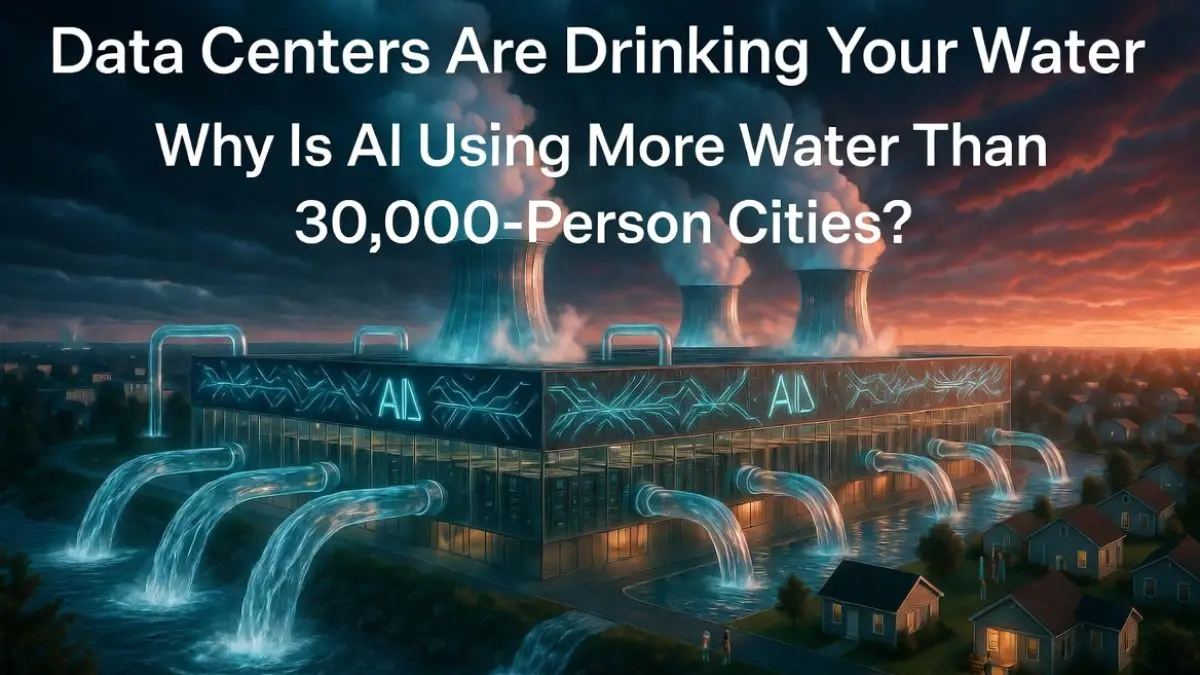
Data Centers Are Drinking Your Water: Why Is AI Using More Water Than 30,000-Person Cities?
You probably used AI today without thinking twice about it. Maybe you asked ChatGPT a question, uploaded photos to the cloud, or streamed a video. Behind every digital interaction lies a massive physical infrastructure—data centers filled with thousands of servers working around the clock. But here’s what most people don’t realize: these technological marvels are also some of the thirstiest facilities on the planet.
As artificial intelligence capabilities explode and cloud computing becomes ubiquitous, communities across America are confronting an uncomfortable reality: the digital revolution comes with a very real environmental price tag. From Texas to Arizona, from Virginia to Western Kentucky, regions are grappling with questions about water usage, energy consumption, and whether technological progress is sustainable.
This post breaks down everything you need to know about data centers, their water demands, emerging responses like cloud seeding, and what this all means for communities trying to balance economic growth with environmental stewardship.
Part 1: Understanding Data Centers and Their Water Appetite
What Exactly Are Data Centers?
Data centers are specialized facilities that house computer systems and associated components like telecommunications and storage systems. Think of them as the engine rooms of the internet—massive warehouses filled with rows upon rows of servers that:
- Power AI models like ChatGPT, Claude, and Google’s Gemini
- Store billions of photos, videos, and files in “the cloud”
- Run social media platforms, streaming services, and online applications
- Process financial transactions, healthcare records, and business operations
- Enable everything from your smartphone apps to corporate databases
The Scale of Modern Data Centers
To understand the water issue, you first need to grasp the sheer scale of these facilities:
- Physical size: A single hyperscale data center can occupy 100,000+ square feet—roughly the size of two football fields or more
- Server density: Modern facilities can house 50,000-100,000+ servers in a single building
- Power consumption: Large data centers consume 20-50 megawatts or more—enough electricity to power tens of thousands of homes
- Growth trajectory: The global data center market is projected to continue expanding rapidly, driven especially by AI workloads
Why Do Data Centers Need So Much Water?
Here’s the physics problem: computers generate heat. Lots of it.
When thousands of processors work simultaneously—especially the powerful GPUs used for AI training and inference—they produce enormous amounts of thermal energy. If this heat isn’t removed, equipment overheats and fails within minutes.
Cooling Methods:
- Air-cooled systems: Use massive HVAC systems and fans (still require significant energy)
- Water-cooled systems: Use water to absorb heat more efficiently than air
- Evaporative cooling: Water evaporates to remove heat (this is where massive water consumption happens)
The Water Consumption Reality:
- A typical large data center can use 3-5 million gallons of water per day
- Some hyperscale facilities use significantly more—Google’s data centers consumed approximately 4.3 billion gallons in 2021, rising to 5.2-5.6 billion gallons in 2022, with continued increases in 2023-2024
- Microsoft’s water usage increased 34% in one year (2021-2022), largely due to AI expansion
- Much of this water is consumptive use—meaning it evaporates and doesn’t return to the local water system
To put this in perspective: a single large data center can use as much water as a city of 30,000-50,000 people.
Part 2: The AI Boom and Escalating Demands
Why the Sudden Urgency?
The water crisis connected to data centers isn’t entirely new, but it’s accelerating dramatically due to:
1. The AI Revolution
Training large language models like GPT-4, Claude, or Gemini requires enormous computational resources:
- Training a single large AI model can require weeks or months of thousands of GPUs running simultaneously
- Each conversation with ChatGPT uses computational resources (and thus energy/water)
- AI inference (using trained models) also requires significant ongoing resources
- Companies are racing to build larger models with more parameters, requiring even more infrastructure
2. Cloud Computing Growth
- More businesses moving to cloud-based operations
- Increased remote work relying on cloud services
- Streaming services expanding (4K, 8K video requires more storage and bandwidth)
- IoT (Internet of Things) devices generating massive data streams
3. Cryptocurrency and Blockchain
Some data centers support blockchain operations and cryptocurrency mining, which are extremely energy and water-intensive.
4. Data Sovereignty Requirements
New regulations require data to be stored in specific geographic regions, driving more localized data center construction.
The Numbers Behind AI Water Usage
Research from recent studies reveals startling figures:
- ChatGPT’s water footprint: Estimates suggest training GPT-3 consumed approximately 700,000 liters of water (enough to fill a Olympic-size swimming pool)
- Per-query usage: Early studies (2023) estimated each conversation with an AI chatbot indirectly consumed the equivalent of a standard water bottle in cooling water. However, newer efficiency improvements in 2024-2025 have reduced this to approximately 5-50 ml per conversation for some models—though this varies significantly by model size and infrastructure efficiency
- Google’s AI impact: The company reported water consumption jumped significantly in facilities running AI workloads
- Microsoft’s pledge: Despite sustainability commitments, the company’s water usage increased 34% year-over-year as AI services expanded
Part 3: Regional Water Stress and Real-World Impacts
The Texas Hill Country Example
Texas has become a focal point for data center-water conflicts:
The Setup:
- Texas offers cheap electricity, business-friendly regulations, and central U.S. location
- Companies like Meta, Amazon, Microsoft, and Google have built or planned massive facilities
- The Texas Hill Country relies on the Edwards Aquifer—a critical underground water source
The Problem:
- The Edwards Aquifer is already stressed from population growth, agriculture, and drought
- San Antonio and Austin draw significant water from this source
- Data centers represent major new water users in already water-stressed regions
- Climate change is making droughts more frequent and severe in Texas
Community Response:
- Local opposition to new data center permits in some Hill Country communities
- Debates about whether economic benefits justify environmental costs
- Questions about who gets priority when water becomes scarce
Arizona and the Southwest
Arizona faces even more acute challenges:
- The Colorado River is at historic low levels
- Phoenix area already under water restrictions
- New data centers proposed despite ongoing drought
- Tensions between residential needs, agriculture, and tech infrastructure
Virginia: The Data Center Capital
Northern Virginia hosts the world’s largest concentration of data centers:
- Over 70% of global internet traffic flows through “Data Center Alley” in Loudoun County
- Facilities consume enormous amounts of water from the Potomac River
- Growing concerns about cumulative environmental impact
- Debates about proper oversight and environmental review
Part 4: Cloud Seeding – Technology Meets Weather Modification
What Is Cloud Seeding?
As water scarcity concerns grow, some regions are turning to weather modification techniques, particularly cloud seeding.
The Basic Science:
Cloud seeding involves introducing substances (usually silver iodide, potassium iodide, or dry ice) into clouds to encourage precipitation. Here’s how it works:
- Nucleation: The introduced particles act as “seeds” around which water droplets can form
- Droplet growth: Water vapor condenses around these particles more readily than it would naturally
- Precipitation: If conditions are right, these droplets grow heavy enough to fall as rain or snow
Delivery Methods:
- Aircraft flying through clouds and releasing particles
- Ground-based generators burning silver iodide
- Rockets launched into cloud formations
The Reality vs. The Hype
What Cloud Seeding CAN Do:
- Potentially increase precipitation by 5-15% under ideal conditions
- Most effective in mountainous regions where orographic (mountain-induced) clouds form
- Can help with snowpack accumulation in specific areas
- Works best when weather systems are already conducive to precipitation
What Cloud Seeding CANNOT Do:
- Create clouds or rain out of clear skies
- End severe droughts on its own
- Work reliably in all weather conditions
- Guarantee specific amounts of rainfall
- Replace need for water conservation and infrastructure planning
Current Cloud Seeding Programs
Cloud seeding is more widespread than many realize:
Active Programs in the U.S.:
- Colorado: Extensive programs to boost mountain snowpack
- California: Multiple programs targeting Sierra Nevada snowfall
- Wyoming: Long-running winter cloud seeding
- Texas: Programs in West Texas and other regions
- Utah: Weather modification programs for ski resorts and water supply
- Idaho: Cloud seeding for both agriculture and recreation
Global Programs:
- China operates the world’s largest weather modification program
- United Arab Emirates uses cloud seeding to address extreme water scarcity
- Australia, Thailand, and numerous other countries have active programs
The Controversy and Concerns
Scientific Debate:
- Difficult to prove effectiveness definitively (weather is variable regardless)
- Questions about whether results justify costs
- Uncertainty about unintended consequences
Environmental Concerns:
- Silver iodide accumulation in ecosystems
- Potential impacts on downwind areas (if you make it rain in one place, does another get less?)
- Unknown long-term ecological effects
Legal and Ethical Issues:
- Who has the right to modify weather?
- What about neighboring regions that might receive less rain?
- Water rights complications
- Lack of comprehensive regulation
Part 5: Western Kentucky’s Position in This National Conversation
Current Water Resources in Western Kentucky
Western Kentucky is in a relatively strong position compared to drought-stricken regions:
Water Assets:
- Rivers: Ohio River, Tennessee River, Cumberland River, and numerous tributaries
- Reservoirs: Kentucky Lake, Lake Barkley, and other managed water bodies
- Precipitation: Generally receives 45-50 inches of annual rainfall
- Groundwater: Various aquifer systems, though not as extensive as major aquifers out west
Key Difference: Unlike Texas, Arizona, or California, Western Kentucky isn’t currently experiencing severe, chronic water stress.
Why Should Western Kentucky Pay Attention?
Even though the region isn’t facing immediate crisis, several factors make this a relevant conversation:
1. Economic Development Pressures
- Kentucky actively recruits businesses and infrastructure projects
- Data centers represent major economic opportunities (jobs, tax revenue, investment)
- States compete aggressively for these facilities
- Decision-makers face pressure to approve projects without full environmental review
2. Infrastructure Growth Patterns
- Tech companies are diversifying locations to reduce risk
- Mid-South regions becoming attractive for data centers due to:
- Lower land costs than coastal areas
- Central U.S. location
- Available electricity from TVA and other sources
- Perceived water availability
3. Interconnected Systems
- Rivers don’t respect state boundaries
- Upstream water usage affects downstream communities
- Regional decisions have cumulative impacts
- Climate change affects precipitation patterns everywhere
4. Precedent-Setting Decisions
Communities that establish strong environmental review processes now will be better positioned to manage growth later.
Questions Western Kentucky Communities Should Consider
Before approving major water-intensive projects:
- What is our current water baseline?
- Total available water resources
- Existing usage (residential, agricultural, industrial)
- Seasonal variations and drought vulnerabilities
- What are our growth projections?
- Population growth
- Economic development plans
- Climate change impacts on water availability
- What safeguards should exist?
- Water usage limits for commercial facilities
- Drought contingency requirements
- Environmental impact assessments
- Community input processes
- How do we balance economic and environmental priorities?
- Job creation vs. resource protection
- Short-term gains vs. long-term sustainability
- Regional competitiveness vs. local needs
Part 6: The Bigger Picture – Energy, Environment, and Ethics
The Energy Dimension
Water consumption is only part of the data center story. Energy use is equally critical:
Power Consumption Reality:
- Data centers consume approximately 1-2% of all global electricity
- A single large facility can require a dedicated power plant
- AI workloads are significantly more energy-intensive than traditional computing
- Cryptocurrency mining adds another enormous energy burden
Grid Implications:
- Strain on local electrical infrastructure
- Need for new power generation (what kind? fossil fuels? renewables?)
- Competition with residential and other commercial needs
- Impact on electricity prices
Environmental Justice Considerations
The data center boom raises important equity questions:
Who Bears the Costs?
- Local communities may face environmental impacts (water use, energy consumption, heat island effects)
- Benefits (tax revenue, jobs) may not offset costs to local quality of life
- Lower-income communities sometimes targeted for industrial facilities
- Indigenous communities’ water rights and sacred sites may be affected
Who Benefits?
- Tech companies gain infrastructure for profit-generating services
- Some local jobs created, though data centers are increasingly automated
- Tax revenues, though companies often negotiate significant abatements
- Global users of technology benefit while local communities bear environmental burden
Climate Change Feedback Loops
There’s a troubling irony here:
- AI is promoted as a tool to help solve climate change
- Training and running AI models requires massive data centers
- Data centers consume enormous water and energy
- This consumption contributes to the climate problems AI is supposed to solve
- Climate change worsens droughts, making water scarcity more severe
- Water scarcity drives interest in cloud seeding and other interventions
- The cycle continues
Part 7: Solutions and Sustainable Alternatives
Industry Innovations
Tech companies are aware of these issues and some are taking steps:
Water Efficiency Improvements:
- Advanced cooling technologies
- Liquid cooling systems that recycle water
- Air-side economizers using outside air when temperatures permit
- Two-phase immersion cooling (servers submerged in special fluids)
- Location strategies
- Building in cooler climates (Scandinavia, Pacific Northwest)
- Locating near renewable energy sources
- Utilizing waste heat for district heating systems
- Operational optimization
- AI-driven cooling optimization (using AI to reduce AI’s footprint)
- Time-shifting workloads to cooler periods
- Efficiency improvements in chip design
Corporate Commitments:
- Microsoft: Pledged to be “water positive” by 2030 (replenishing more water than consumed)
- Google: Committed to operating on 24/7 carbon-free energy by 2030
- Amazon: Aims to become water positive by 2030
- Meta: Building data centers with advanced water recycling systems
The Challenge: Corporate pledges often don’t fully account for indirect water usage or may rely on offsets rather than actual reductions.
Policy and Regulatory Approaches
What Communities Can Do:
- Comprehensive Environmental Review
- Require full water impact assessments before approving large facilities
- Consider cumulative impacts, not just individual projects
- Public comment periods with meaningful community input
- Water Usage Caps and Monitoring
- Set maximum daily/annual water consumption limits
- Require real-time usage reporting
- Penalties for exceeding limits
- Drought Contingency Requirements
- Mandatory water reduction plans during drought conditions
- Tiered response based on drought severity
- Alternative water sources required
- Incentivize Efficiency
- Tax benefits for facilities using cutting-edge cooling technology
- Requirements to use recycled or reclaimed water where possible
- Mandates for waste heat capture and reuse
- Transparency Requirements
- Public reporting of water and energy consumption
- Independent audits of environmental claims
- Community oversight mechanisms
Alternative Infrastructure Models
Distributed Computing: Instead of massive centralized data centers, some propose:
- Smaller, distributed facilities closer to users
- Edge computing reducing need for distant data centers
- Peer-to-peer networks for some applications
Offshore Data Centers:
- Microsoft experimented with underwater data centers
- Natural cooling from ocean water
- Challenges with maintenance and reliability
Renewable Energy Integration:
- Co-locating data centers with wind or solar farms
- Using hydroelectric power where available
- Developing next-generation nuclear (small modular reactors)
Part 8: What Individuals Can Do
Personal Technology Choices
While individual action won’t solve systemic infrastructure issues, awareness matters:
Reduce Unnecessary Data Center Load:
- Delete old files and emails from cloud storage
- Download files for local storage when practical
- Be mindful of AI chatbot usage (though this shouldn’t prevent beneficial use)
- Choose streaming quality appropriate to your screen (don’t stream 4K on a phone)
- Clear out duplicates and unnecessary cloud backups
Support Sustainable Companies:
- Research companies’ environmental commitments
- Choose services from providers investing in efficiency
- Hold companies accountable for sustainability pledges
Civic Engagement
Stay Informed:
- Attend local planning and zoning meetings
- Monitor proposed industrial developments
- Understand your community’s water infrastructure
Ask Questions:
- What environmental reviews were conducted?
- What are the water usage projections?
- What happens during drought conditions?
- How will the local grid handle additional load?
- What are the real local economic benefits?
Advocate for Smart Policy:
- Contact local representatives
- Support comprehensive environmental review processes
- Push for transparency requirements
- Demand community input on major infrastructure decisions
Conclusion: Balancing Progress and Sustainability
The intersection of data centers, water resources, and emerging responses like cloud seeding represents one of the defining infrastructure challenges of our era. As AI capabilities expand and digital dependency grows, the physical footprint of our virtual world becomes increasingly consequential.
Key Takeaways:
- Data centers are essential infrastructure – We can’t simply eliminate them without abandoning modern technology
- Water consumption is significant and growing – Millions of gallons daily per facility add up across hundreds of data centers
- Regional impacts vary widely – What’s sustainable in Western Kentucky might be catastrophic in Arizona
- Cloud seeding is not a silver bullet – Weather modification is limited, uncertain, and potentially problematic
- Technology can improve – More efficient cooling, better location choices, and operational optimization can reduce impacts
- Policy matters – Strong environmental review and oversight can protect communities while enabling growth
- Trade-offs are real – Economic development and environmental stewardship must be balanced thoughtfully
For Western Kentucky and Similar Regions:
You’re in a unique position. You’re not yet facing the severe water stress of Texas or Arizona, but you’re watching national patterns that could eventually reach you. The decisions your communities make now—about environmental review, water management, and sustainable development—will shape your region’s future.
The question isn’t whether technology will continue advancing. It will. The question is whether that advancement happens thoughtfully, with proper consideration of environmental limits and community needs, or whether we repeat the mistakes of regions that prioritized short-term economic gains over long-term sustainability.
The Bottom Line:
Stay informed. Ask tough questions. Demand transparency. Hold both companies and elected officials accountable. Your water resources, your energy infrastructure, and your environmental quality are too important to be treated as unlimited resources for exploitation.
The digital revolution is real, and it’s transformative. But it doesn’t have to be destructive. With smart policy, technological innovation, and engaged citizens, we can build the infrastructure we need while protecting the natural resources we cannot afford to lose.
The conversation is happening now. Make sure your voice is part of it.
Additional Resources
For Further Reading:
- U.S. Geological Survey water usage data
- EPA water conservation resources
- State water resource planning documents
- Academic research on data center environmental impacts
- Corporate sustainability reports (Google, Microsoft, Amazon, Meta)
- Local water utility planning documents
Get Involved:
- Attend local planning commission meetings
- Join environmental advocacy groups
- Contact your state representatives about water policy
- Support organizations monitoring corporate environmental claims
- Educate your community about these interconnected issues
The future of water, energy, and technology infrastructure is being decided now. These aren’t abstract policy debates—they’re decisions that will affect every community, every ecosystem, and every person who depends on clean water and stable environmental systems.
Stay informed. Stay engaged. Your participation matters.