Meteor Explosion in Ohio – What Happened? Is Earth in Danger ?
On the morning of March 17, 2026, something extraordinary happened over Northeast Ohio that left tens of thousands of people asking the same question: What was that loud boom? Within hours, NASA confirmed what seemed almost impossible — a meteor had exploded over Cleveland and the surrounding region in what experts are calling a rare, potentially once-in-a-lifetime event.
If you heard a mysterious loud boom in Cleveland, Ohio this morning, or if you’re searching for information about the explosion in Ohio that shook homes and sparked widespread speculation online, you’ve come to the right place. This is the complete breakdown of what happened when a meteor hit Cleveland’s airspace.
Did a Meteor Really Hit Cleveland? Yes — NASA Confirms
Let’s answer the burning question first: Yes, a meteor did explode over Cleveland. NASA confirmed that a fireball lit up skies across Northeast Ohio Tuesday morning after a seven-ton asteroid entered the atmosphere and broke apart over Medina County.
The asteroid was about 6 feet in diameter and traveling at 45,000 miles per hour. This wasn’t a small flash in the sky — it was a massive space rock moving at incomprehensible speeds, and it happened directly above one of America’s major metropolitan areas.
The confirmation came from multiple sources. The space agency said the meteor was first detected at 8:57 a.m. off Lake Erie near Lorain, and the boom was heard and felt across Northeast Ohio around 9 a.m.
What Exactly Happened? The Meteor Explosion Timeline
Here’s what occurred when the meteor in Cleveland exploded:
First Detection: The meteor was first visible at an altitude of 50 miles above Lake Erie off the beaches of Lorain. At this point, it was traveling at an estimated 40,000 to 45,000 miles per hour — faster than any bullet ever fired from a gun.
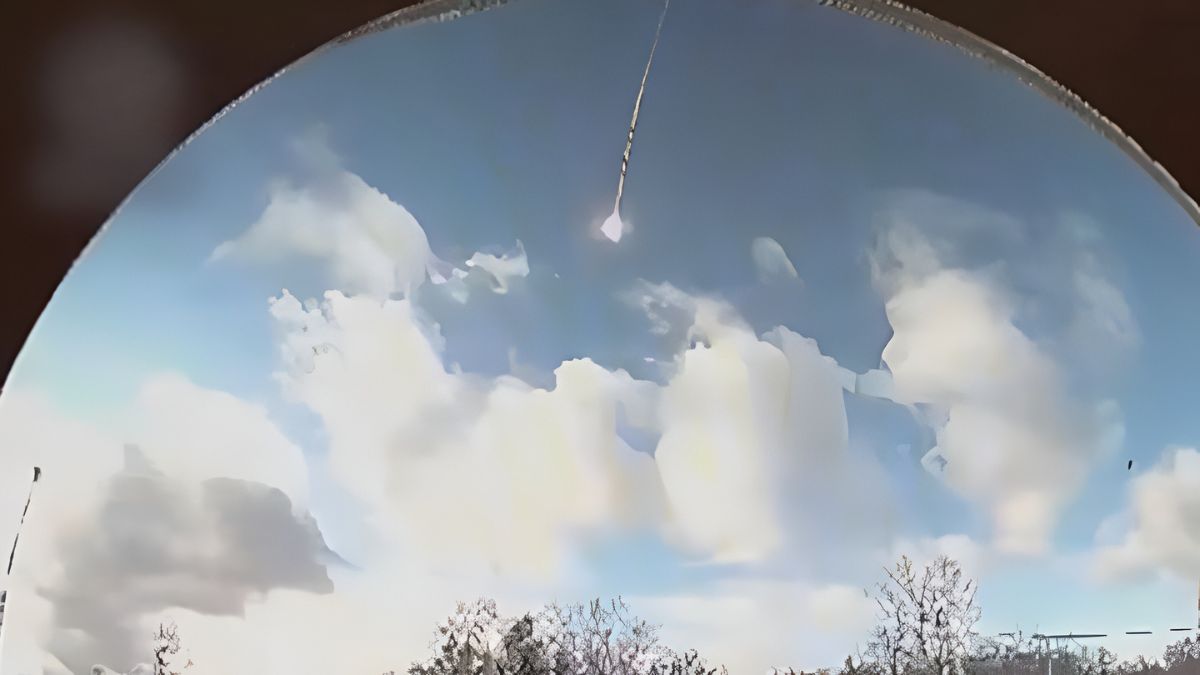
The Journey Through Atmosphere: It moved southeast at 40,000 mph traveling 34 miles through the upper atmosphere before fragmenting 30 miles above Valley City. The friction from moving through Earth’s thick atmosphere at such tremendous speed created the brilliant fireball that people across multiple states witnessed.
The Fragmentation: It traveled more than 34 miles through the atmosphere before breaking up, with some fragments falling to the ground. When the meteor broke apart, it wasn’t a gentle process — the chunk of space rock unleashed an amount of energy equivalent to 250 tons of TNT when it fragmented.
The Sonic Boom and Shockwave: NASA said the sound occurred when the asteroid fragmented, “resulting in a pressure wave” that reached the ground. The space agency confirmed the boom would have been loud enough to shake some homes.
The Loud Boom Heard Across Ohio, Pennsylvania, and Beyond
The explosion in Cleveland was not just visible — it was felt and heard across an enormous area.
Tens of thousands of people heard and felt an explosion all over Northeast Ohio and into Pennsylvania and New York Tuesday morning. But the sonic boom’s reach was even more impressive: The American Meteor Society has more than 100 meteor reports pending from Ohio, Pennsylvania and as far away as Virginia and Canada.
Eyewitness Accounts
People across the region reported shocking experiences:
- One Cleveland resident said: “I heard it, like my house shook. It literally felt like a car hit my house. It freaked me out.”
- Residents in Sandusky reported: “That boom shook our house. Felt like something hit the house. Thought it was an electrical issue.”
- People in Hartville felt the rumble from Stark County, with reports that even animals were disturbed
- The meteor would have been visible to the naked eye had skies been clear
The experience was so intense that many people immediately called 911 to report what they thought was an earthquake, explosion, or downed airplane.
What Caused the Loud Boom in Cleveland? The Sonic Boom Explained
You might wonder: If the meteor broke up in the upper atmosphere, why did we hear such a loud boom on the ground?
The answer lies in sonic booms and shockwaves. A fireball lit up skies across Northeast Ohio Tuesday morning, and JonDarr Bradshaw, a community engagement coordinator for the Great Lakes Science Center, explained: “That’s a rocky or metal piece, a fragment that’s floating through space, that comes in contact with our atmosphere; it’s that friction that creates that streak of light that we see.”
As the meteor traveled at 40,000+ mph through the atmosphere, it created a pressure wave of energy that traveled downward and outward. Detailed lightning maps show an elongated flash, where there were likely two explosions over Northeast Ohio. The first was when the meteor first broke up about 27 miles above Lake Erie while on a north-to-south trajectory. The second was heard and seen moments later.
This is why people reported not just one boom but multiple rumbles and explosions in sequence — they were essentially hearing multiple shock waves as the meteor fragmented into pieces.
Is Earth in Danger? Should We Worry About More Meteors?
The short answer: No, Earth is not in imminent danger. But meteors do strike Earth’s atmosphere more often than most people realize.
Astronomer Jay Reynolds said: “You may not hear them, but a lot of times, they do fall and they are recovered at some point. If it did hit, some farmer will be able to tell us. Unless it hit in the middle of some forest, we may never know the answer.”
However, what made the Cleveland event remarkable was its visibility and location. A Case Western Reserve University professor specializing in planetary science noted that meteors hit the Earth quite often — a couple times a day on average — but it’s rare that it traveled over such a populated area.
The reality is that Earth’s thick atmosphere acts as a shield. Bradshaw explained: “It’s very rare, because the earth has such a thick atmosphere, that that particle, that object actually makes it all the way to the ground.” Most meteors burn up completely before reaching Earth’s surface.
What About Meteorites in Medina County? Are Fragments Still Coming Down?
This is one of the most exciting questions following the Cleveland meteor explosion.
NASA confirmed that the meteor broke up, and fragments that were falling to the ground were produced in the vicinity of Medina County. However, so far, there’s no evidence of impact from the suspected meteor.
Scientists and space enthusiasts are currently searching for these fragments. People are being told to “look for something in your backyard that shouldn’t be there — Look at the rocks, look at them carefully. You’d be surprised and just say well what’s the big deal, yeah, it’s a meteorite.”
The reason it’s so difficult to locate meteorites is that they can scatter across a wide area, and they often look like ordinary rocks. However, meteorites are valuable to scientists, as they provide direct evidence of space composition and help us understand the solar system.
Ohio Meteor: Historical Context and Rarity
This is far from the first meteor to strike Earth — but that doesn’t make it any less significant.
Historically, there are impact craters all over Earth from past meteors, with the biggest among them being what is now the Gulf of Mexico. These ancient impacts shaped the course of Earth’s history and evolution.
More recently, people remember the Chelyabinsk meteor in Russia (2013). The Chelyabinsk meteor was a small asteroid with an estimated size of 65 feet (20 meters) that sailed overhead on February 15, 2013. As people rushed to look at it out their windows, the resulting sonic boom shattered glass and injured observers.
The Cleveland meteor was smaller than Chelyabinsk, but the impact on witnesses was still profound.
How Was the Cleveland Meteor Detected?
You might wonder how we know so much about this meteor so quickly. The answer involves sophisticated satellite technology.
NOAA’s Geostationary Lightning Mapper (GLM) identified the meteor. This equipment is designed to track lightning, but can also detect bright meteors. The National Weather Service and broadcast meteorologists use GLM data to quickly confirm the source and notify citizens.
Additionally, the meteor was captured by a camera at a bus garage for Olmsted Falls City Schools and by other cameras in the region, providing video evidence of the fireball streaking across the sky.
What Are Meteors, Meteoroids, and Meteorites?
If you’ve been reading about the meteor in Cleveland Ohio today, you might see different terms used. Here’s what they mean:
- Meteoroid: A rocky or metal piece floating through space before entering Earth’s atmosphere
- Meteor: The bright streak of light created when a meteoroid enters Earth’s atmosphere and burns up from friction
- Meteorite: A meteoroid that successfully reaches Earth’s surface
In the case of the Cleveland event, we started with a meteoroid entering the atmosphere, it became a brilliant meteor as it burned, and if fragments are found, they’ll be called meteorites.
Why Did the Cleveland Meteor Happen? What Caused It?
The Cleveland meteor wasn’t a special or rare phenomenon in itself — it was simply a piece of space rock that happened to cross Earth’s path at the right (or wrong) time.
A NASA scientist explained: “This could just be a small asteroid that hung out in the belt and eventually migrated, or it could be a fragment from a larger one.”
The asteroid belt between Mars and Jupiter contains millions of space rocks. Occasionally, gravitational forces or collisions cause these rocks to drift toward inner planets, and Earth’s gravity pulls them into our atmosphere.
What Made the Meteor in Cleveland So Bright?
The brightness of the Cleveland meteor surprised many observers. Meteorologist Jeff Tanchak said the meteor would have been visible to the naked eye had skies been clear.
This brightness comes from the meteor’s size and speed. The space agency said the meteor was first detected at 8:57 a.m. off Lake Erie near Lorain. It was a seven-ton asteroid, approximately 6 feet in diameter, traveling at 40,000 miles per hour. At such speeds, even a relatively small object generates tremendous energy when friction occurs.
The Witnesses: From Ohio to Canada
The geographic extent of witnesses is remarkable. The American Meteor Society wrote: “We received 175 reports about a fireball seen over DC, DE, IL, IN, KY, MD, MI, NC, NJ, NY, OH, Ontario, PA, and VA on Tuesday, March 17th, 2026.”
This means people in Delaware, Illinois, Indiana, Kentucky, Maryland, Michigan, New Jersey, New York, Ohio, Pennsylvania, Virginia, Washington DC, and Ontario, Canada all witnessed the event. That’s a massive geographic footprint for a single meteorological event.
What Should You Do If You See a Meteor?
If you were in the Cleveland area or heard about the meteor today, you might wonder what to do:
If You Saw or Heard Something: Report it to the American Meteor Society (AMS) at americanmeteorsociety.org. These reports help scientists track and analyze events.
If You Find a Meteorite: Handle it carefully and don’t let it get wet if possible. Contact a local museum or university with a geology/planetary science department to get it authenticated.
If You Heard the Boom: Don’t panic. According to the National Weather Service, these sonic booms are typically harmless even though they sound frightening.
The Science Behind Meteor Detection Today
Modern technology allows us to identify and understand meteors almost instantly. The meteor was detected by the Geostationary Lightning Mapper on the GOES satellite and several cameras in the region.
This represents a dramatic change from the past. Just decades ago, meteor impacts would have been mysterious and unexplained. Today, we have real-time satellite data, weather radar, and video cameras that capture the entire event.
FAQ
Did a meteor hit Cleveland? Yes, a fireball lit up skies across Northeast Ohio Tuesday morning after a seven-ton asteroid entered the atmosphere and broke apart.
Where did the meteor hit? The meteor broke apart over Medina County, with fragments produced in that vicinity.
How fast was the meteor traveling? The meteor was traveling 44,000 miles per hour across the sky near Lake Erie.
How many people heard the boom? Tens of thousands of people heard and felt an explosion all over Northeast Ohio and into Pennsylvania and New York.
Will this happen again? Yes, but not often in populated areas. Meteors enter Earth’s atmosphere frequently, but it’s rare that it traveled over such a populated area.
Are we safe from meteors? Yes. Most meteors burn up in the upper atmosphere. The risk of a large asteroid impact is extremely small.
The Bottom Line: Why This Cleveland Meteor Matters
The March 17, 2026 meteor over Cleveland, Ohio wasn’t just another space event — it was a visible reminder that we live in an active solar system. March 17 will likely go down in the history books in Northeast Ohio.
For the people who experienced the loud boom, felt their houses shake, and saw the fireball streak across the sky, it was unforgettable. For scientists, it’s an opportunity to study a meteor that passed through a populated area where observations and video evidence are abundant.
The sonic boom that echoed from Cleveland to Canada, the confirmed 7-ton asteroid, the fragments potentially resting in Medina County — these details will fuel conversations and searches for years to come.
If you heard the boom in Cleveland, Ohio today, or if you’re reading this hours or days later wondering what happened — now you know. A meteor really did hit Cleveland, and it was one of the most dramatic demonstrations of Earth’s place in the cosmos that Northeast Ohio residents will ever witness.
Did you experience the Cleveland meteor? Did you hear the loud boom or see the fireball? Share your story in the comments below. The more firsthand accounts we gather, the better scientists can understand this remarkable event.
Still searching for meteorites? Keep your eyes on the ground in Medina County, Ohio. You might just find a piece of outer space in your backyard.