Could Iran Launch Drones at California? What We Know Right Now (2026)
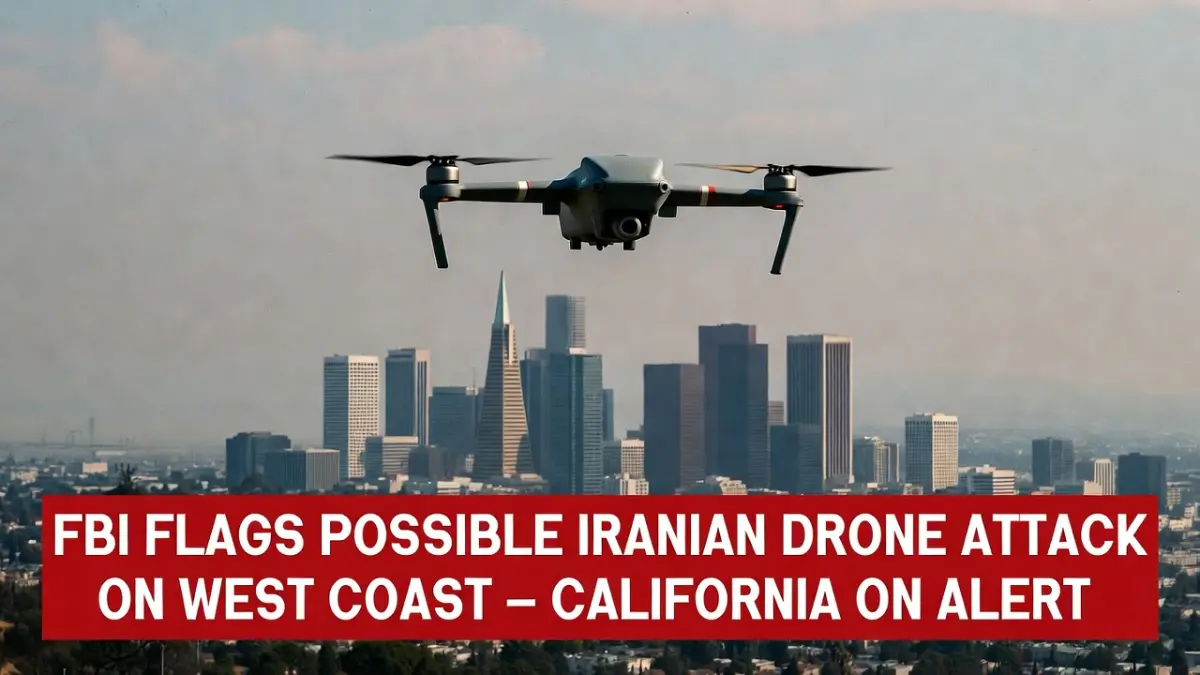
Recent reports of a possible Iran drone threat in California have raised serious security concerns across the entire West Coast. The Federal Bureau of Investigation issued a formal warning to police departments statewide about a potential Iranian drone strike that could target unspecified locations in California.
Officials say there is no confirmed imminent danger — but the warning has sent shockwaves through law enforcement agencies, government offices, and communities from San Francisco to Los Angeles.
Here is everything you need to know — clearly explained.
Why the FBI Issued a Warning in California
The FBI’s Joint Terrorism Task Force sent official memos to California police departments in late February 2026.
The alert stated that as of early February 2026, Iran allegedly aspired to conduct a surprise attack using unmanned aerial vehicles launched from an unidentified vessel positioned off the United States coastline — specifically targeting unspecified locations in California.
The timing of the warning is critical. It was distributed just as the Trump administration launched its ongoing military strikes against Iran — a conflict that began when the US and Israel jointly struck Iranian nuclear and missile facilities.
Iran had already been conducting retaliatory drone strikes against US military targets across the Middle East in response to those attacks. The FBI alert was designed to ensure California law enforcement was situationally aware in case that retaliation expanded to American soil.
A separate federal advisory also warned agencies to increase monitoring of suspicious radio-frequency activity, citing an intercepted encrypted transmission believed to have originated in Iran that could potentially serve as an operational trigger for sleeper assets operating outside the country.
The FBI’s Los Angeles field office declined to comment publicly. The White House did not respond to requests for comment.
Could Iranian Drones Reach the US West Coast?
This is the question security analysts immediately began asking — and the answer is complicated.
Modern Iranian drones are not simple hobbyist devices. Iran has spent years developing and deploying sophisticated unmanned aerial vehicle technology across the Middle East. The Shahed-136 and similar Iranian drone models have been used extensively in conflicts across the region, including being supplied to Russia for use in Ukraine.
The FBI warning did not suggest these drones would be launched from Iranian territory. Instead, the alert specifically referenced an unidentified vessel positioned off the US coastline. That matters enormously.
A ship close enough to the California coast would dramatically shorten the distance any drone would need to travel — making the scenario significantly more technically feasible than a direct launch from Iran.
ABC News contributor John Cohen, a former Department of Homeland Security intelligence official, told the network he is particularly concerned about drone threats originating from both the Pacific Ocean and from Mexico.
“We know Iran has an extensive presence in Mexico and South America, they have relationships, they have the drones and now they have the incentive to conduct attacks,” Cohen said.
Additionally, a Council on Foreign Relations report published on March 5 specifically identified sleeper agents, lone actors inspired by Iran, and cyberattacks on US infrastructure as credible concerns as the war with Iran continues to escalate.
What Experts Say About a Possible Drone Attack
Security analysts and military experts are divided on how seriously to treat the FBI’s warning.
Elizabeth Neumann, ABC News National Security Contributor and former Department of Homeland Security official, described the situation plainly. “We know that Iran’s approach to combating the United States and Israel is through asymmetric warfare,” she said. “They cannot take us on militarily.”
That asymmetric approach — targeting civilian infrastructure, using proxies, deploying drones — is precisely the playbook the FBI warning appears to be anticipating.
Mike Nelson, a retired Special Forces lieutenant colonel with extensive experience at US Central Command, told NewsNation the alert seems consistent with how Iran would think about retaliation as its conventional military capability degrades.
“As the war goes on, and their ability to respond in theater gets less and less, they are more likely to explore hybrid or asymmetric options,” Nelson said. “I think this version would be from a ship off the coast.”
However, multiple US and California law enforcement officials told CBS News there is no known, specific threat underpinning the memo. A counterterrorism source told the Los Angeles Times the threat has “not been deemed credible at this time.”
A California-based federal law enforcement official was even more direct with CBS News — calling the alert “not actionable.”
Former FBI special agent Jeff Harp added important context: “There is a directive to over-communicate with all the different agencies out there about potential threats.” In other words, the FBI sharing the warning does not automatically mean an attack is imminent — it means the bureau is doing its job.
Everything You Need to Know About Operation Epic Fury, Dubai Attacks, and What Happens Next
How California Authorities Are Responding
Despite official reassurances, California’s response to the fbi warning california has been measured, coordinated, and deliberate.
Governor Gavin Newsom stated publicly on X that he is “in constant coordination with security and intelligence officials” and confirmed his office is aware of the FBI warning. “While we are not aware of any imminent threats at this time, we remain prepared for any emergency in our state,” Newsom said.
The California Governor’s Office of Emergency Services confirmed it is actively working with state, local, and federal security officials, coordinating through the State Operation Center. Specialized work groups focused specifically on drone threats have already been assembled.
San Francisco Mayor Daniel Lurie moved quickly to reassure residents. “We have been in constant communication with our state and federal partners who have assured us there are no imminent threats to us here in San Francisco,” Lurie said.
The San Francisco Police Department confirmed it is closely monitoring the situation and remains in constant contact with federal and state partners.
Elsewhere across the Bay Area and Southern California, police and sheriff’s departments confirmed similar coordination protocols are active. The San Jose Police Department stated: “At this time, there is no known threat to our community.”
The US also recently deployed an advanced anti-drone system known as Merops to the Middle East — a highly portable AI-guided system that uses drones to intercept and neutralize other drones. While deployed abroad currently, its existence reflects how seriously the US military is developing domestic counter-drone capabilities.
Who’s REALLY Running Venezuela After Maduro’s Kidnapping?
What This Means for People Living in California
For ordinary Californians, the most important message from every official who has spoken publicly is the same — there is currently no confirmed, specific, or imminent threat to any California community.
However, the broader security landscape has changed. The US is now actively at war with Iran. Iran has already demonstrated its willingness and capability to conduct retaliatory drone strikes across the Middle East. The possibility of that retaliation extending to American soil — while not confirmed — is no longer hypothetical in the way it once was.
East Bay Congressman Mark DeSaulnier put it well: “Living in such odd and stressful times, you have to take all of this seriously, but you also have to take it with a grain of salt. Should we be concerned? Absolutely. But we’ve got to go about our business and our day, take care of our families and our jobs and our communities.”
For Californians, practical awareness is the appropriate response. If you notice suspicious drone activity, report it to local law enforcement immediately. Trust official communications from LAPD, the San Francisco Police Department, Cal OES, and the Governor’s Office as your primary sources of accurate threat information. Avoid sharing unverified social media reports that amplify fear without confirmed facts.
Authorities are watching. The systems are active. Coordination between federal, state, and local agencies is ongoing every single day.
Conclusion
While there is no confirmed imminent threat, the FBI warning about a possible Iran drone attack on California highlights a rapidly changing national security environment that every American — particularly on the West Coast — should be aware of.
The discussion about iranian drones potentially being launched from offshore vessels toward drones in california targets reflects the new reality of modern warfare — where the battlefield is no longer confined to distant regions and advanced drone technology has shrunk the distance between foreign adversaries and American communities.
Authorities continue monitoring the situation around the clock. West coast security remains a top priority. And until this situation changes, staying informed through trusted official sources is the most important thing any Californian can do.
Information sourced from ABC News, CBS News, NewsNation, The Hill, Times of Israel, ABC7 San Francisco, and Newsweek as of March 12, 2026.