
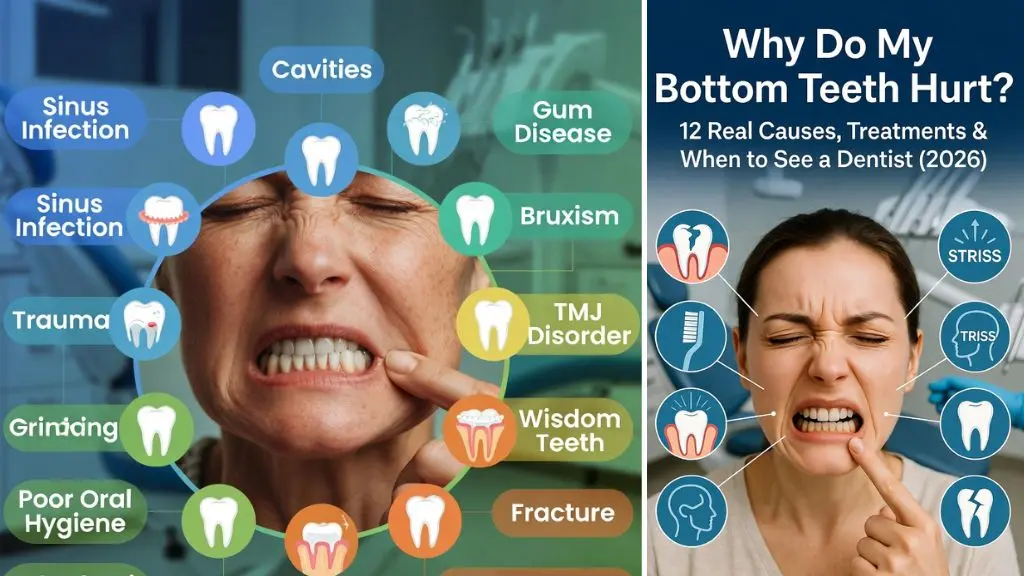
Why Do My Bottom Teeth Hurt? 12 Real Causes, Treatments & When to See a Dentist (2026)
You are eating your breakfast. Or maybe you are just sipping your morning coffee. Or perhaps you have woken up and your mouth already aches before the day has even begun. The pain is real, it is there, and it is sitting right at the bottom of your mouth — and you have no idea why.
Bottom tooth pain is one of the most common dental complaints in the world, and also one of the most misunderstood. People assume it must be a cavity, panic, put off the dentist, and let it quietly get worse. Others chalk it up to sensitivity and ignore it entirely — until the pain becomes impossible to ignore.
The truth is that your bottom teeth can hurt for more than a dozen different reasons. Some are minor and easily treatable at home. Others are serious and need professional attention before they cause permanent damage. The key is knowing the difference — and that is exactly what this post is going to give you.
Let us go through everything. What causes bottom tooth pain, what your pain is trying to tell you, how to treat it, how to prevent it, and when you absolutely cannot afford to wait any longer.
How to Fix a Cracked Tooth Naturally: Expert Tips and Home Remedies
Why Are Bottom Teeth Specifically More Vulnerable?
Before diving into the causes, it is worth understanding why your lower teeth seem to bear the brunt of dental pain more often than the upper ones.
The anatomy of your lower jaw plays a significant role. The roots of your bottom teeth sit closer to the surface of the gum line, which means that any gum recession or plaque buildup around that area exposes sensitive root tissue very quickly. Upper teeth have more gum tissue protecting their roots by comparison.
How to Avoid Dry Socket After Tooth Extraction | Expert Tips and Case Studies
Your lower teeth also take the direct impact of biting force. Every time you chew, bite down, or clench — consciously or not — your bottom teeth absorb the majority of that pressure. Over time, this consistent mechanical stress wears down enamel, stresses the surrounding gum tissue, and gradually makes the lower arch more susceptible to pain and sensitivity.
Doctors Warn: How Long Until a Tooth Infection Becomes Deadly?
Bottom teeth are also closer to saliva pooling, making them prime targets for plaque accumulation. And because the lower jaw moves independently during chewing, alignment issues and grinding habits tend to show up in the lower teeth first and most severely.
Understanding this anatomy helps make sense of almost every cause we are about to discuss.
Do Pads Expire? Everything You Need to Know About Sanitary Pad Shelf Life, Safety, and Storage
12 Reasons Your Bottom Teeth Hurt
1. Teeth Grinding (Bruxism)
This is one of the most common and most overlooked causes of bottom tooth pain — and the cruel part is that most people who do it have absolutely no idea.
Bruxism is the medical term for grinding or clenching your teeth, and it most commonly happens at night during sleep. Your bottom front teeth take the greatest impact because they make direct contact with the upper teeth during the grinding motion. Over time this wears down the protective enamel layer, exposes the sensitive dentine underneath, and creates a dull, persistent ache — especially noticeable in the morning when you first wake up.
Stress is one of the biggest triggers of bruxism. Sleep disorders, misaligned bites, and even certain medications can also cause it. If you regularly wake up with sore bottom teeth, jaw stiffness, or headaches at the temples, nighttime grinding is very likely the culprit.
A custom-fitted night guard from your dentist is the most effective protective solution. It cushions the contact between your upper and lower teeth, significantly reducing the pressure and damage caused overnight.
2. Cavities (Tooth Decay)
Do not assume cavities only happen to children. Adults develop them constantly — particularly on the chewing surfaces of the lower back molars, where food debris accumulates most readily.
A cavity begins as bacteria in your mouth producing acids that eat through your tooth enamel. In the early stages you may feel nothing at all. But once the decay reaches the inner dentine layer — which is packed with microscopic tubes leading directly to the nerve — the pain begins. It typically presents as a sharp, sudden jab when you bite down on something, or a throbbing sensitivity when you drink something cold or eat something sweet.
Left untreated, a cavity progresses deeper toward the pulp of the tooth — the living core containing nerves and blood vessels. At that stage, what started as mild sensitivity becomes severe, constant, and excruciating pain. The fix becomes far more complex and expensive than the simple filling that would have resolved it earlier.
Good oral hygiene — brushing twice daily, flossing, using fluoride toothpaste, and attending regular check-ups — prevents the majority of cavities from forming in the first place.
3. Gum Disease (Gingivitis and Periodontitis)
Gum disease is deceptive. It starts quietly, progresses slowly, and often causes significant damage long before it causes significant pain. By the time your bottom teeth are hurting because of gum disease, the condition has usually been developing for months or even years.
In its early stage — gingivitis — the gums become inflamed, red, and puffy from bacterial plaque buildup along the gum line. Your lower teeth may feel tender and your gums may bleed when you brush. This stage is entirely reversible with improved oral hygiene and a professional dental cleaning.
If gingivitis is not treated, it advances to periodontitis — a more serious infection where the gum tissue and the bone supporting your teeth begin to break down. The gums pull away from the teeth, creating pockets where bacteria thrive. Your bottom teeth may become loose, feel painful under pressure, and appear longer as the gum line recedes. At this stage, professional treatment including deep cleaning procedures is required to halt the progression.
4. Gum Recession and Exposed Roots
Your tooth enamel — the hard protective outer shell — only covers the crown of the tooth. The root portion below the gum line is covered by a much softer tissue called cementum, which offers far less protection against temperature, pressure, and bacterial exposure.
When gum tissue recedes — whether due to gum disease, overly aggressive brushing, or natural aging — the roots become exposed. Because roots lack enamel entirely, they are highly sensitive. Hot drinks, cold drinks, sweet foods, acidic foods, and even breathing in cold air can trigger sharp, shooting pain from exposed root surfaces on your bottom teeth.
Brushing with a soft-bristled toothbrush using gentle, circular motions rather than aggressive scrubbing is one of the most important things you can do to protect your gum line from recession. Once gums have receded significantly, surgical procedures may be required to restore the tissue.
5. A Cracked or Fractured Tooth
You do not need to have been in an accident or bitten something extremely hard to crack a tooth. Hairline fractures are incredibly common — and incredibly difficult to detect. They can develop gradually from years of grinding, chewing hard foods, or even temperature changes that cause the tooth structure to expand and contract repeatedly over time.
A cracked bottom tooth typically causes sharp, sudden pain when you bite down — particularly when you release the bite rather than when you apply it. It may also cause sensitivity to temperature. The tricky thing about cracked teeth is that they rarely show up on standard dental X-rays. Your dentist may need to use special dye or a bite test to identify the fracture.
If the crack extends into the pulp of the tooth, a root canal becomes necessary. Caught early, a crown can often protect and preserve the damaged tooth entirely.
6. Dental Abscess or Root Infection
An abscess is a pocket of pus caused by a bacterial infection — and when it occurs near the root of a bottom tooth, it causes some of the most severe dental pain a person can experience. The pain is typically described as intense, throbbing, or shooting, and it can radiate into the jaw, the ear, and even the neck.
Other signs of a dental abscess include swollen gums, swollen lymph nodes under the jaw, fever, a foul taste in the mouth from the draining pus, and extreme sensitivity to temperature and pressure. This is not something to manage at home or wait out — a dental abscess is a genuine infection that can spread beyond the tooth and into surrounding bone and soft tissue if not treated promptly.
Treatment typically involves draining the abscess, a course of antibiotics, and a root canal to remove the infected pulp from inside the tooth.
7. TMJ Disorder (Temporomandibular Joint Dysfunction)
Your temporomandibular joint — the hinge joint on either side of your jaw that connects your lower jaw to your skull — is one of the most complex and heavily used joints in the human body. When this joint becomes inflamed, damaged, or misaligned, the resulting pain does not always stay in the jaw. It frequently radiates directly into the lower teeth.
TMJ-related bottom tooth pain often comes with accompanying symptoms: clicking or popping sounds when you open and close your mouth, difficulty opening your jaw fully, headaches at the temples, earaches, and pain that worsens with chewing or stress. Because the symptoms overlap with many dental conditions, TMJ disorders are frequently misdiagnosed or missed entirely.
Stress management, jaw exercises, anti-inflammatory medications, night guards, and in more severe cases, physical therapy or specialist intervention, are among the treatment options for TMJ dysfunction.
8. Wisdom Teeth (Third Molars) Coming Through
Wisdom teeth — the final set of molars at the very back of your lower jaw — typically attempt to emerge between the ages of 17 and 25. However, because most modern jaws do not have enough space to accommodate these teeth, they frequently become impacted — meaning they get stuck beneath the gum line, push against the adjacent teeth, or emerge at an angle.
The result is significant pain at the back of the lower jaw that can radiate forward and make multiple bottom teeth feel sore and pressured. Swollen, tender gum tissue over the emerging tooth, difficulty opening the mouth, and jaw stiffness are all common accompanying symptoms.
In most cases of impaction, extraction is the recommended course of action — sooner rather than later, before the impacted tooth causes damage to adjacent teeth or increases infection risk.
9. Enamel Erosion From Acidic Foods and Drinks
Tooth enamel is the hardest substance in the human body — but it is not immune to acid. Frequent consumption of acidic foods and drinks — citrus fruits, carbonated drinks, coffee, wine, vinegar-based foods, and energy drinks — gradually erodes the enamel from your tooth surfaces. Since the lower teeth pool saliva and retain liquid longer, they are often the first to show signs of acid erosion.
As enamel thins, the yellowish dentine layer below becomes visible and the teeth become increasingly sensitive to temperature, sweetness, and pressure. Enamel, once lost, cannot regenerate. Protection through reduced acid consumption, drinking through straws, rinsing with water after acidic drinks, and using fluoride toothpaste helps slow further erosion.
Conditions that cause frequent vomiting — including acid reflux, GERD, bulimia, and morning sickness during pregnancy — expose the teeth to stomach acid repeatedly, accelerating enamel erosion significantly. If any of these conditions apply to you, discussing dental protection strategies with your dentist is important.
10. Sinus Infection or Sinusitis
This one genuinely surprises people — but a sinus infection can cause real tooth pain, including in the lower teeth. The nerves that supply your teeth share pathways with the nerves that service your sinuses. When the sinuses become inflamed and pressurized during an infection, that pressure and inflammation can travel along the nerve pathways and manifest as tooth pain.
While sinus-related tooth pain is more classically associated with the upper teeth — whose roots sit directly beneath the sinus cavity — the pressure and nerve radiation can absolutely extend to the lower jaw as well. If your bottom teeth ache and you also have congestion, facial pressure, a runny nose, or cold symptoms, sinusitis should be on your list of suspects.
The tooth pain from sinusitis typically affects multiple teeth rather than one specific tooth, and it resolves on its own once the sinus infection clears.
11. Recent Dental Treatment
If your bottom teeth became sensitive or painful shortly after a dental procedure — a filling, a crown, a professional cleaning, a scale and polish, or a whitening treatment — this is often a completely normal, temporary response.
Dental work involves drilling, pressure, temperature changes, and chemical agents that temporarily irritate the nerves inside your teeth. The resulting sensitivity typically peaks within the first two to three days and gradually fades over one to two weeks. Desensitizing toothpaste and avoiding extreme temperature foods during this period helps manage discomfort.
However, if the sensitivity worsens rather than improving, or if it persists beyond two weeks, this warrants a follow-up with your dentist. In some cases, a filling may be slightly too high and creating an uneven bite force on the treated tooth, or there may be a complication from the procedure that needs attention.
12. Brushing Too Hard
One of the most common causes of bottom tooth sensitivity that people genuinely do not consider is brushing too aggressively. The lower teeth — particularly the lower front teeth and the exposed gum line around them — are especially vulnerable to the damage caused by hard scrubbing.
Overly vigorous brushing with a medium or hard bristle toothbrush wears down enamel, erodes the gum margin, and eventually causes gum recession that exposes sensitive root surfaces. This is entirely self-inflicted damage, entirely preventable, and unfortunately extremely common.
Always use a soft-bristled toothbrush. Use gentle, circular motions. Let the bristles do the work rather than applying heavy pressure. Electric toothbrushes with pressure sensors that alert you when you are brushing too hard can be genuinely transformative for people who struggle with this habit.
How to Relieve Bottom Tooth Pain at Home
While home remedies do not replace professional dental care, they can provide meaningful short-term relief while you wait for an appointment:
Warm saltwater rinse — dissolve half a teaspoon of salt in a glass of warm water and swish gently for 30 seconds. Salt water reduces bacterial load, soothes inflammation, and cleanses the sore area without chemical irritation.
Cold compress — apply an ice pack or a bag of frozen peas wrapped in a cloth to the outside of your jaw for 15 to 20 minutes at a time. Cold reduces swelling and numbs the immediate pain signal.
Over-the-counter pain relief — ibuprofen (if safe for you) is particularly useful for dental pain because it addresses both pain and inflammation simultaneously. Acetaminophen is a gentler alternative if you cannot take ibuprofen.
Clove oil — eugenol, the active compound in clove oil, is a natural analgesic and antiseptic. Applying a small amount to a cotton ball and pressing gently against the sore tooth provides temporary numbing relief. This is a traditional remedy that is genuinely backed by evidence.
Desensitizing toothpaste — formulas containing potassium nitrate or stannous fluoride work by blocking the microscopic channels in exposed dentine that transmit pain signals. Used consistently twice daily, they provide measurable reduction in sensitivity over two to four weeks.
Avoid triggers — temporarily eliminate very hot drinks, very cold drinks, sweet foods, and acidic foods from your diet while the pain is active. Removing the stimulus gives the nerve time to settle.
When You Must See a Dentist — Do Not Wait
Home remedies are for temporary management only. The following symptoms require professional attention without delay:
Pain that persists for more than 48 hours without improving is a sign that something needs professional diagnosis and treatment.
Swelling of the gum, jaw, or face around a painful tooth can indicate an abscess — a spreading infection that needs urgent care.
Fever accompanying tooth pain signals that an infection may be spreading beyond the tooth structure and into surrounding tissue or the bloodstream.
Severe, throbbing, or shooting pain that does not respond to over-the-counter medication is not something to wait out.
Loose teeth in an adult are never normal and always require immediate investigation.
Visible pus or discharge around a tooth or gum line is a clear sign of infection requiring immediate treatment.
Pain that radiates to the jaw, ear, neck, or chest needs urgent evaluation — particularly the last, as in rare cases tooth pain has been associated with cardiac events.
Prevention: How to Protect Your Bottom Teeth Going Forward
The majority of bottom tooth pain is preventable with consistent, simple habits:
Brush twice daily with a soft-bristled toothbrush using gentle circular motions — never aggressive scrubbing. Floss at least once every day to remove plaque from between the teeth and along the gum line where your toothbrush cannot reach. Use fluoride toothpaste consistently — fluoride remineralizes and strengthens enamel against acid erosion and decay. Attend a professional dental check-up and cleaning every six months — not just when something hurts. Limit acidic and sugary foods and drinks, and rinse with water after consuming them. Wear a custom night guard if you grind your teeth. Stay hydrated — saliva is your mouth’s natural defense system against bacteria and acid.
FAQs — Why Do My Bottom Teeth Hurt?
Q1: Why do my bottom teeth hurt when I wake up in the morning? Morning bottom tooth pain is one of the most reliable signs of nighttime teeth grinding (bruxism). While you sleep, you apply unconscious pressure to your lower teeth through grinding and clenching motions. By morning, the enamel has been worn and the jaw muscles are fatigued, producing soreness, sensitivity, and sometimes headaches. A custom night guard from your dentist is the most effective solution.
Q2: Why do my bottom front teeth specifically hurt? Bottom front teeth are thinner than back teeth and have less enamel coverage. They receive direct contact during biting and grinding, making them the first to show signs of enamel wear. They are also the first to be affected by gum recession around the lower front gum line. Sensitivity in this area is often caused by exposed dentine from enamel erosion or receded gums.
Q3: Can stress cause my bottom teeth to hurt? Yes, significantly. Stress is one of the primary triggers of bruxism — teeth grinding and jaw clenching — which directly causes bottom tooth pain. Stress also weakens immune function, making existing gum disease progress more aggressively. Managing stress through exercise, sleep, and mindfulness practices genuinely helps protect your dental health.
Q4: Could my bottom teeth hurting be a sign of something serious? In some cases, yes. A dental abscess, advanced gum disease, an impacted wisdom tooth, or even in rare situations an underlying systemic condition can all present as bottom tooth pain. Pain that is severe, persistent, accompanied by swelling or fever, or that radiates into the jaw and neck should be evaluated by a dentist without delay.
Q5: Why do my bottom teeth hurt when I eat something cold? Sharp pain triggered specifically by cold temperatures points to either dentine hypersensitivity from exposed root surfaces or enamel erosion, or a cavity that has reached close to the nerve. If the pain fades quickly after the cold is removed, sensitivity is the likely cause. If the pain lingers for more than 20 to 30 seconds after the cold stimulus is gone, nerve involvement from decay or a crack is more likely.
Q6: Can a sinus infection really cause my bottom teeth to hurt? Yes, though it is more commonly associated with upper tooth pain. The nerve pathways supplying your sinuses and your teeth share connections, meaning sinus pressure can radiate as tooth pain in both the upper and lower jaw. If multiple bottom teeth ache simultaneously and you have nasal congestion or facial pressure, sinusitis is worth considering. The tooth pain resolves when the sinus infection clears.
Q7: Why do my bottom teeth hurt after eating? Post-meal bottom tooth pain typically points to either a cavity responding to the pressure of chewing, a cracked tooth that flexes when biting down, or acidic food erosion irritating exposed dentine surfaces. If the pain is consistently triggered by eating and centers on one specific tooth, a cavity or crack is the most likely explanation and warrants a dental appointment.
Q8: Is it normal for bottom teeth to hurt during pregnancy? Yes, and it is more common than most people realize. Pregnancy hormones increase blood flow to gum tissue, making gums more sensitive, prone to inflammation, and vulnerable to a condition called pregnancy gingivitis. Morning sickness also exposes the teeth to stomach acid repeatedly, accelerating enamel erosion on the lower teeth. Maintaining excellent oral hygiene and attending dental check-ups during pregnancy is particularly important.
Q9: Can brushing too hard cause my bottom teeth to hurt? Absolutely, and it is extremely common. Aggressive brushing wears away the enamel at the gum line and causes gum recession, exposing sensitive root surfaces on your bottom teeth. If you notice that your bottom teeth feel sensitive after brushing or that your gum line appears to be moving upward over time, switch to a soft-bristled toothbrush immediately and use a lighter touch.
Q10: How long should I wait before seeing a dentist about bottom tooth pain? If the pain is mild and began after something identifiable — a new filling, a whitening treatment, or eating something very cold — giving it 48 hours to settle is reasonable. If the pain persists beyond 48 hours, is severe, is accompanied by swelling, fever, or radiating pain, or has no obvious explanation, see a dentist as soon as possible. Dental pain does not resolve on its own — it progresses.
The Bottom Line
Your bottom teeth are trying to tell you something. Pain is never random — it is always your body communicating that something needs attention. Whether that message is as simple as “you are brushing too hard” or as urgent as “there is an abscess here that needs treating today,” the answer is always the same: listen to it, identify it, and act on it.
Most causes of bottom tooth pain are entirely treatable — and the earlier they are caught, the simpler and less expensive the treatment. Do not wait for a toothache to become unbearable before you take it seriously. Your teeth are the only ones you have.
This article is for informational purposes only and does not constitute professional dental or medical advice. If you are experiencing tooth pain, please consult a licensed dental professional for an accurate diagnosis and appropriate treatment.


