Randy Fine: A Complete Life Story — From Harvard Halls to the Hebrew Hammer of Congress
Born April 20, 1974, Tucson, Arizona
In American politics, there are people who seek power quietly, accumulate it slowly, and exercise it cautiously. And then there are people like Randy Fine — a Harvard-educated, casino-industry-hardened, self-described “Hebrew Hammer” who spent nearly a decade methodically building a platform in the Florida state legislature before arriving in Washington in April 2025 with the enthusiasm of someone who had been waiting his entire life to fight on the biggest stage available.
Fine is, depending on who you ask, either a fearless conservative champion who says what others are afraid to say, or one of the most provocative and controversial politicians currently serving in the United States Congress. Both characterizations are grounded in facts. The story of how Randall Adam Fine — a boy from Tucson raised in Lexington, Kentucky by an MIT-trained engineer and a science teacher — became one of the most nationally discussed freshman members of the 119th Congress is one of the more unusual journeys in recent American political life.
Randy Fine Early Life: Tucson, Lexington, and a Household Built Around Learning
Randall Adam Fine was born on April 20, 1974, in Tucson, Arizona — but he did not stay there long. The family relocated to Lexington, Kentucky, where he grew up and where his formative years were shaped by two parents who treated education as the foundational value of the household.
His father, H. Alan Fine, was an MIT graduate who became a professor of engineering at the University of Kentucky. His mother, Harriet Fine, was a junior high school science teacher. Between them, they created a home environment in which intellectual rigor, academic ambition, and the ability to articulate arguments clearly were not merely encouraged but expected.
Randy has identified his father as his most significant personal influence — a man whose clarity of thought and commitment to principled positions shaped his son’s own combative, conviction-driven approach to public life. His mother, Harriet, passed away in 2024 from Alzheimer’s disease — a loss that occurred during the same year Randy was ascending to the United States Congress. He has spoken of her with deep affection.
He grew up Jewish in a predominantly Christian region of the American South, an experience that gave him an early and personal understanding of what it means to be a religious minority — context that would later inform his fierce advocacy for Israel and his sensitivity to antisemitism in all its forms.
He also grew up as a self-described third-generation Floridian — a biographical note that appears on his official congressional website and reflects his family’s deeper roots in the Sunshine State even as he was raised in Kentucky.
He attended Lafayette High School in Lexington, where his academic performance was extraordinary enough to earn him a position on Capitol Hill long before he was old enough to vote.
A House Page at 16: The US Capitol Page School (1990–1991)
In the 1990–1991 school year, during his junior year of high school, Randy Fine served as a United States House of Representatives Page — one of the most competitive and educationally selective positions available to American high school students. Pages work in the House chamber, delivering messages, assisting members, and attending the United States Capitol Page School, which conducts its classes at 5:00 AM so students can work the full congressional day afterward.
Being selected as a page at 16, working directly in the United States Capitol, watching the legislative process from the floor of the House — the experience left a permanent imprint. Fine has cited it as formative to his understanding of how Congress actually works and as one of the seeds of his eventual political ambition. He would spend the better part of the next three decades building toward a return.
Harvard University: Bachelor’s and MBA, Both with Distinction
Randy Fine attended Harvard College from 1992 to 1996, earning a Bachelor of Arts in Government — and graduating magna cum laude, placing him in the upper tier of his class. His record at Harvard was exceptional enough to win him a place in the most selective program at Harvard Business School.
From 1996 to 1998, he attended Harvard Business School and received his Master of Business Administration — graduating as a Baker Scholar, the designation given to the top 5% of HBS students and the school’s highest academic honor. Baker Scholars are among the most competitively credentialed business school graduates in the world.
The two Harvard degrees gave Fine intellectual pedigree, professional credibility, and a network that opened every door in American corporate life. He used all of it.
Between his undergraduate and graduate years, he also served as a teaching fellow at Harvard — an indicator that he had the academic depth to teach the material he was studying, not merely to learn it.
Corporate Career, Phase One: McKinsey, Circuit City, and Smartmouth Technologies (1996–2003)
Fine’s post-Harvard career moved through several industries with the kind of restless energy that characterizes people who are building toward something larger.
His first major corporate role was at McKinsey & Company, the globally elite management consulting firm that recruits almost exclusively from the most competitive graduate programs in the world. McKinsey trains its consultants in the systematic analysis of large organizations — their costs, their inefficiencies, their structural problems — and deploys them to advise some of the most complex businesses on earth. For a young man who graduated as a Baker Scholar from HBS, McKinsey was the natural next step.
After McKinsey, he moved into direct corporate operations. From 1998 to 1999, he was Vice President of Sales and Distribution at Circuit City Stores — the then-dominant consumer electronics retail chain, which at the time was one of the most recognized brands in American retail.
In 1999, he made his first entrepreneurial move: he founded and served as Chairman and CEO of Smartmouth Technologies, Inc. through 2001 — a technology startup during the boom years of the early internet, reflecting his willingness to bet on his own ideas and take entrepreneurial risk during one of the most volatile periods in technology history.
From 2002 to 2003, he served as Vice President of Slots and Total Rewards Operations at Harrah’s Entertainment — one of the largest casino and hotel companies in the United States, operating dozens of gaming properties across the country. This was his entry into the casino industry that would occupy the central decade of his business life.
From 2004 to 2005, he served as Senior Vice President of Marketing at American Casino & Entertainment Properties, LLC — the parent company of the Stratosphere Casino, Hotel and Tower in Las Vegas, one of the most recognizable landmarks on the Las Vegas Strip.
Facts About Nuno Loureiro: MIT Fusion Scientist and Plasma Physicist Fatally Shot at His Home
The Fine Point Group and CEO of Greektown Casino (2005–2015)
In 2005, at the age of 31, Fine made his most significant entrepreneurial move. He founded the Fine Point Group — a Nevada-based consulting and management business specializing in casino gaming, cruise lines, technology, and healthcare. Headquartered in Nevada but with offices in Florida, Memphis, and Las Vegas, Fine Point Group advised casino operators across Las Vegas, San Diego, Mississippi, New Mexico, Oregon, Pennsylvania, and Washington State.
The firm was a serious success. For nearly a decade, it established Randy Fine as a recognized expert in casino management and operations — earning him a “40 Under 40” recognition in Las Vegas business in 2009, the year he simultaneously became CEO of one of the most distressed major casinos in America.
In 2009, Fine served as Chief Executive Officer of the Greektown Casino in Detroit, Michigan — a major urban casino that had filed for bankruptcy in 2008 amid the broader economic collapse. Fine was brought in to provide executive leadership during the restructuring process. The Greektown Casino was the kind of complex, high-stakes turnaround situation that tested every skill a McKinsey-trained, HBS Baker Scholar could deploy: financial restructuring, operational management, political navigation, and stakeholder communication in a city that was simultaneously experiencing one of the most severe economic crises of any major American urban center.
He ran Fine Point Group until approximately 2014, when he retired from the gambling industry consulting world at age 40 — winding down his business operations, selling his consulting ventures, and turning his full attention to the next chapter.
Fine’s net worth, estimated by various sources as comfortably in the millions, derives primarily from his casino executive earnings, the proceeds of Fine Point Group, and his investments. His Melbourne Beach, Florida residence — which he expanded to over 4,500 square feet at an estimated cost of $1 million — reflects the lifestyle of a man who built significant wealth before entering public service, not one who used public service to build wealth.
Family: Wendy, Jacob, and David
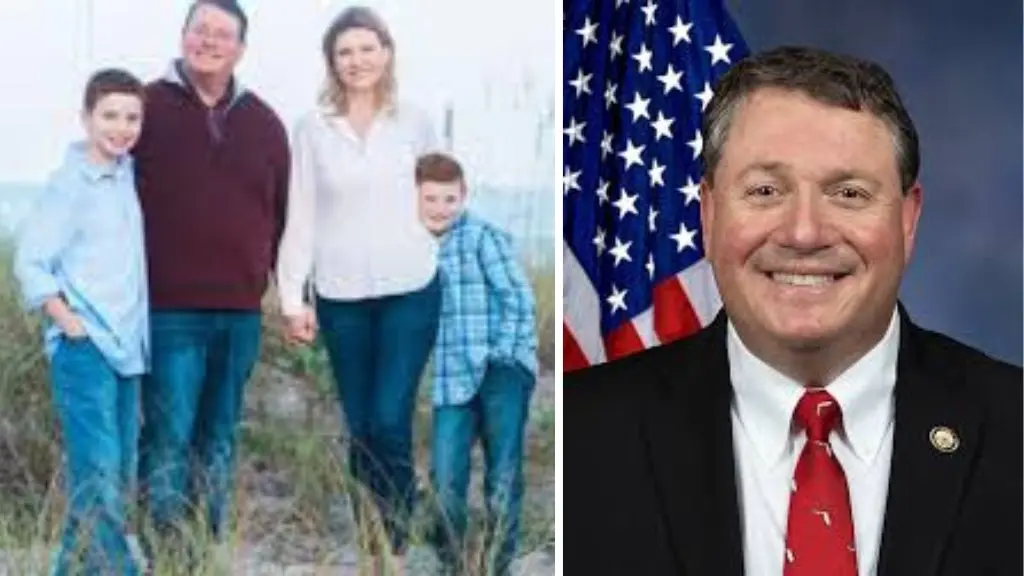
Randy Fine is married to Wendy Fine. The couple has two sons: Jacob and David. The family lives in Melbourne Beach, Florida, in Brevard County — a coastal community on the Atlantic that is part of the Space Coast region.
Fine has spoken often and directly about the personal costs of political life on his family, particularly during his state legislature years when he was serving for the nominal salary of a state representative: “I don’t particularly like being a legislator. It comes at a great cost to my family. It comes at a great cost to my boys.” He has framed his political career not as a pursuit of personal satisfaction but as a sacrifice made for causes he believes are genuinely important — a framing that his supporters find admirable and his critics find convenient.
His mother Harriet passed away in 2024 from Alzheimer’s disease while he was running for Congress. He has not spoken extensively about this loss publicly, but it occurred during one of the most professionally consuming periods of his career.
Entering Florida Politics: The 2015 Consideration and the 2016 State House Race
In 2015, Randy Fine considered running for United States Senate in Florida — a statewide campaign of enormous scope and cost that would have launched him immediately onto the national stage. He opted instead for a different path: start local, win big, and build from there.
In 2016, he ran for the Florida House of Representatives District 53 seat — a seat being vacated due to term limits by Representative John Tobia. Fine’s district covered parts of Brevard County, home to the Kennedy Space Center and a significant military and defense community. He defeated Democrat David Kearns with 57% of the vote, a decisive margin in a competitive state.
What was notable even in that first campaign was the style. Fine did not run as a cautious, consensus-building Republican. He ran as someone willing to fight — on issues, on opponents, on the orthodoxies of both political parties when he believed they were wrong. He was combative by design, and he made no apology for it.
He won four consecutive elections in the Florida House, representing both the 53rd and (after redistricting) the 33rd districts:
2016: Defeated David Kearns, 57% to 43% 2018: Defeated Phil Moore, 55% to 45% 2020: Defeated Phil Moore again, 55% to 45% 2022: Defeated Anthony Yantz — Democratic primary was cancelled, Fine ran unopposed in the general
Eight years in the Florida House. Four terms. Dozens of bills introduced, debated, passed, and signed.
Major Florida Legislative Battles: From Classroom to Corporate Kingdom
The “Don’t Say Gay” Bill (2022)
In 2022, Fine was a vocal supporter of Florida House Bill 1557 — the Parental Rights in Education Act, known to its critics as the “Don’t Say Gay” bill. The legislation prohibits classroom instruction on sexual orientation and gender identity from kindergarten through 3rd grade, and requires that any such instruction in higher grades be “age-appropriate or developmentally appropriate” according to state standards. It also empowers parents to sue schools that they believe violated the law.
Fine did not merely vote for the bill — he actively championed it and defended it against national and international criticism. He argued the legislation protected parental rights over what young children are taught in public schools and was not a form of discrimination against LGBTQ+ individuals. Critics, including major civil rights organizations, the American Academy of Pediatrics, the American Psychological Association, and hundreds of major corporations, argued it would harm LGBTQ+ children by silencing discussions that could support their wellbeing.
The bill passed both chambers of the Florida legislature, was signed by Governor Ron DeSantis on March 28, 2022, and immediately became one of the most litigated education laws in recent American history.
Dissolving Disney’s Reedy Creek: Taking on the Mouse
When the Walt Disney Company announced it would oppose the Parental Rights in Education Act and work toward its repeal, Randy Fine moved with extraordinary speed and aggression.
He filed House Bill 3-C — legislation that would dissolve all six independent special districts in Florida established prior to November 5, 1968. The practical target of the bill was unmistakable: the Reedy Creek Improvement District (RCID), the extraordinary self-governing jurisdiction Disney had operated since 1967, which gave it the authority to build roads without following state transportation guidelines, construct buildings without standard zoning codes, manage its own utilities, and theoretically even build a nuclear power plant without state permission.
Fine summarized Disney’s status with characteristic bluntness: “Disney is a guest in Florida. Today we remind them.”
When asked whether the bill was retaliatory for Disney’s stance on the education legislation, Fine told CNBC: the research into special districts began “when Disney kicked the hornet’s nest several weeks ago.” He simultaneously maintained the bill was about legitimate policy and acknowledged that Disney’s political intervention had been what drew attention to it.
The bill passed both chambers and was signed into law by DeSantis on April 22, 2022. The ensuing legal battle between Disney and the state of Florida — including Disney’s clever invocation of a legal clause tied to King Charles III that preserved some of its special status — became one of the most widely covered corporate-political conflicts in recent American history.
LGBTQ+ Legislation Record
Fine’s Florida House record on LGBTQ+ issues is extensive and consistently restrictive. He:
Voted yes in April 2021 on CS/HB 1475, which bars transgender girls and women from competing on girls’ sports teams at public schools.
Sponsored and supported legislation banning drag shows for minors, making the argument — which critics called inflammatory and unsubstantiated — that some in the LGBTQ+ community were engaged in “grooming” children.
Backed bills limiting access to gender-affirming healthcare for transgender minors.
Supported measures targeting pride flags and political flags in public spaces.
Fine has framed all of this legislation as a defense of parental rights, child protection, and biological reality. His critics characterize the cumulative record as a sustained legislative campaign against LGBTQ+ individuals and families, and particularly against LGBTQ+ youth in public schools.
School Choice Advocacy
Among his most consistent and least controversial legislative priorities has been school choice — expanding the range of educational options available to Florida families, including through charter schools, private school vouchers, and homeschooling support. He has described this as one of the core reasons he entered politics and one of the areas where he believes conservative governance can most concretely improve lives.
Environmental and Infrastructure Legislation
Fine has also worked on more local and technical legislative issues relevant to his Space Coast district, including environmental infrastructure in Brevard County. While the national attention generated by his more combative positions often overshadows this work, his constituents have cited his infrastructure advocacy as among his most practically significant contributions.
The Ethics Investigation (2023–2024) and the School Board Feud
In April 2023, the Florida Commission on Ethics made a notable finding: it determined there was “probable cause” to believe that Fine had abused his position to obtain a disproportionate benefit and had misused his position by threatening to take away state funding as part of a personal feud with a Brevard County School Board member.
The allegation stemmed from Fine’s conduct in a dispute with a local school board official — specifically, the accusation that he had leveraged his position as a state legislator to threaten the withholding of state funding in a matter that was personal rather than public in nature.
Fine’s response was characteristically combative: “It is clear to me that the kangaroo court that is the Florida Commission on Ethics has a personal axe to grind with myself and my politics.”
The Commission announced in May 2024 it would re-evaluate the charges. In July 2024, it dismissed the case for lack of legal sufficiency — meaning the evidence, even if the allegations were believed, was insufficient to constitute a legal violation under the relevant statutes. Fine interpreted this as full vindication. His critics noted that the probable cause finding itself reflected poorly on his conduct regardless of the ultimate legal outcome.
COVID-19 and Mask Mandate Opposition
On July 22, 2020, Fine announced he had tested positive for COVID-19. He disclosed the diagnosis publicly. In the months that followed, he became one of the most vocal opponents of school mask mandates in Florida, comparing schools that imposed them to “child abusers” and advocating strongly for parental choice in COVID safety protocols. His position aligned with Florida’s broader approach under Governor DeSantis, which diverged from many other states in resisting statewide mandates.
The 2024 State Senate Race and the Brief Senate Stint
In August 2024, Fine won the Republican primary for Florida State Senate District 19 — the district covering Cape Canaveral and the majority of Brevard County. He defeated Democrat Vance Ahrens in the November 5, 2024 general election, 59% to 41%, and was sworn in to the Florida Senate on November 19, 2024.
He earned a state senator’s salary of $29,697 — a fraction of what he had earned as a casino executive, and a number he has cited as evidence that his political career is not motivated by financial self-interest.
He had been a Florida state senator for approximately six weeks when the next opportunity arrived.
The Break with DeSantis Over Trump
Before Fine’s meteoric rise to Congress, one of the more politically significant moments of his state career was his public endorsement of Donald Trump for president during the 2024 Republican primary — at a time when Florida Governor Ron DeSantis was actively running against Trump and expecting support from his Florida legislative allies.
Fine’s endorsement of Trump over DeSantis was, in the zero-sum world of Florida Republican politics, a direct rebuke of the governor. It led to mutual public recriminations between Fine and DeSantis’s political circle. The break was real and lasting, even as both men remained members of the same party pursuing overlapping policy agendas.
When Trump won re-election in November 2024, Fine’s loyalty was rewarded with something concrete: a presidential endorsement that would prove decisive in his congressional race.
Congress at Last: The Special Election for Florida’s 6th District (April 2025)
When President-elect Trump nominated Mike Waltz — the Republican Congressman from Florida’s 6th district and a decorated Green Beret combat veteran — as his National Security Advisor in November 2024, a congressional seat came open in a competitive but Republican-leaning district covering a six-county area including Daytona Beach.
Fine declared his candidacy on November 26, 2024 — just 19 days after the election. He had clearly been watching the political board. His announcement post on X: “The Hebrew Hammer was coming” to Congress, and Rashida Tlaib and Ilhan Omar “might consider leaving before I get there.”
The endorsements came immediately and comprehensively:
President-elect Donald Trump: “Randy Fine has my Complete and Total Endorsement. RUN, RANDY, RUN!” Senator Rick Scott (R-FL) House Speaker Mike Johnson (R-LA) House Majority Leader Steve Scalise (R-LA) House Majority Whip Tom Emmer (R-MN)
His campaign priorities, as listed on his official campaign page: “Secure our borders,” “Protect our elections from fraud,” “Defend life,” and “Protect the Second Amendment at all costs.”
On April 1, 2025, Fine formally resigned from the Florida Senate — as required by Florida’s resign-to-run law — effective March 31, 2025.
On April 2, 2025, he won the special election for Florida’s 6th Congressional District.
On April 9, 2025, he was sworn in as a United States Representative for the 119th Congress.
The boy from Lexington who had served as a House page at 16, who had sat in the Capitol and watched the legislative process from the floor, had come back — this time as a member.
In Congress: The Foreign Affairs Committee, the Education Committee, and the Bills
Fine serves on two House committees: the House Foreign Affairs Committee and the House Education and Workforce Committee — assignments that reflect both his policy priorities (Israel and the Middle East on Foreign Affairs; school choice and education policy on Education and Workforce) and his professional background (education policy aligns with his legislative record; Foreign Affairs aligns with his Israel advocacy).
His congressional legislative record from April 2025 through February 2026 already includes dozens of introduced bills. Among the most notable:
The No Antisemitism in Education Act — legislation targeting the presence of what Fine characterizes as antisemitic content and environments in American educational institutions, introduced in the context of post-October 7 campus protests.
The No Welfare for Non-Citizens Act — legislation restricting access to federal welfare benefits for non-citizens, part of his broader immigration enforcement agenda.
The PEACE Act — foreign policy legislation reflecting his positions on the Middle East.
The Greenland Annexation and Statehood Act (January 2026) — introduced just weeks ago, this legislation supports President Trump’s stated interest in acquiring Greenland and would begin the formal process of considering Greenland as a potential U.S. territory or state. It has been referred to the House Foreign Affairs Committee, where Fine himself serves.
H.R. 7534 (February 12, 2026 — one day before this post was published) — legislation to amend the Small Business Act to establish a goal for participation by veteran-owned small businesses in procurement contracts.
His vote attendance record is exemplary: from April 2025 through February 2026, he missed just 1 of 344 roll call votes — a 0.3% miss rate, significantly better than the 2.0% median among currently serving representatives.
The Gaza Controversy: Artillery Shells, “Starve Away,” and AIPAC Removal
Randy Fine’s advocacy for Israel — fierce, consistent, and rooted in his Jewish identity and his reading of history — has been one of the defining features of his political career. It has also generated some of the most serious criticism he has faced, including from within the pro-Israel community itself.
In October 2023, following Hamas’s attack on Israel on October 7, Fine arranged for the message “Regards from Randy Fine” to be written on an Israeli artillery shell destined to be fired on Gaza. He subsequently arranged for messages on two more shells. He posted about this publicly. The gesture was widely condemned as dehumanizing by critics and defended as solidarity with Israel’s right to self-defense by his supporters.
In November 2023, Fine voted against a Florida House of Representatives resolution calling for a ceasefire in Gaza — the resolution received only two supporting votes. He asserted that anyone who voted for the resolution was antisemitic and was “putting every Jewish child in the state at risk.”
In May 2024, when Ireland, Norway, and Spain recognized the State of Palestine, Fine called Ireland an “antisemitic country” and pledged to introduce legislation banning Florida government entities from contracting with Irish, Norwegian, and Spanish companies.
In July 2025, as international warnings about famine conditions in Gaza intensified, Fine posted on X that Palestinians should “starve away” until Israeli hostages held by Hamas were returned. He dismissed reporting on Palestinian starvation as “Muslim terror propaganda.” He subsequently repeated claims that the humanitarian crisis was a hoax.
The response to these posts came from across the political spectrum:
The American Jewish Committee condemned the tweet for “making light of the humanitarian crisis.”
Fine was subsequently removed from AIPAC’s database of pro-Israeli politicians — a significant signal from the most powerful pro-Israel lobbying organization in the United States that his rhetoric had crossed a line.
His Republican primary challenger Aaron Baker accused Fine of “genocidal” rhetoric.
Republican primary challenger Charles Gambaro called Fine’s comments “outrageous” and “unacceptable.”
Marjorie Taylor Greene (R-GA) — whose own rhetoric has generated extensive controversy — described Fine’s tweet as “disgraceful.”
Fine showed no indication of retreating from any of his stated positions.
The “Hebrew Hammer”: Identity, Branding, and Political Style
Randy Fine’s self-description as the “Hebrew Hammer” is both a statement of identity and a strategic positioning choice. He is Jewish, he is proud of it, and he has made his advocacy for Israel and against antisemitism among the most prominent pillars of his public persona. The nickname signals combativeness, cultural specificity, and a refusal to present the soft edges that political consultants often recommend.
His political style has been described as “bare-knuckle” by observers across the political spectrum. He is not a legislator who seeks consensus or softens his positions for palatability. He identifies problems as he sees them, names opponents directly, and pursues his goals with the kind of single-mindedness that his Harvard Business School training might have called “strategic clarity” and his critics call “recklessness.”
He has also, in moments of self-reflection that are relatively rare in his public persona, acknowledged the costs of this approach. His observation that he does not “particularly like being a legislator” — that it costs his family, costs his boys, and that the sacrifice is only worth it if he works on the “big issues” — suggests a man who is genuinely trying to calculate the price of what he is doing, even as he continues to pay it.
He is also, in ways that don’t always make it into the national coverage, a practitioner of civic gestures that reflect a more conventionally community-minded public servant. He organized the first annual Boy Scout Day at the Florida Capitol in 2018 and continued it as an annual tradition — a small but telling data point about a politician who, beneath the combative exterior, still believes in the structures of civic engagement he encountered as a page in the United States Capitol at age 16.
Randy Fine Today: February 2026
As of February 14, 2026, Randy Fine is 51 years old — four days from his next birthday — and has been a member of the United States House of Representatives for ten months. He represents Florida’s 6th Congressional District, which covers Daytona Beach and five surrounding counties. He serves on the Foreign Affairs and Education and Workforce Committees. He introduced a bill yesterday.
He is a man shaped by extraordinary educational privilege, real corporate achievement, eight years of state legislative experience, and a political philosophy that is simultaneously coherent in its principles and combustible in its expression. He is a vocal defender of Israel who was removed from AIPAC’s database. He is a Jewish Republican in a party whose relationship with his faith community is complicated. He is a Harvard Baker Scholar who became a casino CEO who became a state legislator who became a Congressman — a biographical arc that defies easy categorization.
He is also, by his own repeated admission, someone who didn’t run for office because he enjoys it. He ran because he believed the big issues demanded someone willing to fight for them, and he was willing to fight. Whether the country finds that fighting admirable or alarming — and the answer, increasingly, appears to depend almost entirely on which big issues you care about most — Randy Fine shows no sign of changing his approach.
The Hebrew Hammer is in Washington. And he is not quiet.
Randy Fine represents Florida’s 6th Congressional District in the United States House of Representatives. He serves on the House Foreign Affairs Committee and the House Education and Workforce Committee. He can be contacted through his official congressional website at fine.house.gov. He lives in Melbourne Beach, Florida with his wife Wendy and their sons Jacob and David.