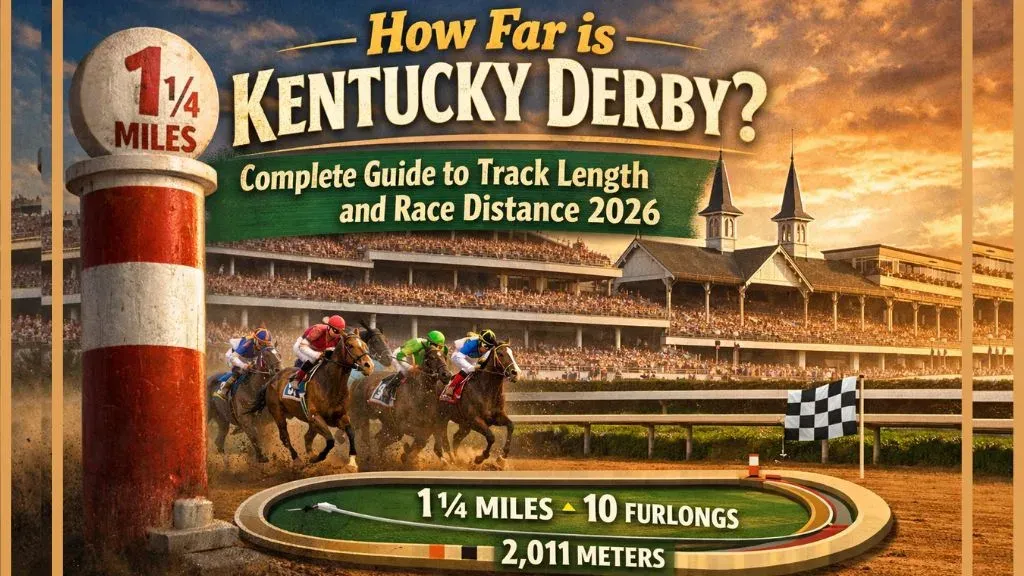
How Far is Kentucky Derby? Complete Guide to Track Length and Race Distance 2026
How Long is Kentucky Derby Track? If you’re planning to watch the Kentucky Derby or visit Churchill Downs for the first time, you may wonder how long the Kentucky Derby track is. The answer isn’t simple. There are different measurements to consider, including the track’s total length, the race distance, and how that distance has changed over the past 150 years.
This guide explains the Kentucky Derby track’s length, layout, and dimensions. It also explores the history behind these measurements and why they matter to both horses and racing fans.
Track Circumference vs. Race Distance
Before we dive deep, let’s clarify the two most important measurements:
Churchill Downs Track Circumference: The main dirt oval track is one mile (1.6 kilometers) around.
Kentucky Derby Race Distance: The actual Kentucky Derby race itself is 1¼ miles (10 furlongs or 2,012 meters) long.
Yes, these are different numbers—and understanding why requires us to explore how horse racing tracks work and how the Derby has evolved over time.
Understanding the Churchill Downs Track Layout
The Main Dirt Track: Where Champions Are Crowned
The primary racing surface at Churchill Downs—the track on which the Kentucky Derby and most other races are run—is a one-mile oval. This means if you walked all the way around the track following the racing surface, you’d travel exactly one mile (5,280 feet or 1,609 meters).
Key Specifications:
- Circumference: 1 mile (1.6 km)
- Width: 79-80 feet (24.1-24.4 meters) for most sections
- Starting Gate Section Width: 120 feet (37 meters) – extra wide to accommodate larger fields of horses
- Surface: Traditional dirt and clay mixture
- Configuration: Oval with gradual banking in the turns
This one-mile configuration is considered ideal for Thoroughbred racing, providing enough space for horses to find their stride while still allowing spectators to see most of the action.
The Turf Track: The Inner Circle
Inside the main dirt track lies Churchill Downs’ turf (grass) track, which hosts races specifically designated for turf racing:
Turf Track Specifications:
- Circumference: 7 furlongs or ⅞ mile (1.4 km or approximately 7,000 feet)
- Width: 80 feet (24 meters)
- Surface: Natural grass, meticulously maintained
- Use: Turf races throughout the racing season
The turf track is slightly shorter than the main dirt oval because it sits inside it, creating two distinct racing surfaces at one facility.
Blood Falls in Antarctica — The Glacier That Bleeds Red
Total Property Size
Churchill Downs occupies an impressive 147-175 acres (sources vary slightly on the exact acreage, likely due to different counting methods for auxiliary buildings and parking areas). This massive property includes:
- The main dirt track (1 mile)
- The turf track (⅞ mile)
- Grandstands and seating for approximately 50,000 people
- The infield (which accommodates 100,000+ on Derby Day)
- Backstretch barns housing more than 1,400 horses annually
- Training facilities
- The Kentucky Derby Museum
- Administrative buildings
- Parking areas
How Long is Kentucky Derby Track and Race Distance: 1¼ Miles
While the track itself is one mile around, the Kentucky Derby race is run at 1¼ miles (also expressed as 10 furlongs or 2,012 meters). But how do you run a 1¼-mile race on a one-mile track? The answer lies in where the race starts.
How the Starting Gate Works
The Kentucky Derby doesn’t start at a fixed “start/finish” line on the backstretch. Instead, the starting gate is positioned at a specific point on the backstretch so that when horses complete 1¼ miles, they cross the finish line located in front of the grandstand.
Here’s how it works:
- The Finish Line: Located directly in front of the grandstand on the homestretch
- The Starting Gate: Positioned on the far turn/backstretch, approximately ¼ mile before what would be the “starting point” of a full one-mile lap
- The Course: Horses run from the gate, around the track past the finish line once, then continue for another ¼ mile to finish
In practical terms, horses in the Kentucky Derby run:
- From the starting gate around the first turn
- Down the backstretch
- Through the far turn
- Past the finish line (completing about ¾ of a mile at this point)
- Continue around the clubhouse turn
- Down the homestretch again
- Across the finish line (total: 1¼ miles)
This configuration creates one of the Derby’s signature features: the horses pass the grandstand twice, building excitement as fans see them thunder by the first time, knowing they still have a full circuit to complete.
Why 1¼ Miles? The Historical Evolution
The Kentucky Derby hasn’t always been 1¼ miles. In fact, when it first ran on May 17, 1875, the distance was significantly longer.
Original Distance (1875-1895): 1½ Miles
The inaugural Kentucky Derby was modeled after England’s Epsom Derby, which ran (and still runs) at 1½ miles (12 furlongs or 2.4 kilometers). Colonel Meriwether Lewis Clark Jr., who founded Churchill Downs, wanted to replicate the prestige of European racing, so he set the Derby at the same distance.
For the first 21 runnings of the Kentucky Derby (1875-1895), horses competed at this longer distance. The winning times were slower, typically ranging from 2:34 to 2:38—considerably longer than today’s standard.
The 1896 Change: Shortening to 1¼ Miles
In 1896, new ownership under William E. Applegate made a crucial decision: they shortened the Kentucky Derby to 1¼ miles, where it has remained ever since—now for 130 consecutive years.
Why the change?
Several factors influenced this decision:
- Horse Development: Three-year-old Thoroughbreds in early May simply hadn’t developed the stamina for 1½ miles. Modern understanding of equine physiology confirms that asking young horses to run that distance so early in the spring pushed them too hard.
- American Racing Trends: By the 1890s, American racing had begun favoring shorter, faster races than their European counterparts. The 1¼-mile distance better fit American tastes and horse breeding programs.
- Spectator Excitement: Shorter races meant faster times and more exciting finishes, which appealed to crowds and generated more enthusiasm.
- The American Classic Distance: The 1¼-mile distance became known as the “American Classic” distance and is now used for many of America’s most prestigious races, including the Breeders’ Cup Classic and the Jockey Club Gold Cup.
The 1896 Derby, won by a horse named Ben Brush, was the first at the modern distance. Since then, every Kentucky Derby has been run at exactly 1¼ miles—128 consecutive years and counting as of 2024.
“The Most Exciting Two Minutes in Sports”
How Long Does the Derby Actually Take?
The Kentucky Derby is famously known as “The Most Exciting Two Minutes in Sports” (a phrase coined by Churchill Downs president Matt Winn and popularized by legendary sportswriter Grantland Rice in 1935). But is it really two minutes?
Average Winning Time: Approximately 2:02-2:04
Most Kentucky Derby winners complete the 1¼-mile course in just over two minutes. The exact time varies based on:
- Track conditions (fast, good, muddy, sloppy)
- Racing pace (how fast the early leaders go)
- Competition level
- Weather conditions
The Fastest Kentucky Derby Ever: Secretariat (1973)
The all-time Kentucky Derby record is held by the legendary Secretariat, who won the 1973 Derby in an astounding 1:59.40 (1 minute, 59 and 2/5 seconds). This record has stood for over 50 years and shows no signs of being broken anytime soon.
Secretariat’s time is so remarkable that the second-place finisher in that same race—Sham—recorded the second-fastest Kentucky Derby time ever (1:59 4/5 seconds), yet was still beaten by 2½ lengths. This demonstrates just how extraordinary Secretariat’s performance was.
The Only Other Sub-Two-Minute Derby: Monarchos (2001)
The only other horse to break the two-minute barrier was Monarchos in 2001, who won in 1:59.97—just 3/100ths of a second under two minutes. Monarchos’ performance was brilliant, but it still fell short of Secretariat’s seemingly untouchable mark.
The Slowest Modern Derby: Stone Street (1908)
At the opposite end of the spectrum, Stone Street won the 1908 Kentucky Derby in 2:15.2 on a muddy track—the slowest winning time at the 1¼-mile distance. Muddy conditions significantly slow racing times, sometimes adding 5-10 seconds or more to typical times.
Burj Khalifa in Dubai: The World’s Tallest Architectural Marvel and Engineering Wonder
What Makes Two Minutes So Fast?
To appreciate just how remarkable a two-minute mile-and-a-quarter is, consider these comparisons:
Speed Calculation:
- 1¼ miles = 6,600 feet
- 2 minutes = 120 seconds
- Average speed: 55 feet per second or approximately 37.5 miles per hour
Thoroughbred racehorses at full gallop during the Kentucky Derby are traveling nearly 40 miles per hour while carrying a jockey, navigating turns, and competing against 19 other elite horses. That’s faster than most people drive through residential neighborhoods—and these animals are doing it on their own power, sustained for two full minutes.
Churchill Downs’ Signature Feature
The Long Homestretch
One of Churchill Downs’ most celebrated features—and a key component of its overall length—is the extended homestretch.
Homestretch Length: Approximately 1,234 feet (about ¼ mile or 2 furlongs)
This long straight stretch from the final turn to the finish line has witnessed countless dramatic Kentucky Derby finishes. It’s long enough that horses with superior closing speed can make up significant ground in the final furlongs, yet short enough that early speed horses can still hold on if they’ve conserved energy well.
Famous stretch duels at Churchill Downs include:
- Affirmed vs. Alydar (1978): Affirmed held off Alydar’s furious charge by 1½ lengths
- Sunday Silence vs. Easy Goer (1989): Sunday Silence won by 2½ lengths despite Easy Goer’s strong close
- Smarty Jones (2004): Dominated throughout, winning by 2¾ lengths with one of the most commanding Derby performances ever
The homestretch’s length is perfectly calibrated—long enough to allow exciting late rallies, but not so long that it favors closers overwhelmingly.
The Turns at Churchill Downs
Churchill Downs features gradual, sweeping turns rather than sharp corners. This design:
- Allows for Higher Speeds: Horses can maintain momentum through the turns rather than having to slow down dramatically
- Reduces Injury Risk: Gentler turns put less stress on horses’ legs and joints
- Accommodates Large Fields: The wide turns give 20-horse Derby fields room to maneuver
The turns are banked (sloped) slightly to help horses maintain balance and speed, though not as dramatically as some smaller tracks.
How Kentucky Derby Distance Compares to Other Major Races
The Triple Crown: Three Different Distances
The Kentucky Derby is the first leg of American Thoroughbred racing’s Triple Crown, but each race is run at a different distance:
- Kentucky Derby (Churchill Downs): 1¼ miles
- Preakness Stakes (Pimlico Race Course, Baltimore): 1 3/16 miles (slightly shorter)
- Belmont Stakes (Belmont Park, New York): 1½ miles (longest)
This progression—short to medium to long—tests different aspects of a Thoroughbred’s ability:
- The Derby tests speed and tactical ability
- The Preakness tests recovery and versatility (run just two weeks after the Derby)
- The Belmont tests stamina and endurance (“The Test of the Champion”)
Winning all three requires a truly exceptional horse with speed, stamina, tactical brilliance, and the ability to recover quickly—which is why only 13 horses in history have accomplished this feat.
International Comparisons
Epsom Derby (England): 1½ miles
- The race that inspired the Kentucky Derby still runs at the original longer distance
Prix de l’Arc de Triomphe (France): 1½ miles
- Europe’s most prestigious race, run on turf
Melbourne Cup (Australia): 2 miles (3,200 meters)
- Known as “the race that stops a nation,” significantly longer than American classics
Dubai World Cup (UAE): 1¼ miles
- The world’s richest race matches the Kentucky Derby distance
The 1¼-mile distance has become the American standard for championship racing, representing an ideal balance between speed and stamina for three-year-old Thoroughbreds.
Track Width and Starting Gate Specifications
Why Track Width Matters
Churchill Downs’ track width varies at different points:
Standard Width: 79-80 feet (24.1-24.4 meters)
This width accommodates typical race fields comfortably, allowing horses room to maneuver without crowding while still encouraging competitive racing.
Starting Gate Area Width: 120 feet (37 meters)
The extra width at the starting gate is crucial for the Kentucky Derby, which can field up to 20 horses. This expanded section helps prevent the congestion and bumping that can occur when large fields break from the gate.
The 2020 Starting Gate Innovation
For the 2020 Kentucky Derby, Churchill Downs introduced a revolutionary new singular 20-stall starting gate, replacing the previous arrangement that used a standard 14-stall gate combined with an auxiliary 6-stall gate.
The Problem with the Old System:
The gap between the two gates created several issues:
- Horses starting from the auxiliary gate had to navigate around or through the gap
- This led to early-race congestion and traffic problems
- Some horses got caught in poor positions simply due to their starting position
- The uneven start gave certain post positions advantages or disadvantages
The New Solution:
The singular 20-stall gate provides:
- A level, uniform starting platform for all horses
- Equal opportunity regardless of post position
- Reduced congestion at the break
- Fairer racing conditions
This seemingly small change has significantly improved Derby starts, leading to cleaner breaks and fairer races.
Track Elevation and Geography
Altitude: 450 Feet Above Sea Level
Churchill Downs sits at approximately 450 feet (137 meters) above sea level. While this is relatively modest elevation (unlike tracks in places like Denver or Mexico City), it does contribute to Louisville’s climate characteristics:
Climate Impact:
- Hot, humid summers: Typical of the Ohio River Valley region
- Mild winters: Allowing for extended racing seasons
- Variable spring weather: The Derby in early May can experience anything from sunshine to rain to even snow (though rare)
Louisville’s Weather and Racing Conditions
The track’s geographic location in Louisville, Kentucky means:
Temperature Range:
- Derby Day (early May): Typically 60-75°F, but can range from 40s to 80s
- Spring Meet: Warming from cool April to hot July
- Fall Meet: Cooling from warm October to chilly November
Precipitation:
- Louisville receives approximately 44 inches of rain annually
- Spring thunderstorms are common
- Derby has been run in rain numerous times, creating “muddy” or “sloppy” conditions
Track Conditions Classification:
- Fast: Dry, hard surface (fastest times)
- Good: Slightly moisture but still firm
- Muddy: Wet but not standing water
- Sloppy: Wet with standing water (slowest times)
These conditions can significantly affect racing times and strategy, with some horses excelling in mud while others struggle.
Centralia, Pennsylvania — The Town Burning Underground for Over 60 Years
The Backstretch and Training Areas
Beyond the Main Track
While fans focus on the main racing oval, Churchill Downs includes extensive additional facilities:
Training Track: A separate track where horses work out and train without interfering with race-day activities. This track allows horses stabled at Churchill Downs to maintain their conditioning between races.
Walking Rings and Exercise Areas: Designated paths where horses are walked to cool down after workouts or warm up before races.
Total Backstretch Area: The “backside” occupies a significant portion of Churchill Downs’ 147-175 acres, including:
- Barn and stable facilities
- Dormitories for stable workers
- Veterinary facilities
- Tack rooms and equipment storage
- Feed and supply areas
This infrastructure supports the 1,400+ horses housed at Churchill Downs annually during racing seasons.
How Distance Affects Betting and Handicapping
Why Track Length Matters to Bettors
Understanding Churchill Downs’ dimensions helps handicappers (people who analyze races to make betting decisions) evaluate horses:
The One-Mile Configuration:
- Two Turn Race: The Derby requires horses to navigate two turns, favoring horses that handle turns well
- Long Stretch: Gives closers a chance, so late-running horses shouldn’t be dismissed
- Post Position Impact: The wide track means outside posts aren’t as disadvantageous as on smaller tracks
The 1¼-Mile Distance:
- Stamina Test: At this distance, pure sprinters struggle—horses need both speed and stamina
- Pace Scenarios: Early pace (how fast the leaders go) dramatically affects outcomes
- Experience Level: Most Derby horses have never run this far before, adding uncertainty
Historical Data:
Handicappers study how horses have performed at various distances:
- Horses that won at 1 mile might not handle 1¼ miles
- Horses that excel at 1⅛ miles often improve at 1¼ miles
- Running style (front-runner, stalker, closer) matters more at longer distances
Comparing Churchill Downs to Other Famous Tracks
How Does Churchill Downs Measure Up?
Track Circumference Comparison:
- Churchill Downs: 1 mile
- Belmont Park: 1½ miles (largest dirt track in US)
- Saratoga Race Course: 1⅛ miles
- Keeneland: 1⅛ miles
- Santa Anita Park: 1 mile
- Del Mar: 1 mile
Churchill Downs’ one-mile configuration is standard for major American tracks, providing an ideal balance for races ranging from short sprints to classic distance contests.
Track Character:
Each track has unique characteristics despite similar sizes:
- Churchill Downs: Favors speed with long stretch
- Belmont Park: “Big Sandy” rewards stamina
- Saratoga: Tighter turns favor tactical speed
- Santa Anita: Downhill stretch adds unique element
Fun Facts About Churchill Downs Track Dimensions
Numbers That Tell the Story
- 6,600 feet: Total distance of the Kentucky Derby in feet (1¼ miles)
- 120 feet: Width of the starting gate area—wide enough to park about 15 cars side by side
- 1,234 feet: Length of the homestretch—nearly ¼ mile of heart-pounding drama
- 147-175 acres: Total property size—larger than 100 football fields
- 7/8 mile: Turf track circumference—7 furlongs of pristine grass racing
- 79-80 feet: Standard track width—providing ample room for competitive racing
- 1,400+ horses: Housed annually in backstretch facilities
- 450 feet: Elevation above sea level—modest but contributing to Louisville’s unique climate
- 21 years: How long the Derby was run at 1½ miles before changing to 1¼ miles
- 130 years: How long the Derby has been run at 1¼ miles (1896-present)
The Track’s Role in Derby Strategy
How Length Influences Race Tactics
The Break: With 20 horses starting, the wide gate area is crucial for avoiding early traffic problems.
First Turn: Positioned shortly after the start, jockeys must decide quickly: push for position or settle back and save ground on the rail.
Backstretch: The longest straightaway, where horses settle into their preferred running positions.
Far Turn: Critical juncture where closers begin their moves while early leaders conserve energy.
Homestretch: The long run to the wire where races are won and lost—positioning entering the stretch often determines the outcome.
Famous Derby Tactics
Front-Running Strategy (Secretariat 1973): Secretariat ran each quarter-mile faster than the previous one (“negative splits”), defying conventional wisdom and demolishing the field.
Stalking Strategy (American Pharoah 2015): Sat just off the pace, then powered by tiring leaders in the stretch.
Closing Strategy (Mine That Bird 2009): Saved ground on the rail, then unleashed a spectacular rally—one of the greatest Derby upsets ever at 50-1 odds.
Maintaining the Track
The Science of Track Surface
Churchill Downs employs specialized track superintendents who:
Monitor Conditions:
- Moisture content testing
- Compaction measurements
- Drainage assessments
- Surface composition analysis
Make Adjustments:
- Add or remove material as needed
- Water the track to optimal moisture levels
- Harrow (rake) the surface for consistency
- Repair any irregularities or divots
Ensure Safety:
- Regular inspections for hazards
- Immediate repairs to any problem areas
- Testing after heavy rain or extreme weather
- Collaboration with veterinarians on horse safety
Track Preparation for Derby Day
In the weeks leading to the Kentucky Derby, track maintenance intensifies:
- Surface Optimization: Fine-tuning the dirt composition for ideal racing conditions
- Drainage Checks: Ensuring the track can handle potential rain
- Equipment Inspection: Verifying starting gates, rail, and all equipment function perfectly
- Backup Plans: Preparing for all weather scenarios
On Derby Day morning, the track crew completes final preparations, carefully monitoring conditions and making last-minute adjustments if needed.
Final Thought
So, how long is the Kentucky Derby track? The answer has several layers:
- Track length: 1 mile
- Derby distance: 1¼ miles
- Race time: About two minutes
- Tradition: 130 years at this distance
- Legacy: Generations of unforgettable moments
The 1¼-mile distance is more than a number. It reflects over a century of racing history and perfectly tests three-year-old Thoroughbreds by balancing speed and stamina.
Whether you’re watching from the grandstand, the infield, or at home, knowing the track’s dimensions deepens your appreciation of “The Most Exciting Two Minutes in Sports.” Every foot of the 6,600-foot run matters—from the tense start to the final surge beneath the Twin Spires.
The next time someone asks you how long the Kentucky Derby track is, you can share not just the numbers, but the fascinating story behind them—a story of tradition, innovation, and the pursuit of perfection in America’s greatest race.
Quick Reference Guide:
Churchill Downs Main Track:
- Circumference: 1 mile (5,280 feet / 1,609 meters)
- Width: 79-80 feet (24-24.4 meters)
- Starting gate width: 120 feet (37 meters)
Kentucky Derby Race:
- Distance: 1¼ miles (6,600 feet / 10 furlongs / 2,012 meters)
- Average time: 2:02-2:04
- Record time: 1:59.40 (Secretariat, 1973)
Turf Track:
- Circumference: 7 furlongs (7/8 mile / 1.4 km)
- Width: 80 feet (24 meters)
Property:
- Total size: 147-175 acres
- Elevation: 450 feet above sea level
Next Kentucky Derby:
Distance: 1¼ miles (as always)
Date: First Saturday in May (May 3, 2026)
Location: Churchill Downs, Louisville, Kentucky
Diamond Rain on Neptune and Uranus — A True Cosmic Phenomenon”