Japan Earthquake: 7.6-Magnitude Tremor Strikes Northeast, Tsunami Warnings Issued, and Megaquake Vigilance Alert
Japan Earthquake Today: Japan was hit by a strong 7.6-magnitude earthquake on December 8, 2025. It was first reported as 7.5 but later updated by the USGS and Japan Meteorological Agency. The quake struck off the northeastern coast and triggered tsunami warnings for waves up to 3 meters. More than 90,000 people were evacuated, and at least 51 people were injured. This was the strongest earthquake in Japan in 2025.
The quake, called the 2025 Sanriku earthquake, recorded an “upper 6” on Japan’s shaking scale in Hachinohe, Aomori. This level means standing is almost impossible. More than 100 aftershocks followed, including a 5.6-magnitude one. No deaths have been confirmed so far.
Japan issued its first major tsunami warning since the 2011 Tohoku disaster. Coastal towns quickly evacuated. The government also issued a new “Hokkaido/Sanriku Offshore Earthquake Warning.” This alert raised the chance of a megaquake (magnitude 8 or higher) from 0.1% to 1% for the next week.
The quake was felt as far as Tokyo, 550 km away. It caused power outages, road closures, and building damage across several prefectures. Tsunami waves reached about 70 cm in ports like Kuji and Miyako. These warnings have now been downgraded to advisories as the risk lowers.
As panic over tsunami threats settles, Japan is now focusing on recovery. However, the new vigilance alert has many residents from Hokkaido to Chiba staying cautious. This update explains the impact of the earthquake, the government’s response, and what the tsunami warnings mean for the coming days, as of December 9, 2025.
Powerful Japan Earthquake: Location, Impact, and Shaking
A strong earthquake struck Japan at 11:15 p.m. JST on December 8, 2025 (which was 10:15 a.m. ET). Its epicenter was located 80 km (50 miles) east of Misawa in Aomori Prefecture, at a shallow depth of 44 km (27 miles). These details were confirmed by both the USGS and the Japan Meteorological Agency (JMA).
The quake measured a moment magnitude of 7.6, revised from an earlier estimate of 7.5. In Hachinohe, Aomori, the shaking reached “upper 6” on Japan’s 7-point intensity scale, causing people to fall to the ground and knocking over furniture. The tremors spread widely across the country, reaching Tokyo, 550 km away, where skyscrapers swayed and trains halted.
It was also felt in Hokkaido, with residents reporting shaking that lasted up to 30 seconds. Because the earthquake was shallow, the shaking felt stronger and caused visible damage, such as cracked roads in Hachinohe and fallen shelves in supermarkets. Even so, Japan avoided major building collapses thanks to its advanced building codes, which require base isolators and dampers to absorb strong tremors.
Tsunami Warnings: Waves Hit, Alerts Lifted
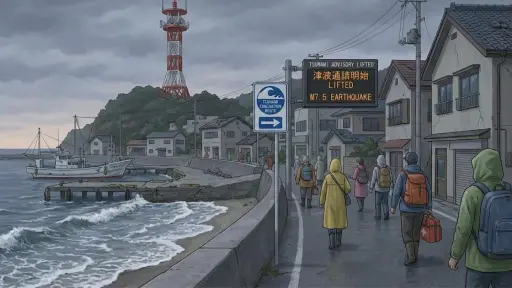
The tsunami threat in Japan was fast and scary. At 11:19 p.m. JST, the JMA issued tsunami warnings for the Pacific coasts of Aomori, Iwate, and Hokkaido. They warned that waves could reach 3 meters (10 feet) and might flood low-lying areas within 30 minutes. Sirens started to ring, and mobile phones sent loud alerts telling people to “Evacuate now.”
In places like Misawa and Kuji, coastal sirens pushed people to run to higher ground.
About 90,000 people evacuated in the dark, many carrying pets and important documents.
The actual waves were smaller than feared. At 12:10 a.m., Kuji Port recorded a wave of 70 cm (28 inches). Miyako and Hachinohe saw waves between 20 and 50 cm. These waves were strong enough to flood some streets and push small boats, but they were nowhere near the huge 40-meter waves of 2011.
By 3 a.m. JST on December 9, the warning was reduced to an advisory.
By 8 a.m., all tsunami alerts were lifted. No major flooding was reported. This success came from Japan’s advanced early-warning system, which gave people 4–5 minutes of lead time through phone alerts and TV messages.
Japan’s warning network, improved after 2011, used buoys and seismic sensors to track waves in real time. This helped avoid panic but still made sure everyone evacuated quickly and safely.
Damage and Injuries: The Human Toll of the Japan Earthquake
The earthquake in Japan caused no confirmed deaths, but people were still hurt and affected. At least 51 people were injured, mostly with small cuts, bruises, and injuries from falling or being hit by debris. By 8:30 a.m. on December 9, around 35 people were staying in 11 evacuation centers across Aomori and Iwate.
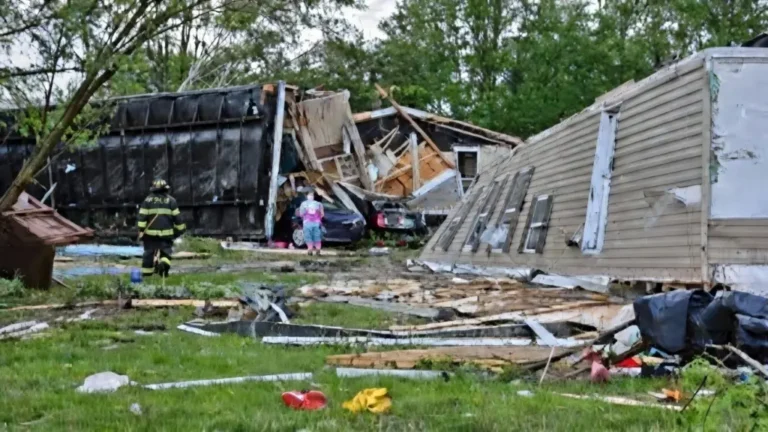
In Hachinohe, part of a shopping center’s wall cracked. Water pipes also burst, leaving about 5,000 homes without water. Power outages briefly hit 20,000 houses, and Shinkansen bullet trains stopped for safety checks.
There were no major building collapses, because Japan’s strict earthquake building rules worked well. But the small tsunami waves still caused damage along the coast. Seawalls in Kuji were eroded, and fishing boats in Miyako Harbor capsized.
Prime Minister Sanae Takaichi quickly activated an emergency task force. She sent 2,000 Self-Defense Forces members to help with rescue and support. NHK also broadcast live updates from the affected areas.
Japan Issues First Megaquake Vigilance Alert
Japan made history when the JMA issued its first-ever Hokkaido/Sanriku Offshore Earthquake Warning at 1 a.m. on December 9. This was a special “vigilance” alert, warning that a megaquake of M8+ could possibly occur within the next seven days. The chance of such a quake rose from 0.1% to 1%, based on new seismic strain readings from the Nankai Trough and the Japan Trench.
This Japan earthquake and tsunami advisory, which covers areas from Hokkaido down to Chiba, tells people to stay ready. It urges residents to prepare emergency kits, avoid the coast, and keep an eye on J-Alert warnings. For many, it brings back memories of the 2011 Tohoku earthquake, which had a magnitude of 9.0, killed 15,899 people, and caused the Fukushima nuclear disaster.
The warning is based on signs of stress buildup in the tectonic plates since 2011. At a press conference on December 9, JMA Director Satoshi Harada said the risk is “elevated.” The vigilance alert will expire on December 16, unless new data changes the situation. Experts like USGS scientist Gavin Hayes say the 1% chance is “real but low,” meaning people should stay cautious but not panic.
Historical Context: Japan Earthquakes and the Shadow of 2011 Tohoku
Japan experiences about 1,500 earthquakes every year, and it faces 20% of the world’s strongest quakes. This happens because four major tectonic plates—the Pacific, Philippine Sea, Eurasian, and North American plates—meet beneath the country.
The 2011 Tohoku earthquake, with a magnitude of 9.0, is still the most devastating in Japan’s modern history. It killed 15,899 people, forced 470,000 people to leave their homes, and caused $235 billion in damage. The 40-meter tsunami destroyed entire towns and led to the Fukushima nuclear meltdown.
The 2025 earthquake is serious but far smaller than the 2011 disaster. Still, it has brought back memories and fear from that time. The JMA’s new vigilance alert reflects this concern. It is based on models showing a 70–80% chance of a massive M8+ quake in the Nankai Trough region by 2040.
Japan remains alert because history has shown how powerful and destructive these earthquakes can be.
Government Response: From Tsunami Warning to Recovery Mode
Prime Minister Sanae Takaichi held an emergency cabinet meeting at 12:30 a.m. She quickly sent 2,000 Self-Defense Forces members for search and rescue. She also deployed 500 engineers to check bridges, rail lines, and other key structures. The government released ¥10 billion (about $65 million) from emergency funds to support immediate relief efforts.
In Aomori, Governor Kenji Nagaoka declared a state of emergency. He opened 11 shelters for the 35 people who had to leave their homes. NHK broadcast nonstop, while J-Alert sirens and emergency apps guided people to evacuate safely.
Japan’s response to the tsunami warning and earthquake showed strong preparedness. People evacuated quickly, without panic. The JMA provided real-time updates through TV, radio, and apps like Yahoo! Disaster Prevention.
Offers of help came from other countries, including the U.S., which sent FEMA liaisons, and China, which offered technical support. Japan politely declined, saying it had enough resources to handle the situation on its own.
What to Watch: Aftershocks, Tsunami Alerts Lifted, and Ongoing Recovery
As of 4 p.m. JST on December 9, aftershocks are still happening. The JMA expects more than 1,000 aftershocks in the next week. There is also a 50% chance that one of these could reach magnitude 6 or higher.
The tsunami threat is over, and all tsunami warnings have been lifted. But officials are still watching for coastal erosion and small rises in sea levels.
Recovery work is moving fast. Power is back for 95% of the homes that were affected. Water trucks are being sent to areas with broken water lines. Shinkansen bullet trains are expected to start running again by the evening.
Prime Minister Takaichi said, “We stand ready, lives first.”
For the latest updates on the earthquake today, continue to follow JMA and NHK.
FAQs
Were Japan’s nuclear power plants affected by the December 8, 2025 earthquake?
No, the earthquake did not cause any irregularities at nuclear facilities. Tohoku Electric Power confirmed that the Higashidori and Onagawa plants were safe, and there were no issues at the Fukushima site, which was damaged in the 2011 Tohoku quake. Authorities also informed the IAEA that all plants remained stable.
How many homes and residents were affected by power outages after the quake?
Approximately 2,700 homes were left without electricity, mainly in Aomori Prefecture. Additionally, around 90,000 residents were ordered to evacuate due to tsunami warnings and potential aftershocks. Some train services along the north-eastern coast were also suspended.
How many people could be affected if a future megaquake strikes Japan?
According to Japan’s latest government assessment, a massive offshore earthquake could potentially kill around 300,000 people and displace over 1.2 million, roughly 10% of Japan’s population. Worst-case damage could reach half of the country’s GDP, or about ¥270 trillion ($1.3 trillion).
How should residents prepare following the 7.5-magnitude quake and subsequent alerts?
Authorities urge people to review evacuation routes, secure heavy furniture, and prepare emergency supplies such as food, water, and portable toilets. Coastal and strongly shaken areas should remain alert for aftershocks and possible landslides for at least one week, even if no evacuation order is issued.
How did the December 8, 2025 earthquake affect Japan’s electricity supply?
Thousands of homes lost power immediately after the quake, particularly in the northeastern regions. However, electricity service was restored by the following morning, and no problems were reported at nuclear power plants in the region, including those run by Tohoku Electric Power and Hokkaido Electric Power.
How did the earthquake impact Japan’s economy and currency?
The tremor caused a brief weakening of the yen against major currencies, with the dollar and euro reaching session highs. While the immediate economic impact was limited, large earthquakes in Japan historically pose risks to infrastructure, trade, and overall economic stability.