Chernobyl: A Comprehensive Guide to the World’s Worst Nuclear Disaster – History, Aftermath, and Latest 2025 Developments
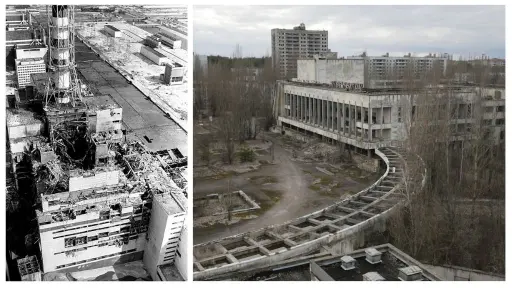
Chernobyl is in northern Ukraine, near the Belarus border. It includes the Chernobyl Nuclear Power Plant and the 2,600 km² Exclusion Zone, which became uninhabitable after the Reactor 4 explosion on April 26, 1986. This was the worst nuclear accident in history, rated Level 7 on the International Nuclear Event Scale. It released radioactive material equal to 400 Hiroshima bombs, contaminating over 150,000 km² across Europe and causing deaths, long-term health problems, and ecological damage.
The disaster was caused by a flawed Soviet RBMK reactor design and human error during a safety test. It revealed deep problems in the Soviet system and led to global changes in nuclear safety.
Today, Chernobyl is a frozen-in-time site. The New Safe Confinement arch, completed in 2019 for €1.5 billion, covers the destroyed reactor. The zone attracts over 100,000 visitors yearly for “dark tourism” and continues to be studied by scientists.
As of December 7, 2025, Chernobyl remains a symbol of resilience, even amid Ukraine’s war. Recent reports about damaged containment structures show there are still risks. This guide explains the explosion, human impact, environmental damage, current management, and latest news.
The 1986 Disaster: What Went Wrong?
Chernobyl Nuclear Power Plant, opened in 1977, had four RBMK-1000 reactors. These used water for cooling and graphite to control reactions. On April 25–26, 1986, engineers at Reactor 4 ran a test to see if the turbine could power emergency cooling during a blackout.
A series of mistakes caused disaster. Operators turned off safety systems, xenon poisoning lowered reactivity, and a design flaw made control rods increase power at first. At 1:23 a.m., a huge power surge caused steam explosions, rupturing the reactor core and starting a graphite fire. The fire released 400 times more radiation than the Hiroshima bomb.
Two workers died instantly. Within weeks, 29 firefighters and plant staff died from acute radiation sickness. Over 116,000 people from Pripyat—the nearby “model atomic city”—were evacuated in just 36 hours, though many had already received dangerous radiation doses.
The Soviet government delayed warnings. Europe first learned of the disaster when Sweden detected radiation on April 28, two days later.
Immediate Aftermath and Soviet Response
The explosion at Chernobyl was massive. About 190 tons of uranium fuel melted, forming a “corium” lava flow called the “elephant’s foot,” which burned through concrete floors.
Over 600,000 people—military personnel, miners, and volunteers called liquidators—worked to stop the fire by May 10. They used 5,000 tons of boron, sand, and lead dropped from helicopters. Thirty-one liquidators died of acute radiation sickness, and thousands more suffered severe burns.
The Soviets built a makeshift “sarcophagus” around the reactor by November 1986, but it still leaked radiation. Glasnost later forced them to admit the scale of the disaster. A 1986 UN report predicted 4,000 future cancer deaths.
Cleanup displaced 350,000 people. Belarus received 70% of the fallout, contaminating 23% of its land. The USSR spent $18 billion (around $45 billion today), worsening its economic crisis and contributing to its eventual collapse.
Long-Term Health and Environmental Effects
Chernobyl released dangerous radioactive materials like iodine-131, cesium-137, and strontium-90. These contaminated soil, water, and food, causing serious health problems. By 2005, over 6,000 children had thyroid cancer, and the UN estimates 4,000–9,000 total excess deaths. Belarus saw 20% of pregnancies affected.
Wildlife and forests were also hit. Trees deformed, bird populations dropped, and some animals suffered mutations. Over time, the Exclusion Zone has become a wildlife refuge, with wolves, lynx, and Przewalski’s horses thriving.
Groundwater contamination still threatens the Dnieper River basin, which provides water to 30 million people. Hotspots like the Red Forest remain deadly, with radiation levels over 10 mSv/hour.
The disaster also caused psychological damage. Around 50% of liquidators suffer PTSD, and evacuees face higher rates of suicide and alcoholism. In total, Chernobyl caused 50 direct deaths, over 15,000 cancers, and $235 billion in economic damages (World Bank estimate).
Current Status: The Exclusion Zone and Ongoing Management
The 30-km Chernobyl Exclusion Zone was set up in 1986 and is managed by Ukraine’s SAUEZM with IAEA oversight. The €2.1 billion New Safe Confinement (NSC) arch, completed in 2019, is a 108-meter steel structure weighing 36,000 tons that covers the old sarcophagus to stop radiation leaks until 2065. It is ventilated to control dust.
Decommissioning work, including removing fuel rods and burying waste, costs €5 billion and will continue until 2065, with over 5,000 workers on rotating shifts.
Before the war, tourism boomed, with 150,000 visitors in 2024. Tours included Pripyat’s Ferris wheel and Reactor 4, generating about $10 million annually.
Russia briefly occupied the zone in February 2022, leaving in April due to sabotage risks, like power line cuts that could cause meltdowns. As of 2025, the area is demilitarized, but IAEA drones and sensors continue monitoring radiation and safety.
Latest News: February 2025 Drone Strike Damages Protective Shield (December 2025 IAEA Update)
On February 14, 2025, a drone strike—Kyiv says it was a Russian Shahed-136 with explosives—severely damaged Chernobyl’s New Safe Confinement (NSC). The IAEA confirmed the damage on December 6, 2025. The strike, denied by Moscow, left a 15-square-meter hole in the NSC’s cladding, caused a small fire, and reduced its ability to contain radioactive dust like cesium-137 and strontium-90.
Radiation levels stayed stable, but the IAEA warned of long-term risks such as corrosion and dust spread. Temporary repairs are planned for 2026, supported by Western allies, with the EU and France pledging €200 million.
President Zelenskyy called the attack “nuclear terrorism,” while Russia called it a Ukrainian “false flag.” Social media and experts raised alarm, but no evacuations are needed. This incident has renewed fears of a potential “dirty bomb” scenario, with calls for stronger monitoring at the site.
UN Agency Says Chornobyl Nuclear Plant’s Protective Shield Damaged
On December 6, 2025, the IAEA warned that Chernobyl’s New Safe Confinement (NSC) can no longer fully perform its main safety function after the February drone strike. The attack blew a 15-square-meter hole in the steel cladding and caused a small fire.
No immediate radiation leaks occurred, and levels remain stable. However, the damage raises long-term concerns about containing dangerous isotopes like cesium-137. IAEA Director General Rafael Grossi stressed the need for “timely and comprehensive restoration.”
Temporary repairs are planned for 2026, funded by the EU and France with €200 million, to ensure the NSC remains safe until its intended lifespan ends in 2065. The IAEA, with staff permanently on site, will continue to monitor and support nuclear safety amid the ongoing conflict.
FAQs
How long was the New Safe Confinement (NSC) at Chernobyl under construction, and who funded it?
Construction of the NSC began in 2010 and was completed in 2019. The €2.1 billion project was funded by contributions from more than 45 donor countries and organizations through the Chernobyl Shelter Fund, coordinated by the European Bank for Reconstruction and Development.
How long is the NSC designed to last, and what makes it significant?
The NSC is designed to last 100 years and is the world’s largest movable land structure. Its arch-shaped steel design covers Reactor 4, containing radioactive materials and enabling safe cleanup operations, making it a landmark in nuclear safety engineering.
Did the February 2025 drone strike permanently damage the load-bearing structures or monitoring systems of Chernobyl’s New Safe Confinement?
No. According to the IAEA inspection, while the drone strike degraded the NSC’s primary safety functions and damaged its protective cladding, there was no permanent harm to the load-bearing structures or monitoring systems.
How does the ongoing war in Ukraine relate to the Chernobyl plant’s safety risks?
During the early weeks of Russia’s February 2022 invasion, Russian forces occupied Chernobyl for over a month. The conflict, including drone strikes, has exposed the plant to security risks, prompting inspections and repairs to ensure the NSC continues to contain radioactive material safely.